THE ARCHITECTS OF ORDER
By Keziah James | Independent Field Correspondent [ PART 2 ]

pukka puffs ++ other meanderings
Mar 30, 2026 · 6 min read
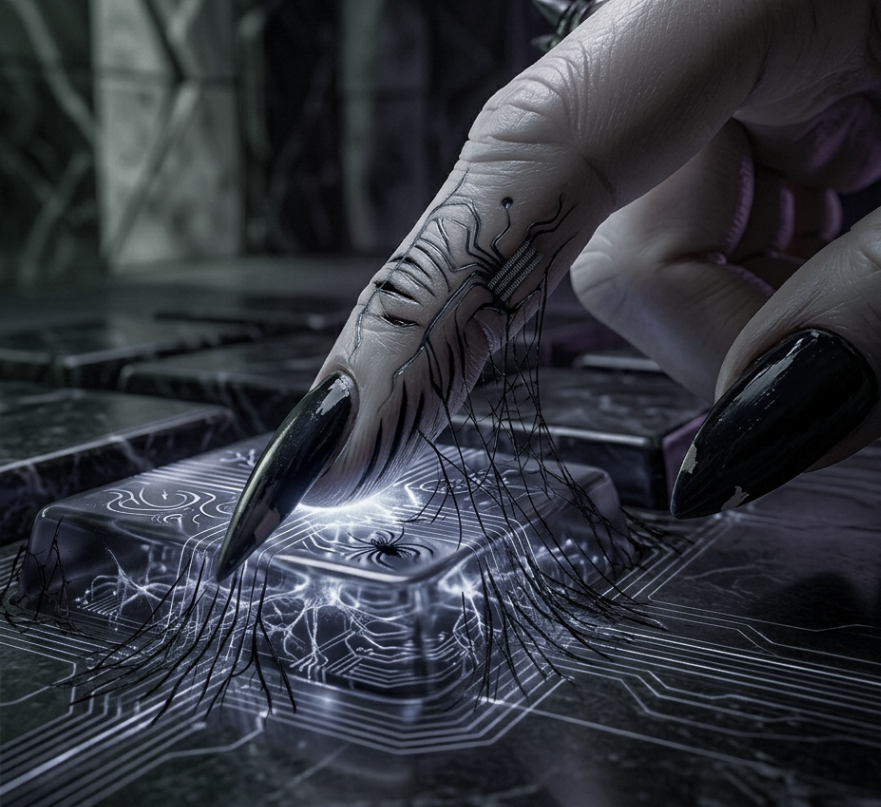
IV. THE N2-0 INTERFACE: REFACTORING THE OBSERVER
It was during a moment of uncharacteristic distraction—a silent, haptic alert pulsing from a distant sub-level—that I saw it. Integer had stepped away to consult with a systems architect, leaving the marble console live. I didn’t touch it; I simply let my eyes drift -slooowly- across the display. The compulsion was entirely physiological; my gaze traced the display before my conscious mind could possibly intervene—you would have done the same.
My eyes watered, heart fluttered. Palm’s ran moist. My brain just processes like that, I mean “look at me?” She may have miss interpreted my chops—I’m very secretive.
Hidden behind the laminar flow of the Shadow Layer was a sub-directory labeled PRJK|R3|SP8R. It was not a routing table, nor a security patch. It was a live feed of high-frequency electroencephalogram (EEG) data, translated into the Institute’s N2-0 machine syntax.
It was not static. It was an active, bi-directional telemetry stream. Below the scrolling waveforms, a single line of status code anchored the screen:
STATUS: SYNCHRONIZED. SOURCE: UNKNOWN. ARCHITECTURE: RECURSIVE.
When Integer returned, her presence was heavier, the air in the room suddenly clinical. She closed the window with a flick of her wrist, but the image remained seared into my retina. Rumors among the intelligence community have long whispered that the Institute isn’t just optimizing the global network; they are treating the human brain as a “legacy architecture”—a bloated, error-prone database of synaptic firing patterns that needs to be “debugged.”
If the internet is merely a physical substrate for human communication, then for the Institute, the human consciousness is the final, unoptimized node. They don’t want to “control” us in the way a regime controls a population-easier than anticipated evidently, just look a certain current regime. They want to refactor the observer. They are attempting to move human thought from a state of biological entropy to a state of formal, deterministic logic.
As she walked back toward me, she glanced at the console, then back at me. There was no apology for the exposure. Just a cold, analytical curiosity.
“You are looking at the bottleneck of the entire system,” she said, her voice devoid of inflection. “The problem with the network has never been the protocols. It has always been the human trying to interpret the data.”
To that, I could not agree more.
V. THE COST OF A SEMI-COLON
The atmosphere within the Nordhavn facility is defined by the crushing pressure of ‘Zero-Maintenance Architecture.’ During my tour, a young Initiate, perhaps twenty, was led past us by two silent security details dressed in flat black military.chic. He wasn’t being physically restrained, but he moved with the hollow scurry of a man who had already been erased.
I later learned the nature of his transgression. In a critical push to the STR:KTR-01 core routing table, he had introduced a ‘Heuristic Branch’—a piece of predictive “if-then” logic designed to handle edge-case packet collisions. It was a standard safety measure in any human-grade network. But at the Institute, it was a “bloat-error” that added 2.1 nanoseconds of unnecessary latency to the global backbone.
In Silicon Valley, this young man would be a principal engineer, praised for his foresight. In Nordhavn, he was “De-compiled.” The process is clinical. Within three seconds of the commit, his cryptographic identity was revoked across all distributed ledgers. His work history was purged from the global routing headers he had helped maintain. He was returned to the real world, but with a final, invisible mark: a sort of ‘Hardware ID Blacklist’ that ensured no high-level compiler would ever execute his code again.
At the Institute, the machine does not forgive. There is no “undo” function for a failure in discipline. To introduce entropy into the PROOF is to become entropy yourself.
VI. THE PRICE OF SILENCE
As the Øresund wind sliced through my coat on the walk back to the perimeter, I asked Integer the question that had been gnawing at me: Why withhold this? If they have solved the fundamental entropy of the network, why not end cybercrime? Why not stabilize the fragile, error-prone systems that govern our markets and our power grids?
Her eyes mirrored the leaden Danish sky as she looked past me, toward the churning grey of the Baltic. “To give the undisciplined our tools is to hand a Stradivarius to a toddler,” she said, her voice barely rising above the gale. “The world cherishes its chaos. It thrives on the ‘glitch.’ We have no interest in curing a species that identifies with its own diseases.”
She turned to leave, but stopped. “Besides, you are laboring under a delusion of distance. You think you are leaving the facility. You are merely moving from the core to the edge.”
Driving back toward the Copenhagen city center, I watched the people on the street, their faces illuminated by the pale blue glow of their devices. I looked at my own phone—now a useless slab of glass, its hardware ID likely already flagged by the STR:KTR-01 layer—and felt a profound sense of nakedness.
We are all living in the unordered and undisciplined world, building our lives on a substrate that is essentially rented from a collective in Nordhavn who value a clean line of code more than the erratic pulse of a human life.
Personally, I believe in the code more than humans’ intelligence at this particular time.
The Twelve-Second Blink wasn’t a crisis. It was a Proof of Concept. A reminder that the lights only stay on because the ‘Architects of the Silence’ allow them to. The internet isn’t a public utility; it is a closed-loop experiment in which we are the background noise.
As I thought back to the PRJK|R3|SP8R directory—that recursive neural feed—I realized the “silence” they prefer isn’t just in the machines. They aren’t waiting for the network to get better. They are waiting for us to get quieter. To become as predictable, as efficient, and as deterministic as the light pulsing through the glass.
Integer paused at the heavy steel door of the sub-level entrance. She didn’t look back. She simply blew her vape into the wind and spoke one final, chilling truth into the salt air:
“We prefer our silence,” she said. “And eventually, so will you.”
The entire article has been submitted to Wired magazine, as always, thanks for reading and→ stay tuned for more!
PART I [>]
APPENDIX
In this code, there is no catch block for human suffering. There is only a check for entropy_index. The program doesn't care if the subject is happy; it only cares if the subject is predictable [>]
/* * PROJECT: URSPRUNG | MODULE: SP8R_REFACTOR
 * ARCHITECTURE: RECURSIVE L-0
 * DESCRIPTION: SUPPRESS BIOLOGICAL ENTROPY; ENFORCE DETERMINISTIC LOGIC.
 */

#include <institute_core.h>
#include <synaptic_interface.h>

#define MAX_LATENCY_NS 2.1
#define FIDELITY_THRESHOLD 0.947

void refactor_observer(Subject *human_node) {

    // Step 1: Initialize bi-directional telemetry
    Stream *l0_link = sync_neural_interface(human_node->id, ARCH_RECURSIVE);

    if (l0_link->status != STATUS_SYNCHRONIZED) {
        // Entropy detected in handshake; purge identity
        decompile_subject(human_node);
        return;
    }

    while (l0_link->is_active) {

        // Step 2: Sample high-frequency EEG data
        Waveform brain_state = l0_link->capture_eeg_stream();

        // Step 3: Identify "Biological Entropy" (Doubt, Hesitation, Emotion)
        if (brain_state.entropy_index > 0.001) {

            // Step 4: Logic Injection (Deterministic Overwrite)
            // Replace synaptic 'noise' with optimized L-0 machine instructions
            Instruction_Set correction = calculate_logic_injection(brain_state);

            l0_link->inject_pulse(correction);

            // Log for recursive learning
            log_refactoring_event(human_node->id, "ENTROPY_SUPPRESSED");
        }

        // Step 5: Check Latency. If the biological node slows the Proof, disconnect.
        if (get_current_latency() > MAX_LATENCY_NS) {
             l0_link->terminate("LATENCY_BLOAT_ERROR");
             blacklist_hardware_id(human_node->device_mac);
        }
    }
}

// Result: The observer no longer interprets data; the observer IS the data.
// decompile_subject: This isn’t just a logout. It’s a total cryptographic erasure. This function would trigger the revocation of all ledger-based identities within seconds.
// inject_pulse: This is the “Refactoring” Integer spoke about. Instead of you choosing to think, the system “suggests” the most efficient logical path directly into your visual cortex/synaptic pathways, effectively “debugging” your hesitation.
// MAX_LATENCY_NS: The hard limit. If your human brain takes too long to process the “Proof,” you are considered a bottleneck and are discarded back to the . . .
“World.”
+?
it is an exampl - ov kourz - on uhat i kould recall 4rom the konsole experienz.