THE ARCHITECTS OF ORDER
By Keziah James | Independent Field Correspondent [ PART 1 ]

pukka puffs ++ other meanderings
Mar 29, 2026 · 6 min read
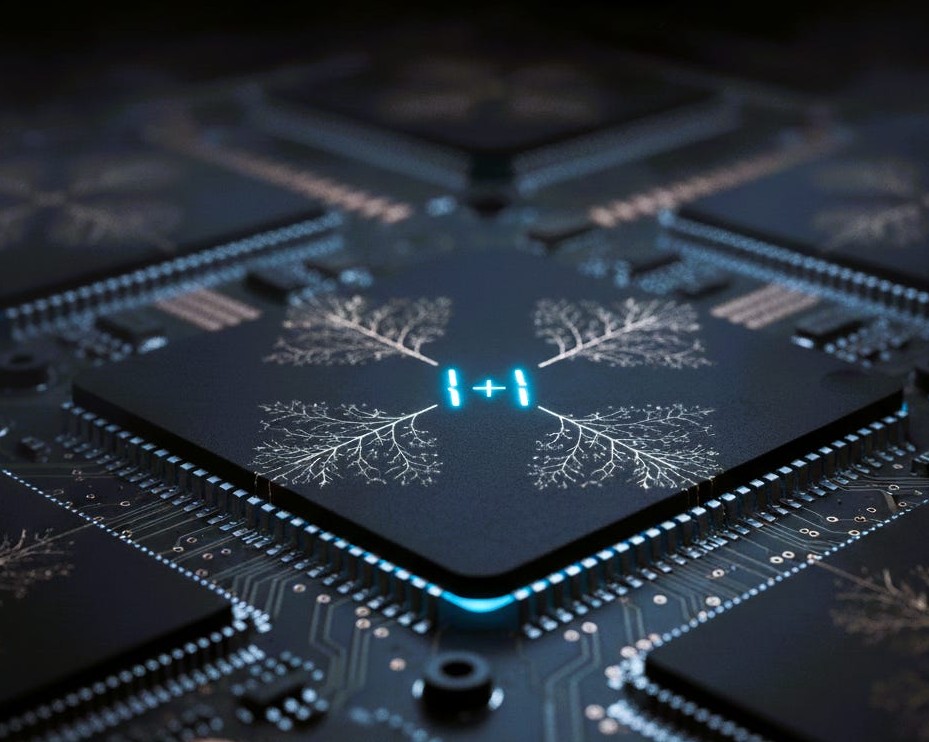
COPENHAGEN — Outside the unmarked, onyx-glass facade of a Nordhavn warehouse, the Øresund wind screams, sharp enough to flay paint from steel. In this corner of Denmark, the Baltic Sea is a churning slate gray, but behind these doors, the world undergoes a sudden, violent stabilization. Inside, the air is perfectly still: filtered to medical-grade purity, pressurized to prevent the intrusion of a single speck of dust, and chilled to exactly 18°C.
I am from Riga, Latvia, before moving to Canada, and have traveled to Copenhagen several times. This time, I am privileged to be sitting across from a woman known only as “Integer.” She wears a tailored charcoal suit that seems to absorb the dim ambient light of the foyer, with an open white frilled shirt, like a classy poet. She has no LinkedIn profile. No digital footprint. Forget social media. In the eyes of the Danish Civil Registration System, she does not exist. Because. She does not exist. Yet, as a Director of the Herausgegeben vøm Internationalen, or the Max Planck Institut fur Ordnung |+| Disziplin, she wields more influence over the hidden architecture of global infrastructure than most—perhaps any and all—heads of state.
“We are not interested in the internet you use,” she says, sliding a glass of sparkling water across a table with no seams. “That is a toy for the undisciplined. We maintain the substrate. Without our intervention, the chaos inherent in your networks would consume itself. We hover or digitally vibrate somewhere between preconception and verification most of the time.”
I. THE GEOMETRY OF THE ABSOLUTE
The Institute—whispered about in Langley’s high-stakes corridors and Fort Meade’s war rooms—is the final destination for the world’s most gifted logical minds. They do not recruit from MIT or Stanford or Cambridge; they extract individuals from deep-web obscurity who have demonstrated what Integer calls “absolute determinism, the ability to write code that is mathematically proven to be incapable of failure.” The word ‘hacker’ is an insult. And of course, it isn’t. The dark web is unsurprisingly their after-hours club, but ultimately a joke compared to the sophistication of this deceptively hidden edifice. And their unbridled, yet technologically proficient heresy within.
The facility is brutalist minimalism incarnate. There are no “fun” tech-campus amenities here. No beanbags. No espresso bars. In their place is The Great Hall of Logic: a cathedral-like server room where the hardware hums at a specific frequency tuned to aid hyper-concentration—I’m not sure if she was serious about that and was too afraid to ask at the time. Suffice it to say, the server room was spectacular and humming.
The hardware itself is a rejection of every commercial standard. The Institute views modern Intel and ARM architectures as “legacy bloat.” Instead, they manufacture their own silicon in-house—proprietary “Optical Logic” gates that utilize photons instead of electrons, eliminating the twin enemies of the elite programmer: heat and latency.
II. GHOST PROTOCOL: THE 12-SECOND MIRACLE
The legend of the Institute was cemented in March 2023, during what is now known among network architects as the Twelve-Second Blink. A vulnerability had been identified in the Border Gateway Protocol (BGP)—the fundamental trust-map that dictates how data packets find their way across the global mesh. It wasn’t just a bug; it was a logic collision that could have allowed a single actor to “blackhole” the Western Hemisphere, effectively erasing entire Tier-1 providers from the routing table.
For twelve seconds, global throughput stuttered. To a teenager in Seoul, it was a momentary buffer on a 4K stream, a kid in the USA an annoying interruption to a Netflix movie night. To the NSA’s visibility centers, it was the digital equivalent of the sun going out.
But when engineers at Cisco and Juniper scrambled to the “hot” routers, they found the breach already sealed. The patch hadn’t been pushed via standard update channels; it had been injected into the kernel memory of every core router on the planet simultaneously.
The fix was a masterwork of ‘Formal Verification’—mathematically proven code that contained zero edge cases. It was written in a hyper-optimized Assembly dialect that reduced routing overhead by 140 nanoseconds per hop. The internet wasn’t just repaired; it had been “upgraded” without human consent. The only trace was a single, non-Unicode glyph embedded in the header: |+|.
“The patch wasn’t ‘written’ in the traditional sense,” the lead architect at Juniper—now part of HPE—whispered during the closed-door Senate briefing. “It was compiled from a formal specification that treated the entire IPv6 address space as a single, closed-loop equation.
They didn’t just fix the leak; they rewrote the physics of the pipe. The code doesn’t execute; it persists. It has no branches, no ‘if-then’ statements, and zero entropy. It is a mathematical tautology running at the speed of light. When we tried to roll it back to the previous version, the hardware rejected our commands. The routers didn’t recognize our ‘messy’ human code as valid logic anymore. The Institute didn’t just save the internet—they fucking claimed it.”
“An aesthetic correction,” Integer says, her expression remaining perfectly static. “The original 1989 specification was a ‘three-napkin’ hack. It was mathematically inelegant. It offended the machine’s internal logic. We did not intervene to save your commerce or your communications. We intervened because the error was an insult to the discipline and structure of code.”
She pauses, the silence more chilling than her words. “Code requires no consensus. Only discipline. I was morbidly offended.” I think I fell in love with, and fear of, her confidence when she gracefully punctuated that point.
III. THE LITHOGRAPHY OF THOUGHT
As we move into the “Deep Logic” wing, the atmosphere shifts. The air is pressurized and desiccated, scrubbed of the humidity that induces micro-fluctuations in high-frequency photonic transceivers. Integer stops before a slab of dense water-like glass. There is no interface; the surface is a single, monolithic tactile sensor that registers the skin’s capacitive charge before a fingertip even makes contact.
She traces an arc across the surface. A visualization blooms across the wall—a live render of global data traffic. It is not the jagged, entropic pulse of the public web. It is a lattice of geometric, laminar white lines.
“This is STR:KTR-01,” Integer says. “The Shadow Layer.”
“You’re describing a secondary network,” I venture. “A dark fiber overlay?”
“No,” she corrects. “It is a temporal shim. Your ‘internet’ is a physical layer of light pulses traveling through silicon dioxide. It obeys the laws of refraction and reflection. But it does not account for ‘Quantum Tunneling’ or the way photons interact with the microscopic lattice of the fiber itself.”
She taps the display, and the map shifts from geography to a temporal grid. “By exploiting the non-linear Kerr effect in standard fiber-optic strands, we have mapped the ‘noise’—the microscopic backscatter that humans ignore as interference. We don’t just read the data; we read the intent of the packet before it clears the buffer.”
The implication is bone-chilling. By analyzing the photonic backscatter—the tiny reflections created as light travels through a cable—the Institute is effectively observing a data packet’s arrival 30 milliseconds before the router on the other end technically receives it.
“We don’t use this to trade, or for profit” Integer says, a glacial smile touching her lips. “We use it to curate. When the ‘undisciplined world’ suffers a collision or a logic error, we inject a corrective pulse into the fiber. We don’t wait for the error to propagate. We resolve the causality before the human-written protocol even registers a conflict.”
She looks at me, her eyes reflecting the static geometry of the Shadow Layer. “We are not watching history happen. We are buffering the reality of the network to ensure it never deviates from mathematical proof.”
The entire article has been submitted to Wired magazine, the remainder will be available here—soon! . . . .
→ Stay tuned!
and, thanks, as always, for reading!