Panoptes
I refer to the word Perception in the broader sense.

May 5, 2026 · 8 min read
As children, we are raised to trust in the people who have custody or authority over us. These people were armed with their delusional interpretations and pedagogical distortions. They hand their truths to us as the Truths.
They were all lies.
Lies of ignorance or psychological impairment, but lies nonetheless. Some of us inherited bias as well. Bias is fascinating but complex and difficult to quantify. So, rather than talk about them all. I will talk about mine. At birth, my bias was purely physical, but it grew to encompass the social, psychological, and emotional.
This “bias” was that I am blind in one eye.
One might not think that is a bias, but it affects perception, and I am not only referring to depth. I refer to the word Perception in the broader sense.
I was only ever perceiving half of everything.
I’ve been told our memories or remembered experiences are wrong. They are light flipped upside down, synapses misfiring, shaped by adrenaline and mood. I’ve always found that a little terrifying.
So, yes, it is not the Baader-Meinhof Phenomenon or some other cognitive bias. It is not the Mandela effect. I was seeing half of what most others perceived. I was also never aware of this.
Since it was something I was born with, I had no metric for comparison. I had no way of communicating my broken experience of the world because I believed it was normal. I knew once I was beyond the haze of infant consciousness that I was somewhat askew, but I understood it to be astrological or inherited trauma.
The teachers in school diagnosed me as lazy. They thought my handwriting was poor because I was rushing, careless, and uninterested. They thought my grades were low because I didn’t care.
I believed them when they said these things. They were the ones in charge. I was told they know best. How else is a seven-year-old supposed to react to this kind of reinforcement?
Amblyopia is the scientific term for what most people call a lazy eye. It has been stigmatized because of its appearance. I will not be parsing out misconceptions about lazy eye, but my eyes always looked as they should. That is the crux of the issue when it came to my guardians. If I had been boss-eyed or cross-eyed, measures would have been taken. We have to keep up appearances! Don’t we?
I appeared healthy, and although this issue could have been corrected with an eyepatch from the pharmacy, it was not deemed important enough to warrant a quick ride to the store. Let’s save the violins for another time.
What I am addressing here are the results. What happens when one grows up seeing only half of what is there?
Depending on your source, the psychological effects range from anxiety and depression to somatization, obsession-compulsion, and interpersonal sensitivity. Regardless, our personalities are informed by what we see and how we see it. We form our perspective and bias through our vision of the world. I was crafting a prefrontal cortex and a social epistemology through the lens of an unreliable narrator.
Myself.
Alright, so Mister Narrator, narrate.
You have set the course.
Framed the whole thing.
Tell me the story, Mister Narrator.
I remember being kicked in the face. It was one of those perfect alignments of adolescent cruelty and accident, but it set a tone for me…
Yes…a tone.
A Geodesic Dome Climber, about eight feet in diameter.
I don’t know whether or not playgrounds still have these domes. I also don’t know if they are inherently more dangerous than the other pieces of playground equipment. This one was metal and set on blacktop. I am sure that this type of layout is no longer allowed.
Several children, ranging from age six to thirteen, were climbing on this dome. I happened to be one of them, and somehow, I was kicked in the face hard by a much older child.
I fell to the blacktop. I had yet to learn the correct protocol for a fall. The one where we are supposed to jump up and pretend not to be injured, so I remained prone. I wasn’t crying or wailing; I was used to the physical pain at this point, but the older kid who kicked me, by accident, I thought, stood over me and said.
“You deserved it.”
I again believed in his authority.
I didn’t move out of the way, I guess?
Had I had full vision, I might have been able to dodge or avoid the blow. I didn’t know that I couldn’t see at that time. The other child was my senior.
an authority…
a playground authority….
So, I believed them. I did deserve it.
It is not just black, my right eye.
At some point between the ages of five and eight, it just gave up. It detached from my brain. But not with emptiness, or a nothing. It left me with a shadow and a blur. I see things moving, Shapes and crawling — shifting.
It is hard to explain in a binary world. Many subtle things about it won’t make sense to someone who doesn’t know.
I am right-handed, but since that eye is turned off, I am left-hand dominant. I can’t trust that about myself. I lead with my left to protect my right, but it is counterintuitive. It is a struggle of protection vs. function.
Who are you protecting, Mister Narrator? Which one? Who is steering the ship?
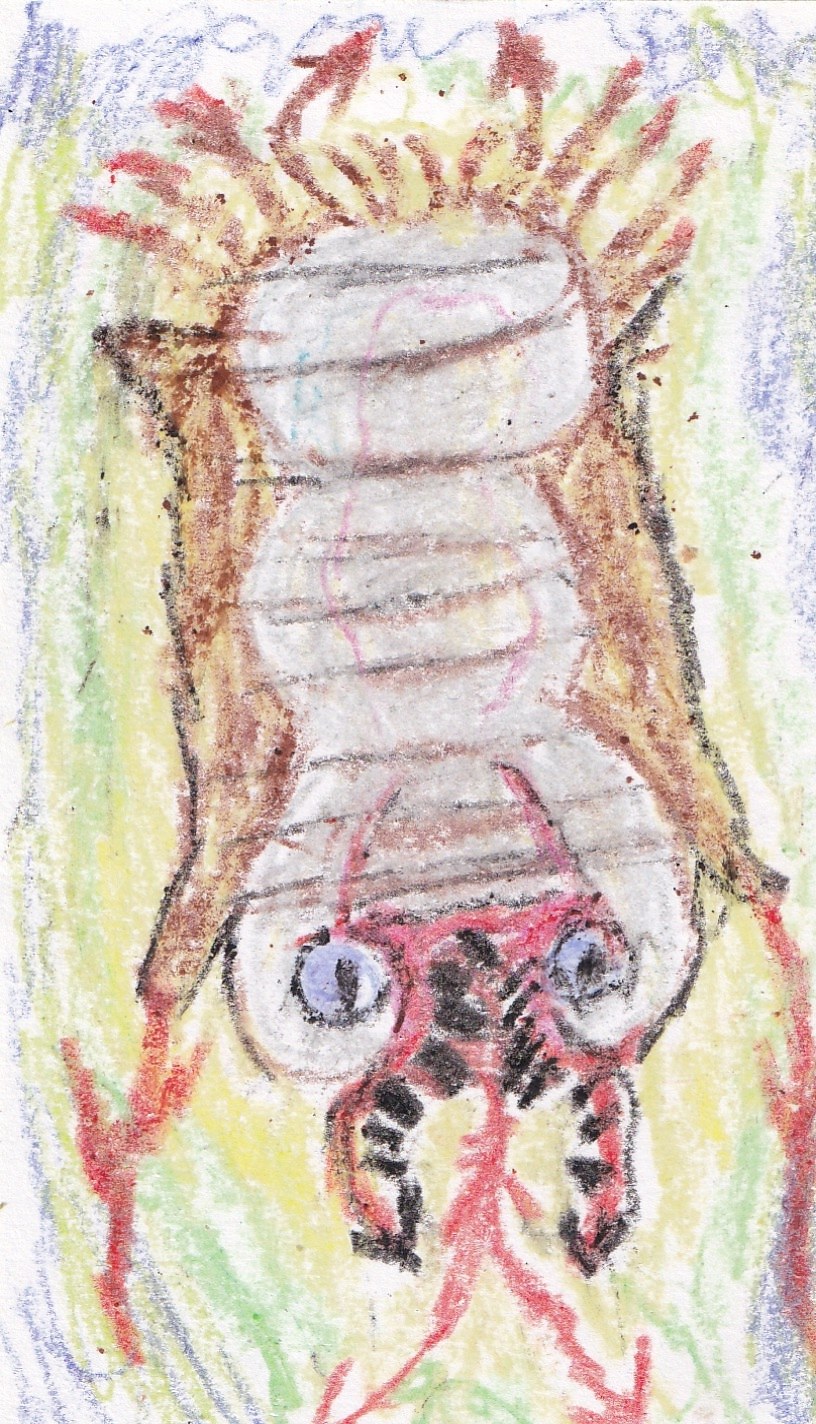
The Dobsonfly has a larval form. This larval form is called a hellgrammite. I won’t go into the full entomology or description, but they are aptly named; horrid-looking things with large pincers. Fishermen use them for bait. My father used them for bait. Occasionally, he would take me with him down to the banks of the Merrimack River.
Pops, his strapping young boychild, a bucket of hellgrammites, a pocket flask, and a pole. Whistling Andy Griffith’s “fishing hole” the entire time.
I thought hell was a swear word and didn’t want to say the name of those bugs. My father thought that meant I was afraid to carry them. I got a whole monologue about how vicious these things are.
My father reveled in scaring me.
It’s funny to scare children, especially with big bugs.
So, he played it up, telling me about how mean these things are and how painful the pincer bites can be.
He had me carry the bucket. That is what men do.
If they are scared of something, they need to face it head-on.
I lugged the bucket with my right arm, but the weight of the water and the disconnect with that side of my body caused me to lose my balance on the trail. I tumbled down an incline and spilled the larvae all over myself.
I don’t know how many bites I received, and somatization is a strange thing. So I cannot accurately narrate the pain. I don’t remember it too much, but I remember the shadows crawling all over me. Creeping hellgrammites with eight pairs of lateral appendages skittering over my face. I had ruined the fishing trip. I should have been paying attention to where I was going. I never paid enough attention. I wasn’t to be trusted.
I agree.
I am not a dependable person.
Just like they said.
The salad days are behind me. I am forty-two, and I can’t read the eye exam at the DMV. They told me I need to see an optometrist. I never got along with doctors. I don’t think they like the way Mister Narrator talks.
He never says things right.
He reports a scene.
Doctors don’t like that. They don’t trust it. They believe a person cannot be detached from themselves.
Who is reporting?
Which one is in charge of the tale?
It is difficult.
I found that if I clearly say, “I am not being obtuse, I am not trying to be difficult.”
Some doctors take pity on me. Most doctors can’t have pity; It is counter to their training.
The optometrist was having a hard time.
They didn’t understand how I made it this far without knowing I was blind in my right eye. I didn’t have an excuse. I tried to tell the doctor all I knew about perception and learned behaviors, but I was being abstract. Mister Narrator offered no assistance, as a condition delivered with the flat affect of a regional forecast is not trusted in this environment.
We feel that we are speaking plainly and in English, but for some reason, it doesn’t work.
“We are not being obtuse, we are not trying to be difficult.”
They wonder who this we is. I wonder that too.
I need glasses. Not to help with vision, because that is no longer an option. I need glasses to protect my left eye. If I lost that one, I would be blind. My right eye has “turned,” and surgery might help, but the connection that gave out decades ago won’t come back.
They want to dilate my eyes. They want to know something.
I consent.
They are the ones in charge. I’ll need to wait for several hours afterward because the dilation will take my remaining vision.
It takes time to wear off.
The drops enter my eyes, and I am deposited in the waiting room. Something else was wrong with my vision. There was some other obstruction. Something foreign in my right eye.
I was sitting with a clenched posture in a small wooden chair. The waiting room seemed empty, but I wouldn’t know. It was just more shadows. Voices were happening, but I try not to listen to anything when I am in public. I am lazy, and I don’t pay attention.
I felt it first. A flutter or an itch in my right eye. I thought it was the eye drops.
It was an insect.
Something large, with long wings.
It was near my right eye.
It was attempting to fly or wriggle free. Quickly, more came. They seemed to multiply. There was a relief of pressure as they were pouring out. It felt like a huge amount, a swarm almost, fluttering and groping to be free.
I saw a shadow, and I felt them crawling. There were other sounds too. Creaking, groaning.
Shouts and screams.
When the swarm had exhausted itself, I realized what they were. I felt the familiar eight appendages crawling out of my eye and onto my face. I felt the pincers digging in.
The dobsonflies had flown out first,
But the larvae,
The Hellgramites made their exit now.
Thousands might be an overstatement, but I don’t trust numbers. The bites pinched, and my skin felt warm, wet, and sticky.
I just wait. Only a few hours, and the vision will clear.
I will be able to leave.
No point in running away.
We cannot run from oneself.
I cannot run from itself.
Let them have us.
We deserve it.
We should have been more proactive.
We were just lazy, and now we get what we deserve.
Shadowy pincers and pantomimes of bites.
They can have us.
Right, Mister Narrator?
They have the authority here. They are steering the ship in this waiting room.
All I can offer is this familiar refrain.
I’ll use a louder version of my speaking voice, but resist the urge to scream.
We offer this as an explanation to the shadows that shout and cry.
“We are not being obtuse, we are not trying to be difficult.”