What if we want to be 'BROKEN' (part 1)
A simple label or actual thing?

Mar 11, 2026 · 5 min read
DISCLAIMER:
This piece is not written with anyone or anything in mind. The last thing I want is to upset someone.
These are merely my observations.
To reduce bias, I even discussed this idea with several of my teachers, most of whom have backgrounds in psychology. Their perspectives are blended within the post.
Please note, when I bring up terms like anxiety, depression, or ADHD, I am not referring to those who are clinically diagnosed. My reflections are more about how these terms are sometimes used casually online.
That said, the topics explored here may feel sensitive to some. Please read with care, and if you need a break, don’t hesitate to step away.
I’ll be presenting this as more of a debate. So, I hope you’ll read it with an open mind. :)
I joined Substack nearly 2 months ago and during that time I have seen a lot of things. I’ve noticed encouragement (tons of it), I’ve seen unlimited talent, unshakeable bonds being formed. I’ve glimpsed journeys and seen how community matters a lot.
And then I’ve seen instances, posts and notes almost every other day regarding anything deep, emotional, vulnerable. Words when formed create this idea that life isn’t worth it or that things are getting worse.
But here’s the twist.
It’s not just Substack. It’s almost everywhere. The only other social media I use is Instagram and I see the same pattern there.
Which brings me to a thought that what if…people are drawn to the idea of being “broken” - not because they’re weak, but because it feels like the norm?
And not in a destructive, self-sabotaging way, but more of an accepting one.
It’s the idea that upon meeting, sharing traumas, struggles and issues as a form of connection has become the norm. Trauma bonding, in short. You get to know everything but their hobbies, their likes and dislikes.
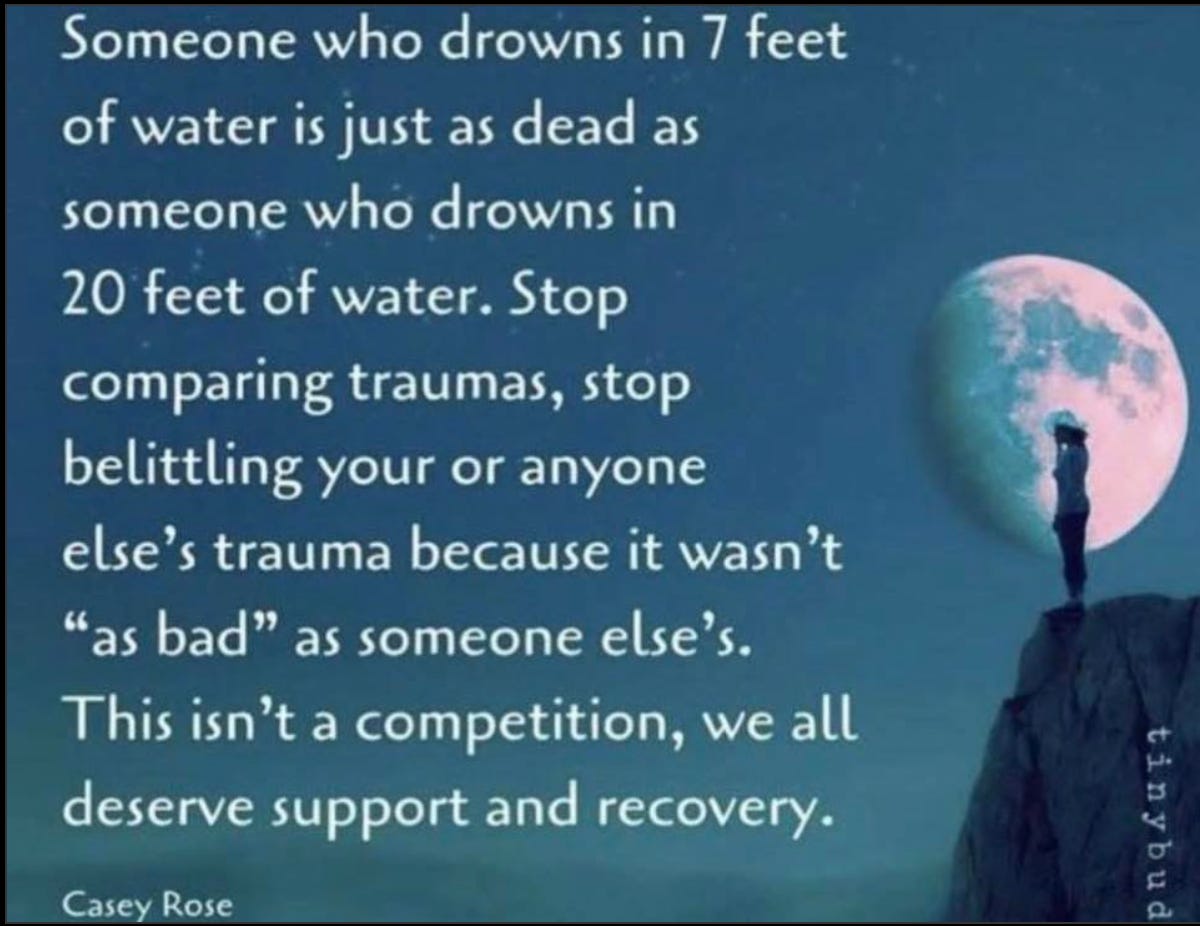
And it’s not just that either. Sometimes it feels that everyone is unconsciously trying to compete and see whose struggle is worse.
I presented the idea to one of my teachers. He stated that our society is drawn to the idea of acceptance and validation. And that many lack self-esteem and have a poor self-image which is why they try to find it somewhere else.
I thought about it and realised he wasn’t wrong.
How many of us have had our moods fluctuating because of a single person or an audience?
I know I have, at some point in life at least.
He continued by giving me an example of the Yakuza, and stated that in order to be accepted in the organisation, you need to cut off a finger. The ritual is known as Yubitsume. The point was that people would do anything to be accepted.
Which brings me to another thought, what if people felt the need to reshape a situation in order to be accepted?
The Yakuza is on the extreme end, so here’s another example.
Last week during one of my classes, I was having a conversation with 3 more people regarding sexual assault. They asked if I had ever had an experience. To which I responded, no.
What happened after?
Nothing. I just couldn’t relate to any situation being talked about because I hadn’t felt it. I could understand but not relate.
Now, here’s the thing. What if I said yes? Of course, I’d never lie about something like this, but it makes me wonder…what if there was some sort of unconscious pressure to exaggerate in order to belong?
No, I’m not accusing people of lying about this. But I am saying that people may feel the need to label something incorrectly. For example, someone may just be kind to you but you find it suspicious and weird rather than a simple act of kindness.
There was another idea that these days, medical terms are misused. As someone who’s studying psychology, mental issues such as anxiety, depression, OCD and even ADHD are something I struggle to properly define. Not because I don’t know, but because everything is in a spectrum that it’s hard to limit it to a single thing.
These days, the terms are casually thrown around almost everywhere and in every other situation. So much so that it makes me wonder if the person is exaggerating or telling the truth?
I hate to say it, but it’s true.
I believe that it’s sometimes less about the accuracy of something, and more about giving the feeling a name. The idea of naming it to tame it - when you name certain things in order for them to become less intimidating.
And I do acknowledge that there are people who truly struggle with these kinds of issues and I pray that they get the help that they need. Another point was raised that those individuals who are struggling often describe what they’re going through rather than just saying, “I’m struggling with depression” or “I have anxiety.”
Sure, labels can be given but lived experiences will always sound different.
But when I hear these terms casually being used, almost as if they are stripped off of their true nature and presented as a throwaway description…it just feels off. And sometimes the words tend to lose their meaning, eventually overshadowing those who are actually going through it.
I’ve often wondered why people felt the need to share certain struggles instead of keeping them private. Is it because expressing them brings support, understanding, or a sense of relief?
Later, I understood the idea more clearly. Even 10–15 years ago, a community like today’s likely wouldn’t have existed. Nowadays, people are encouraged to express their struggles and emotions instead of bottling them up. Interestingly, many find it easier to share these feelings with strangers rather than with people they know, which is part of why therapy is so effective.
So maybe, showing vulnerability is some sort of strength and courage.
Additionally, it is also the feeling of belonging somewhere. And when you do, you just feel more comfortable.
You could also say that this also depends on how heard an individual feels at home. If they are heard and understood by their family, the chances of them being vulnerable with strangers decreases.
That's part one, will be posting part 2 as well!