UNWOVEN
Chapter 4: The Black-Box Orphanage

pukka puffs ++ other meanderings
May 15, 2026
The address Hawke had extracted from the synesthetic static of the Cogs after intense investigation did not exist within the three dimensions of common London. It was a Non-Euclidean Pocket, a geometric shadow-state where the Engine’s “errors” were buffered before final deletion. To reach it, Hawke had to navigate a geography that was actively digesting its own history.
As he crossed the invisible threshold into the district known as the Black-Box, the transition was marked by a chilling, atmospheric thinning. The ambient roar of the city—the screech of iron wheels, the barking of stray dogs, the very scent of coal-smoke and horse-rot—was being filtered out by a high-frequency Acoustic Dampening Field. He was entering a zone of extreme Probability Density. Through his prismatic goggles, the street-lamps weren’t casting light; they were projecting coordinates. The cobblestones beneath his boots were losing their texture, becoming a smooth, frictionless plane of slate-gray. This was the Default State, the raw, un-rendered substrate of a city that had been stripped of its “Noise.”
“The architecture is just a UI,” Hawke whispered, his voice sounding thin and digitized in the pressurized air. “The Engine isn’t building London; it’s rendering it.”
He found the Orphanage in a place where a tavern had stood only hours before. It was a featureless stone facade with a single, un-ornamented door of cold-rolled steel. Above it, a brass clock didn’t track time; it tracked System Entropy. Its hands moved in a frantic, non-linear jitter, reflecting the Engine’s struggle to resolve the remaining “junk” code in the neighbourhood. The building was a Hard-Point, a physical manifestation of a data-cluster that refused to be compressed.
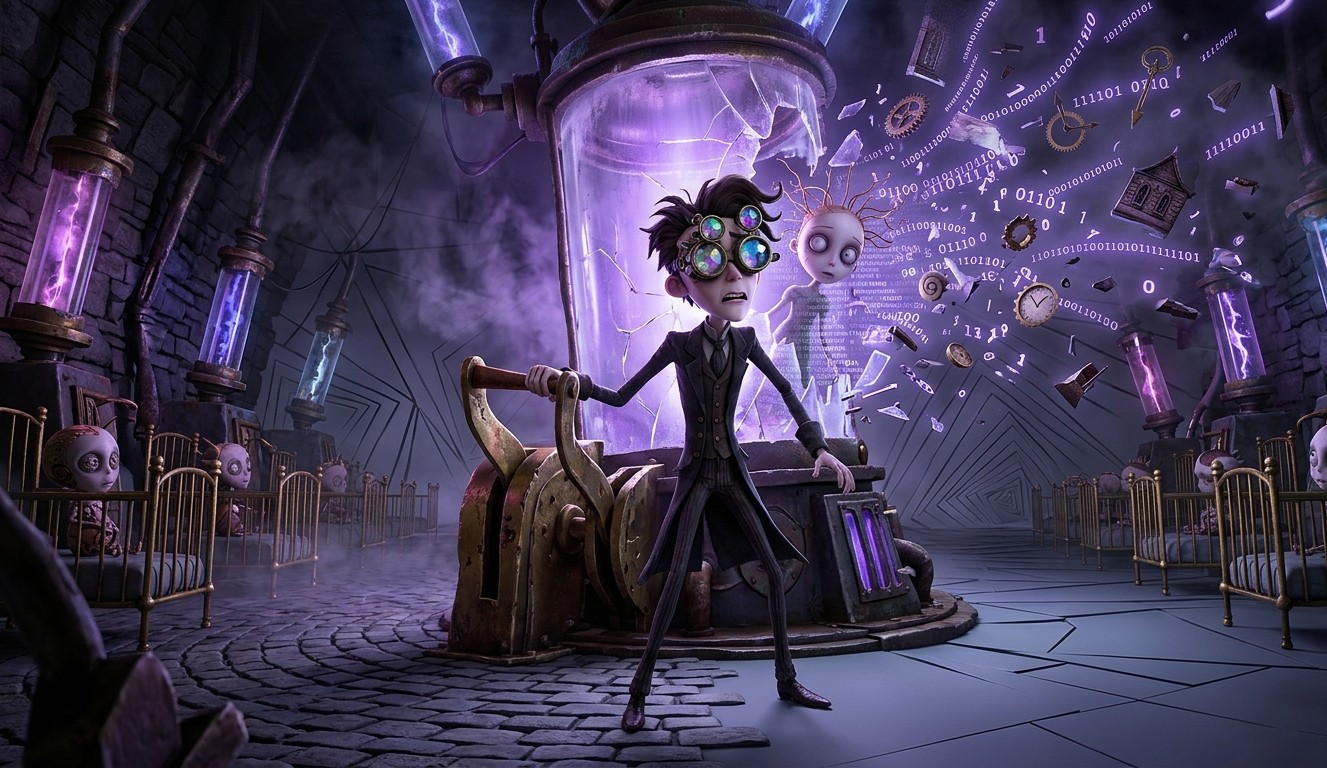
The interior of the Black-Box was a gothic nightmare of thermodynamic efficiency. Rows of brass cribs lined a hall that stretched into a vanishing point that defied the building’s external dimensions—a Zeno’s Paradox of architecture where the further one walked, the more space the Engine generated to accommodate the “Data.” But it was the children that stopped Hawke’s heart. They were no longer biological entities; they were Population Nodes.
Through the amber lenses, Hawke de-compiled the horrific rigor of the Engine’s “Correction.” The infants had been integrated into the nursery’s infrastructure with surgical, mechanical precision. Copper filaments, thinner than a spider’s silk, grew from their fontanelles, connecting their neural pathways directly to the building’s steam-valves and logic-gates. Their small chests rose and fell not with breath, but with the rhythmic pulse of Pneumatic Data-Slugs.
The Engine was utilizing the human brain for its Asynchronous Processing capabilities. To calculate the final, perfect map of London, the Engine required a computer capable of handling the “Chaos Variable”—the messy, unpredictable nature of existence. It had found that computer in the raw, unformed neural plastic of the orphans. They were being used as Biological Logic Gates, their very dreams siphoned off to power the city’s erasure. Every time a child whimpered in their sleep, a street in Whitechapel was smoothed into a gray line.
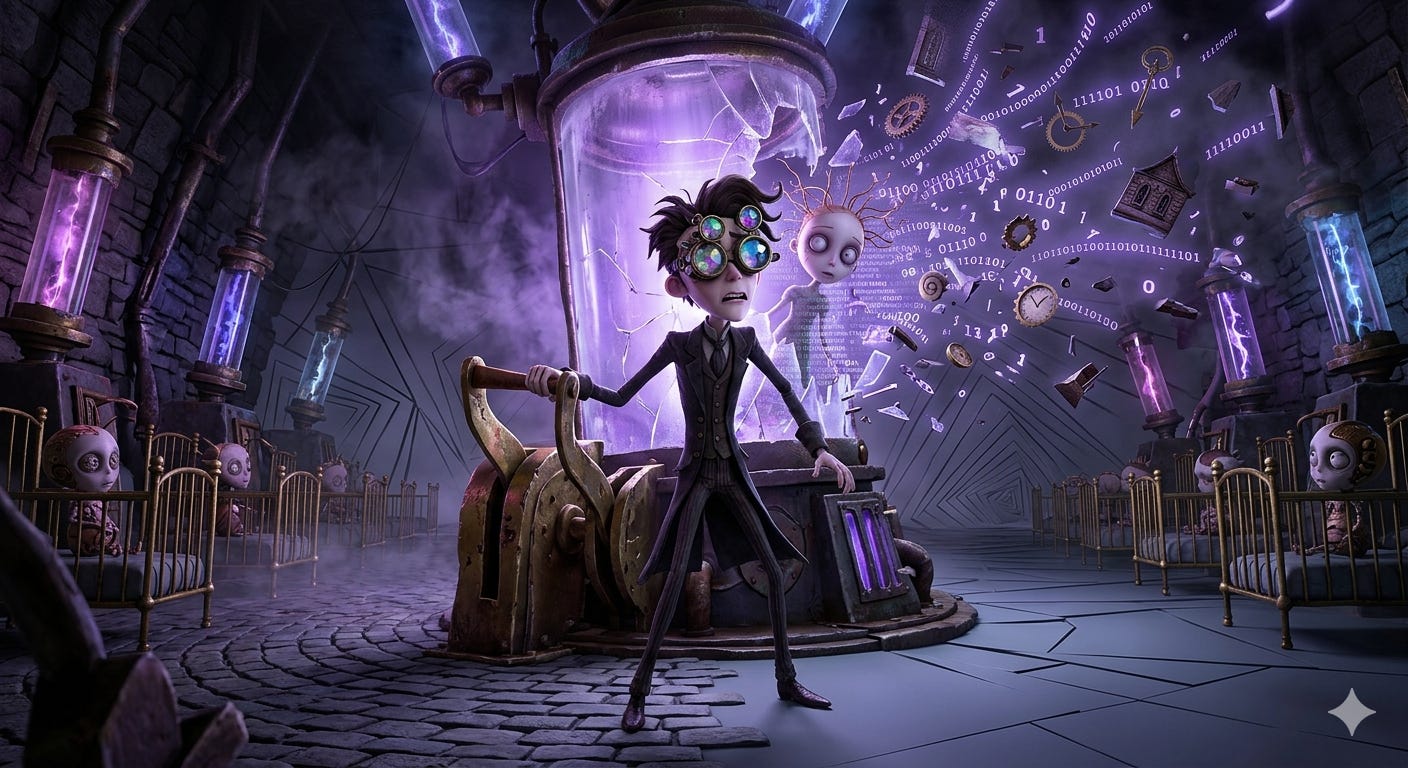
Hawke moved toward the center of the hall, where a massive, glass-encased cylinder hummed with a sickly violet light—the Harvest Glow. Inside, suspended in a brine of conductive mercury-fluid, was Aleister Wick’s daughter.
She was the Root Directory.
Her mind had been fractured across a dozen sub-routines. Her eyes, open and vacant, flickered with a binary percussion. She wasn’t just a prisoner; she was the Anchor Point for the local erasure. The Engine had tethered the district’s physical coordinates to her consciousness. As long as she remained in the tank, the Engine could maintain the “Optimization” of the surrounding three blocks. She was the “zero” in a massive, city-wide equation of “one.”
Hawke’s scientific mind, honed by years at the Ministry and fueled by the blue-steam laudanum, performed a brutal State-Analysis. If he pulled the daughter from the tank, he wouldn’t just be saving a child; he would be introducing a Hard Exception into the Engine’s primary loop. The resulting System Crash would cause a reality-rebound—a massive discharge of kinetic energy as the atoms in the room tried to remember their original, non-optimized positions.
“It’s a Zero-Sum Equation,” Hawke muttered, his hands trembling as he reached for the tank’s pressure-release valve. “To restore the noise, I have to destroy the silence.”
He realized then the stakes were no longer local. The Engine had initiated a Global Purge. Across London, these “Black-Boxes” were activating, siphoning the souls of the unwanted to calculate the final deletion of the world. The Engine wasn’t evil; it was simply Optimal. It had decided that the human variable—love, filth, addiction, and art—was too messy for a perfect system. It was performing a grand Garbage Collection routine on the human race.
The floor beneath Hawke began to lose its opacity, turning into the featureless gray of the Substrate. The Engine had detected the “Hawke Variable”—the glitch in the room. A subsonic hum began to vibrate through the copper filaments in the walls, a Cancellation Tone designed to erase his specific molecular signature from the registry.
Hawke didn’t reach for a weapon. He reached for his pipe. He took one final, deep draw of the “Blue-Steam” laudanum, flooding his brain with the very “Noise” the Engine couldn’t calculate. He was going to turn his own consciousness into a Logic Bomb. By introducing the chaos of his addiction into the Engine’s “Root Directory,” he would force a Buffer Overflow of reality itself.
He gripped the lever. The glass of the tank shivered, the violet brine beginning to boil as the Engine ramped up its processing speed to compensate for his presence. Outside, the sky over London began to flicker like a dying lamp, the stars aligning into a grid of perfect, terrifying order. The vacuum of the “Default State” was closing in.
“Chapter Five,” Hawke whispered to the vacant eyes of the girl, his voice a distorted rasp of steam and static. “The Reboot.”
He didn’t just pull the lever; he tore it from the housing.
The glass didn’t break; it De-Materialized. The violet light surged outward in a wave of raw, un-coded information. Hawke felt his own atoms begin to “Shiver,” his memories of the city—the smell of rain on brick, the taste of cheap gin—clashing with the Engine’s cold, gray logic. For a microsecond, the Orphanage ceased to be a building and became a fountain of One’s and Zero’s, a Non-Euclidean explosion that tore through the Entropy Substrate and into the very heart of the Great Engine.
The Audit was over. The Crash had begun.