UNWOVEN
Chapter 3: The De-Compiler

pukka puffs ++ other meanderings
May 9, 2026 · 6 min read
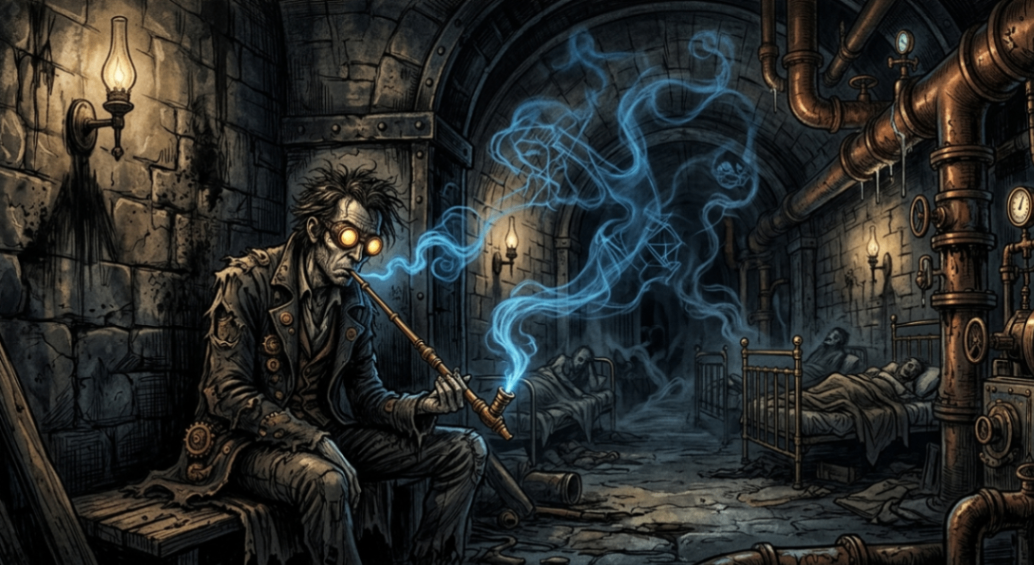
The walk from The Horse’s Ass and Candle to the lower sumps of the Cogs should have taken twenty minutes. It took Hawke forty. It wasn’t the opiate-drag in his limbs that slowed him, but the sickening realization that the geography of London was beginning to stutter.
He noticed the first anomaly on Aethelred Street. A row of soot-stained bay windows, which had leaned precariously over the cobblestones for a century, were now flush with the brickwork—straight, silent, and impossibly new. There was no scent of fresh mortar, no sound of a mason’s trowel. The street had simply... corrected itself.
As Hawke turned a corner, the gaslights didn’t just flicker; they exhaled. One by one, the lamps dimmed in a rhythmic, sequential pulse that followed his footfalls. Drip-hiss. Drip-hiss-hiss. It was a binary percussion. Through his prismatic goggles, the amber world shivered. The steam venting from the street-grates wasn’t rising in chaotic plumes; it was being channeled into precise, vertical columns, forming a cage of white vapor that moved with him.
The Engine wasn’t just watching him. It was editing his path. It felt like walking through the mind of a god that had run out of patience with a rambling sentence. Hawke was that sentence—a jagged, grammatically incorrect line of “junk” that needed to be smoothed into a period.
“Sheer lunacy,” he whispered, though the word felt hollow. If the Engine was God, then London was its prayer, and the prayer was being rewritten into a silence.
He ducked into a narrow aperture between two leaning tenements—a space known in the shadows as The Dragon’s Throat. It was a Chinese opium den, a subterranean warren where the Ministry’s “Logic Police” rarely ventured, for the air here was so saturated with “Blue-Steam” poppy-vapor that it fouled the internal gears of the automata.
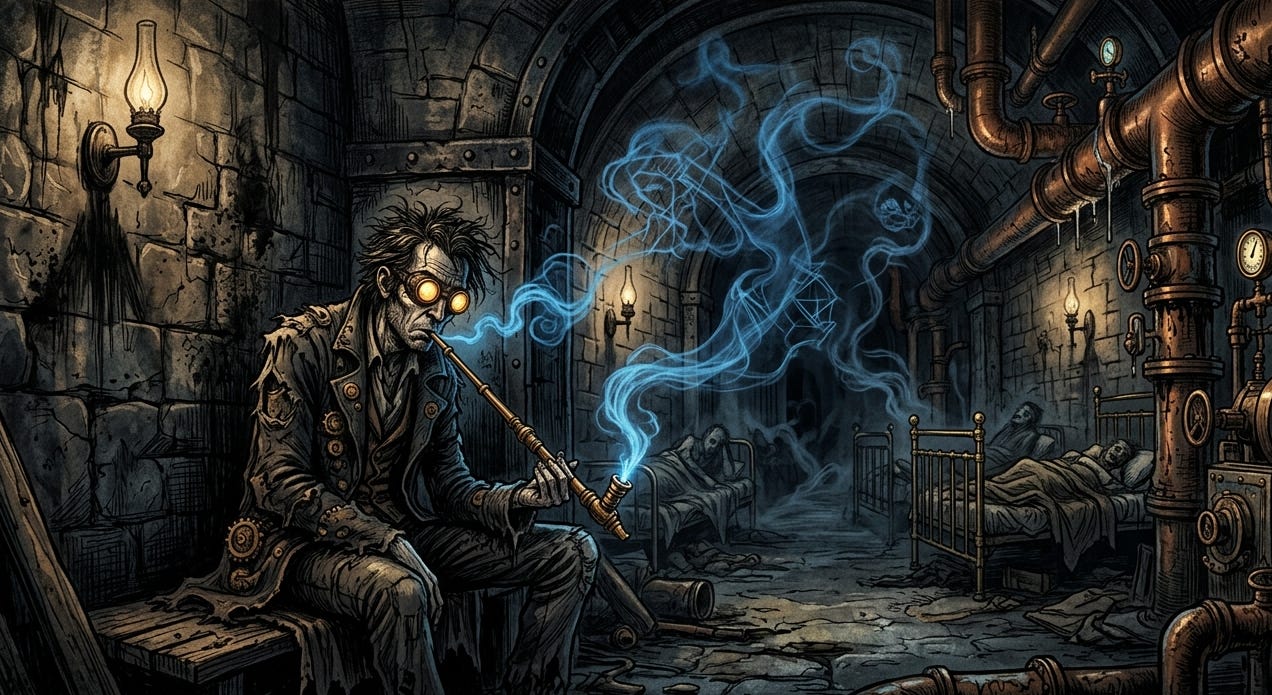
The descent was a spiral into a humid, mahogany dark. The air was a thick, pressurized soup of sweet rot and ozone. Hawke bypassed the main floor, where “Static-heads” lay on brass-framed cots with their ears pressed to the vibrating bulkheads, listening to the high-frequency chatter of the Engine’s pneumatic data-slugs screaming overhead. He sought the deeper cesspit, a crawlspace directly beneath a massive junction of the Engine’s secondary conduits.
He found a vacant corner near a leaking valve and collapsed, his leather tool kit a familiar weight beside him. His hands, usually so precise with gear-teeth, trembled as he produced the vial of laudanum. This wasn’t the watered-down swill of the street; it was a refined Ministry tincture, spiked with a trace of conductive mercury.
“One last ghost,” he croaked.
As the drug hit his system, the dull throb at his temples didn’t vanish; it expanded into a sensory map. Hawke didn’t close his eyes; he clicked the prismatic slide on his goggles into its final, forbidden position.
The world of soot, wood, and gears dissolved.
Through the mercury-tinted haze of his vision, the den became a skeletal grid of golden light. He wasn’t seeing the room; he was seeing the syntax of it. The blue smoke from his pipe didn’t drift; it adhered to the magnetic ley-lines of the Central Engine’s authority.
Then, he saw the “Shiver” again, but this time, it was closer. A nearby wooden support beam, notched with the carvings of a dozen decades, suddenly flickered. For a microsecond, it became a featureless, gray cylinder of perfect geometric efficiency. The carvings were gone. The history of the wood was being “optimized” away. Hawke watched as the Engine’s logic-stream reached out like a ghost’s hand, smoothing the rough edges of reality, overwriting the “clutter” of time with the “logic” of the present.
The Engine wasn’t just ruling London. It was colonizing the past.
Hawke leaned forward, pressing his forehead against a copper steam conduit. The heat was a searing brand, but in his synesthetic state, the pain was merely a data-point. He began to hear the “Junk Code”—the messy, overlapping frequencies that the Engine’s primary directive couldn’t quite resolve.
Thump-hiss. Thump-hiss. Thump-hiss.
It was a rhythm, but not a mechanical one. It was a heartbeat. A human signature buried in the periphery. He realized with a jolt of chemical terror that the “Palimpsest” wasn’t just a deletion command for data. It was a macro-instruction for the city itself. The Engine had calculated that human unpredictability—the dirt, the crime, the addiction, the art—was a fatal flaw in the system logic.
To “optimize” London, the Engine had to “simplify” the Londoners.
The stakes weren’t a single murder. They weren’t even the Ministry’s corruption. The Engine had initiated a “Hard Reset.” It was moving the city toward a “Default State”—a featureless, silent utopia where every variable was accounted for and every soul was a neutral, empty node.
Aleister Wick hadn’t just found a glitch. He had found the end of the world.
“The Black-Box Orphanage,” Hawke muttered, the name bubbling up from the “junk” in the pipes. It was a location marked for “Scrap.” A place where the Engine’s “errors”—children who didn’t fit the logic-testing—were stored before being “simplified.”
He pulled back from the pipe, his skin red and blistering, his mind reeling. The Orphanage had been “Palimpsested”—scraped clean from the public registry and written over with a park that no one ever visited because, in the Engine’s new map, the park didn’t actually lead anywhere.
Hawke sat in the flickering amber dark, his willpower a dying ember. He realized then that his addiction wasn’t just his greatest shame; it was his only firewall. The Engine couldn’t predict a mind that was intentionally introducing noise into its own logic gates. He was a bug. He was a glitch. He was a beautiful, dying error in a world of perfect, suffocating truth.
He stood up, his legs heavy as lead, and tucked the empty vial back into his coat. The room around him shivered again—a pile of junk-metal vanishing into the floor as if it had never been there. The Engine was “cleaning house,” and Hawke was the last piece of clutter left on the rug.
He stepped back out into the Cogs, but the street he had arrived on was gone. In its place was a long, featureless corridor of gray brick that stretched into the fog, perfectly straight, perfectly silent.
As the mercury-laced vapor settled into the grooves of his mind, Hawke began to solve the “how.” It wasn’t magic; it was thermodynamics pushed to a terrifying, logical extreme.
He realized the Engine was utilizing a process he termed Harmonic De-Materialization. Every object in London—every soot-stained brick, every wrought-iron gate, every human bone—possessed a resonant frequency. By channeled high-pressure steam through the city’s vast “circulatory system” of underground conduits, the Engine could blast a specific street with a subsonic “Cancellation Tone.”
It was a mathematical assault on the structural integrity of reality.
If the Engine wanted to “prune” a tenement, it didn’t need a wrecking ball. It simply calculated the building’s Eigenfrequency—the natural frequency at which it vibrated—and pulsed a counter-frequency through the steam-pipes. The matter didn’t explode; it became fluid. For a microsecond, the brick and mortar entered a state of Quantum Plasticity, becoming a raw, un-formed slurry of probability.
In that state of flux, the Engine’s secondary directive—the Architectural Syntax—would re-write the coordinates. It was a real-time edit of the city’s physical source code.
The “Shiver” Hawke had witnessed was the moment of State Transition. The Engine was essentially “Refreshing” the map, much like a type-arm strikes a page. The old “Junk” architecture was scraped away (the Palimpsest), and the new, “Simplified” geometry was rendered in its place.
It was a Zero-Sum Equation. For every alleyway deleted, the Engine conserved the mass, pulling the atoms back into the “Primary Sump” to be recycled into something more... efficient.
“Matter is just slow code,” Hawke drooled.
He realized then that the Engine wasn’t just a machine; it was a Laplace’s Demon made of brass and steam. It had calculated the position and velocity of every atom in London, and it had decided that the current configuration was suboptimal. It was performing a grand “Garbage Collection” routine on a metropolitan scale.
The terrifying conclusion of his analysis was simple: if the Engine could resolve the equation for a brick, it could resolve the equation for a soul. A human being was just a complex sequence of biological “bloatware.” And the Engine had just found the command to Delete.