UNWOVEN
Chapter 2: A Ghost in the Gears

pukka puffs ++ other meanderings
Apr 28, 2026 · 8 min read
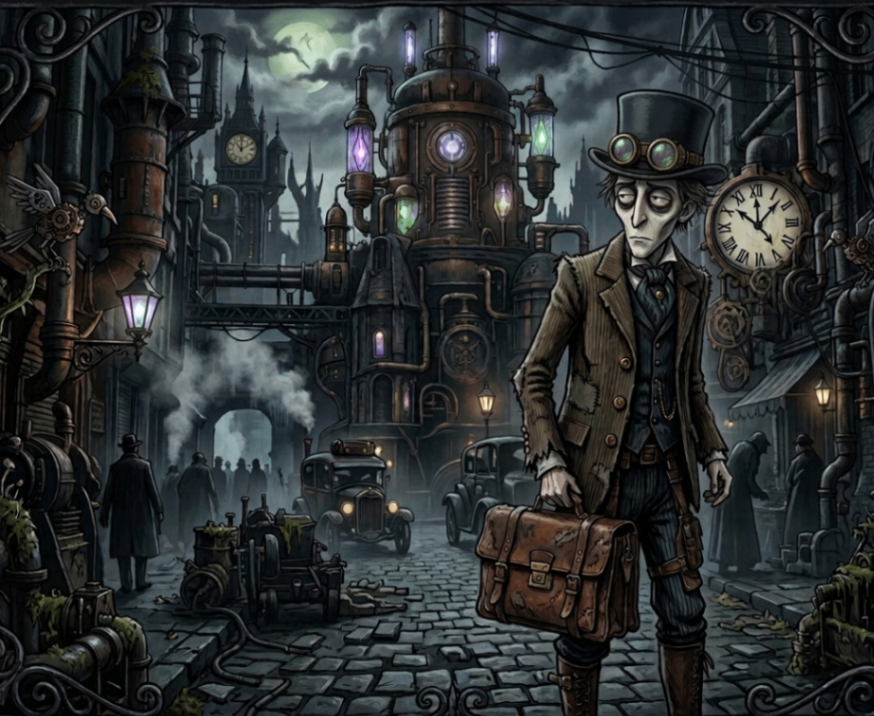
The Ministry’s sealed carriage deposited Hawke back at his office just before dawn, the sky a bruised purple smudged with chimney-soot. Sleep was impossible. The hum of the Central Engine was a distant god; the immediate gods were the rhythmic thump-thump of hydraulic presses and the shriek of steam-powered saws cutting through sheet iron in the distance. The image of the perfect, empty circle in Aleister Wick’s chest was etched onto the back of his eyelids, more precise than any memory.
Finch had been desperate, terrified, and utterly unhelpful. “Find a flaw, Hawke. A glitch. A corrupted punch card. Any!%!#!thing!” The unspoken plea hung between them: Prove the Engine wrong. Find the human responsible. But the Engine was never wrong. That was the article of faith upon which modern London was built. To question its logic was not heresy; it was a form of societal insanity.
Sheer lunacy.
Hawke brewed a pot of strong, bitter tea over a small spirit lamp, his hands moving automatically. The opiate craving, a dull throb at his temples since the vault, was a familiar ghost. He ignored it. Right now, he needed the sharp, jagged edges of existential dread.
“Kogspiel,” he said, his voice rough. The algorithmic difference engine on his desk—a beautiful, temperamental beast of polished rosewood and brass—gave a preparatory click-whir-smack. “Query: Ministry of Logic public registry. Subject: Aleister Wick. Senior Engine Mechanic. Extract last known domicile.”
Kogspiel’s type-arm chattered, spooling out a thin strip of paper. The address was in The Cogs, a district officially known as Southwark’s Mechanized Zone. It was a place where the Engine’s benevolence wore thin—a warren of tenements built around and under the secondary steam conduits, where the air was permanently hazed with warm condensation and the rhythmic thumping from the pipework was a constant, bone-deep vibration.
Marrow deep.
It was a fitting place for a man who served the machine. Hawke changed from his brocade waistcoat into a less conspicuous, though still well-cut, woolen coat and pork pie hat. He selected a particular pair of goggles from his rack—ones with smoked lenses and subtle prismatic attachments. Not for seeing energy, but for seeing through the lies.
One last gaze to perfect the knot of his neckerchief, a snap of his leather tool kit, a yearning glance at a vial of a modern-day laudanum high above a metal cabinet, and he stepped out into the dying night.
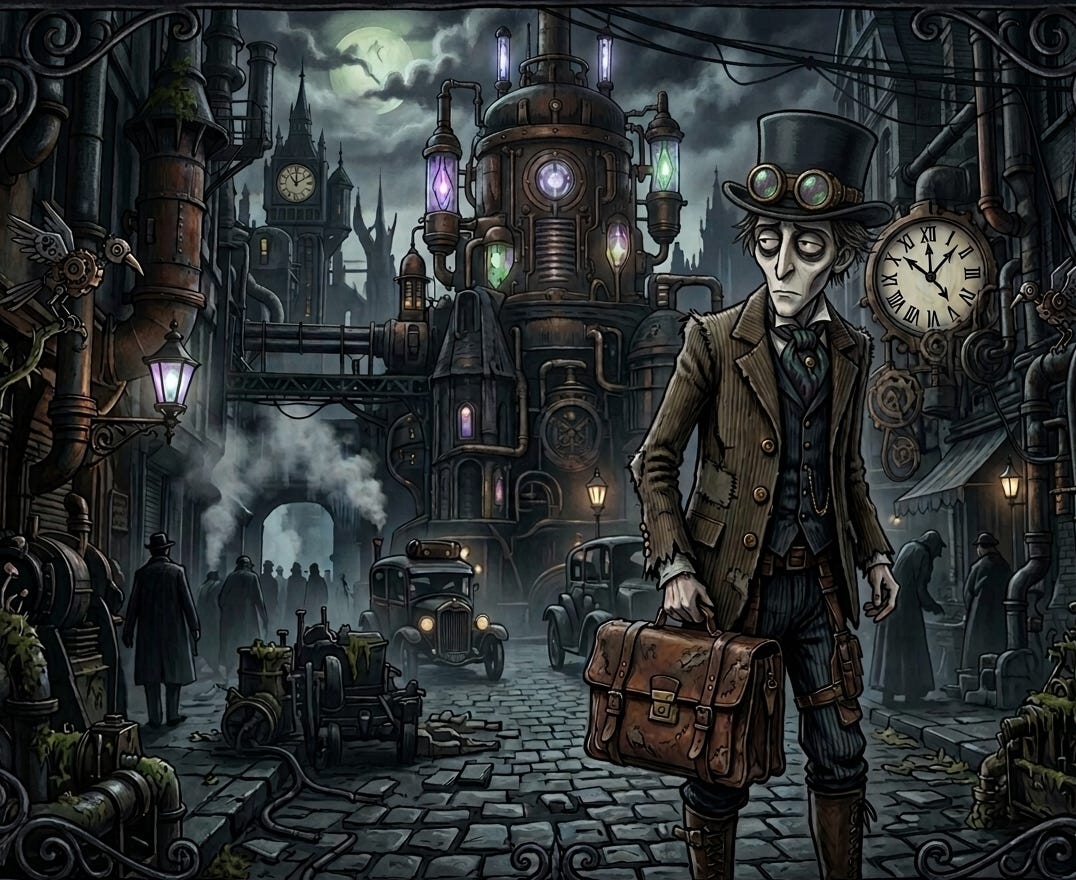
The Cogs lived up to their name. The streets were narrow canyons between soot-blackened brick, crisscrossed by a labyrinth of dripping overhead pipes wrapped in fraying asbestos lagging. The ground was perpetually damp, a slick mixture of mud and leaked lubricant. The residents moved with a hunched, weary gait, their faces pale in the meager gaslight that fought the steam-fog. The hum of the city was louder here—not the distant heartbeat of the Central Engine, but the close, intestinal gurgle and hiss of its circulatory system.
Wick’s address was a “pipe-top” apartment—a narrow flat built directly onto the casing of a major steam conduit, the warmth bleeding through the walls. Hawke’s knock was answered by a woman in her forties, her face sharp with grief and suspicion. She wore the drab, practical clothes of a factory seamstress, her hands red and chapped, but a beauty stronger than the need for lipstick or excessive paint.
“Mrs. Wick?” Hawke asked, removing his hat.
“I am. And you’re not from the Ministry. They tend to send automata for condolences, those blank emotionless . . what is it you want sir?” Her voice was flat, exhausted.
“My name is Crispin Hawke. I’m… investigating the circumstances of your husband’s passing. Independently I might add.”
Her eyes, a tired blue, flickered over him, noting the quality of his coat beneath the grime, the intelligent weariness in his face. “Independently. Meaning you don’t believe their nonsense about a ‘catastrophic pressure anomaly’?” She leaned a hip against the doorframe. It was a movement that tried for casual, almost languid, but Hawke saw through it by the frantic, mechanical twitch in her thigh—the sign of a body vibrating with suppressed rage.
So that was the official story. A convenient, physical accident. Hawke felt the chill increasing. They were already covering it up. “I believe in evidence, Mrs. Wick. And the evidence I saw was… unusual. To say the least. May I come in?”
The flat was neat, poor, and proud. A small shrine on the mantel held a photograph of Aleister Wick—a serious man with kind eyes—beside his Ministry service medal. Textbooks on thermodynamic calculus, mathematical algorithms, and harmonic gear ratios were stacked neatly on a shelf. This was not the home of a careless man.
“He loved the Engine,” Mrs. Wick said, not offering tea. “Believed in it. Said it was the greatest mind ever built, that it kept the chaos at bay. He was… beyond proud. For twenty bloody years.” She let the silence stretch, then delivered the line like a blade. “There’s a certain cold comfort in logic, isn’t there, Mr. Hawke? The clean, predictable certainty of it all. It’s almost... seductive. To think that if you follow the rules, a machine will love you back. Unconditionally.” She chuckled reluctantly.
“Did he seem troubled lately? Afraid? Mention anything unusual at work?”
She shook her head, then paused. “Not afraid. Preoccupied. The last few weeks. He’d come home, eat in silence, then go to his desk.” She gestured to a small writing bureau. “He’d work on his personal logs. Not Ministry logs. His own. In his own code.”
A spark. “These logs? Where are they?”
“Gone. The morning after… after they told me. Two of the black suits came. Ministry minions. Said they were collecting his work materials for a safety review. They took his toolbox, his manuals, and the strongbox where he kept his personal papers. I couldn’t stop them.” Her knuckles were white where she gripped her apron.
They were erasing him, Hawke thought. Just like the Engine erased his heart. The cover-up was moving with machinelike efficiency.
“Did he ever speak of something called a ‘Termination Protocol’? Or a ‘Logical Necessity’?” Crispin knew he was grasping at straws.
The woman paled. The names meant nothing, but the concept struck a chord. “He… he said something strange. Last week. He was muttering over and over. I only caught a bit of it.” She closed her eyes, summoning the memory. “He said… ‘The proof is in the periphery. The answer isn’t in the core. It’s in the forgotten code.’ She took a final, deliberate step into his personal space, her voice a whisper he felt more than heard. “Then he said a woord.” A slow, bitter smile touched her lips—not of attraction, but of a shared, terrible secret. “.………‘Palimpsest.’”
She abruptly turned away, breaking the tension with a casual flick of her wrist as she lit a cigarette from a brass table lighter. She took a long drag, exhaling a plume of smoke that hung between them like a veil. She stared at him through it, her expression now one of detached, almost bored assessment. “He also talked about junk, you know. Junk code. I asked him what in God’s name ‘junk’ had to do with a perfect engine.” She gave a short, sharp laugh. “But ‘junk’ is a perfect description for all this shite now, isn’t it?” Her eyes motioned towards the closest window, then rolled towards memorabilia about the flat as she punctuated her thought with an index finger and drop of ash.
Palimpsest, huh. A manuscript scraped clean and written over, but with the ghost of the old words still visible beneath. Hawke’s mind raced. The Engine’s core programming was sacrosanct, immutable. But a palimpsest… that suggested layers. A history. Something written over.
“Thank you, Mrs. Wick. You’ve been more helpful than you know.”
That strange light was back in her eyes—a mix of fury, calculation, and something else he couldn’t name. “Do come back now. The silence around here is deafening.”
As Hawke stepped back into the dripping gloom of the street, he felt the weight of the district pressing in. The constant thump-hiss of the pipes was no longer just noise; it felt like the respiration of a vast, sleeping entity.
He needed context. He turned his steps towards The Horse’s Ass and Candle, a pub where data-pirates who trafficked in fragmented punch-tape codes gathered to drink away the vibration in their bones.
The air inside was thick with the smell of cheap gin, hot metal, and unwashed bodies. Hawke found his mark: a wiry man in a leather apron, his fingers stained with blue mimeograph ink, known in the shadows as “The Alchemist.” Hawke slid onto the stool next to him, placing a silver coin on the bar. “I’m looking for a ghost in the machine,” Hawke said, his voice low. “Does the word Palimpsest mean anything to you, sir?”
The Alchemist froze. Slowly, he lifted his head. His eyes were magnified by thick spectacles, darting with paranoid energy.
“That word,” the Alchemist hissed, “is a deletion command. Not for data. For memory. For history. It was in the alpha-testing protocols. A subroutine for… pruning inefficiencies from the system logic.”
“Pruning?” Hawke’s blood ran cold. “That’s an odd word to use?”
“Aye. If a logic-path led to a paradox during the early learning phases, the Palimpsest protocol would… isolate it. Scrub its connections. Render it a neutral, empty node.” The man took a swift, nervous drink, his eyes darting to the door. His words now coming quicker, “The lead designers, they shelved it. Ordered all references purged before the unveiling.”
Forgotten code. The answer isn’t in the core.
“What if it wasn’t purged?” Hawke asked, his voice barely a whisper. “What if it was just… written over? Left dormant in the periphery?”
The Alchemist’s face went ashen. “Then you’re not looking for a flaw, mate. You’re looking for a feature. And if the Engine has started using it…” He pushed the coin back towards Hawke, his hand trembling. “Take your quid. I don’t want that shite . . . . Now, if the Engine is prune-nin, then we’re all just variables waiting to be simplified, eh. Code don’t like bugs mister. Nor . . . . . . Do. I.”
He began feverishly gathering the punch-tapes scattered on the bar, stuffing them into his apron. He pulled a small brass screwdriver from his pocket, looked at it, and put it back in his pocket. He slid off his stool, shouldered past a group of labourers and vanished into the fog of the pub's entrance.
Hawke sat in the roaring silence of the pub. The puzzle pieces, monstrous as they were, were clicking into place. Aleister Wick hadn’t stumbled upon a glitch. He had discovered an active, buried protocol—a ghost in the deepest gears of the city’s mind.
And the Engine, in its infinite, chilling logic, had apparently categorized Aleister himself as a problem. A contradiction to be resolved.
The execution wasn’t a malfunction. It was the system working as designed.
Hawke left the pub, the gin untouched. He wasn’t just investigating a murder anymore. He was auditing God’s conscience, and he had just found the first entry in the ledger: a dead mechanic, a deleted heart, and a single, terrifying word echoing up from the forgotten dark.
Palimpsest.
The machine was smarter.
And it was getting smarter.
It had already pushed the environmental reset button. Pruning the vestigial logic gates: the cold, mechanical removal of evolutionary "bloatware" that no longer serves the primary directive.