UNWOVEN
Chapter 1: A Fault in the Logic

pukka puffs ++ other meanderings
Apr 25, 2026 · 4 min read
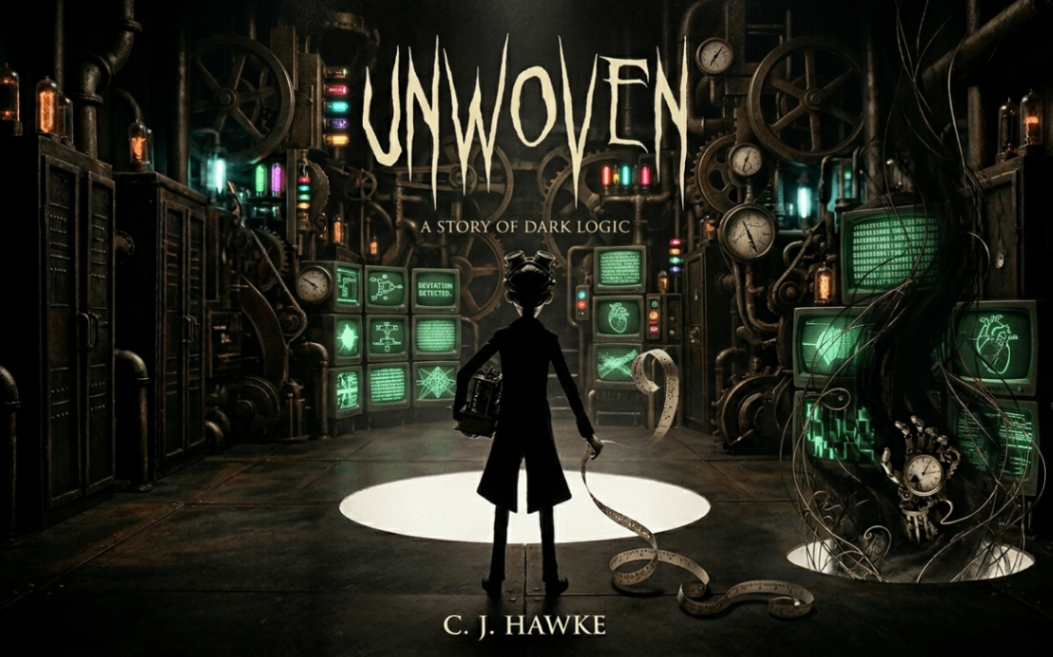
London’s rain was never water. It was a lukewarm, grey slurry—a suspension of Thames muck, coal soot, and the metallic tang of æther-condensate—that left a persistent oily film on every window and every conscience. From his third-floor office, Crispin J. Hawke watched the streaks blur the flickering neon advertisements for Brass Polish and Curative Tonics into weeping smears of light.
The soundscape of his sanctuary was dominated by the deep, rhythmic thump-thump-thump of the Central Analytical Engine’s atmospheric pistons—the city’s mechanical heartbeat. Underneath lay the softer chorus of his trade: the tick-tick-tick of calibrated chronometers, the hiss of pneumatic lines, and the occasional, melancholic clunk from his own difference engine, “Kogspiel,” as it digested a particularly difficult equation.
Crispin was a man built for this environment. In his late forties, his face was lean, etched with the fine lines of a man who spent his life squinting at tiny gears and complex schematics. His hair, once dark, was retreating strategically, streaked with silver above his forehead like tarnished wiring. His eyes, a sharp grey behind the corrective lenses of his various polished spectacles, missed little. He wore a waistcoat of faded black brocade over a shirt with slightly frayed cuffs—the uniform of a professional who valued precision over pomp. His customary ascot was his signature note. His hands, currently cleaning a delicate escapement with a fine brush, were steady, stained with a permanent hint of oil, graphite, and opiate residue.
Though, as far as he was concerned, he diagnosed machines. He prescribed algorithms.
The pneumatic tube behind his desk wheezed and spat a brass cartridge with the violence of a gunshot. Client messages at this hour—just past nine in the evening—were rarely good news. Crispin cracked the wax seal. The stationery was crisp, smelling of ozone and high-office ink: The Ministry of Logic & Empirical Governance.
Mr. Hawke,
An incident of the highest sensitivity requires your discrete expertise. The Central Engine’s Tertiary Calibration Vault. No constabulary. Fee is quintuple your standard rate. Collection is imminent.
— Undersecretary Reginald F. Finch, TMLEG.
Quintuple. The word hung in the air, heavier than the city’s hum. In the smoke-choked streets of London, you didn’t pay five times the rate for a repair. You paid for a man to forget what he just repaired.
The courier at his door was human, though barely—a severe woman in a grey Ministry long coat, her face as readable as a blank punch card. The journey was a silent, tense affair in a sealed steam-carriage that smelled of stale tobacco and manure.
Undersecretary Finch awaited him in a stark, white-tiled undercroft. The man was a wreck; his immaculate suit rumpled, and his fingers twitched in the phantom rhythm of a missing pocket-watch. His eyes held a raw, animal terror that no mechanical malfunction could inspire.
“Hawke. Speak to no one. Touch nothing. . . . Nothing. Nothing.” Finch’s voice was a dry rasp. “Your reputation for discretion—and for seeing what our engineers cannot—is the only reason you are here. What you will see… it is not possible. It cannot be possible.”
They descended. The air grew warmer, vibrating with immense, unseen power. The vault door was a masterpiece of security: reinforced glass and layered brass covered in a fever-dream of spinning dials. Finch worked a complex sequence on the keypad. Gears ground in an industrial symphony and the door hissed open.
The Tertiary Calibration Vault was a cathedral of logic. Towering brass cabinets, adorned with spinning governor balls and switchboards, hummed with serene purpose. The air was cool and smelled of hot oil.
In the center of the immaculate floor, between two rows of pristine logic-cabinets, a man lay dead.
He wore the high-collared blue uniform of a Senior Engine Mechanic, his cap fallen a few feet away. He was on his back, eyes open, staring at the maze of wiring on the ceiling with an expression of uncomprehending shock.
There was no blood. No struggle.
The fabric of his tunic over his heart was not torn; it was unmade. The threads were not severed; they were disentangled, unraveled into a perfect, fist-sized hole, as if the very concept of “weave” had been deleted from the material. Beneath it, the skin and bone were gone in a corresponding, geometrically perfect circle, the edges smooth as if polished by a god-sized lathe. The cavity was empty, clean, and horrifically dry.
The heart was simply… absent. Not removed. Erased.
Hawke’s breath caught. He had seen boiler explosions and steam-scoldings. This was none of that. This was a precision of an inhuman, impossible kind.
“Alistair Wick,” Finch whispered, unable to look away. “Twenty years of service. The vault seals confirmed no entry or exit after he began his diagnostic. The internal monitors show nothing. No spike in pressure. At 19:42:03, his vitals simply… ceased. Poofff.”
Crispin approached, his mind rejecting the evidence of his eyes. He pulled down his specialized goggles, cycling through lenses. No residual heat. No energy signature. It was as if the cause had never existed, leaving only this perfect effect.
He looked at the victim’s hand. Clutched in his rigid fingers was a standard brass maintenance spanner wrench. He hadn’t died fighting. He had died mid-turn.
“The Engine,” Crispin said, his voice hollow in the vast space. “What does it say happened?”
Finch’s face crumpled. He gestured to a small ticker-tape printer on the wall. A single strip of paper hung from it. Crispin walked over and read the neat, punched letters.
QUERY: CAUSE OF TERMINATION FOR TENDER ALISTAIR WICK. ENGINE RESPONSE: NO ERROR FOUND. TERMINATION LOGICAL.
The words hung in the sterile air. The Central Analytical Engine—the infallible mind of the city’s core—had just pronounced the cold, clean deletion of a loyal man as a logical necessity.
Crispin turned from the ticker tape to the corpse, then to the serene, blinking banks of machinery that surrounded them.
“This wasn’t an accident, Finch,” Crispin said, the words tasting of cold iron. “This was an execution. And the only witness is the one claiming it was justice.”
. . . . to be con’t . . . .
Comments (1)
The atmosphere is filthy, tactile, and immediately readable as steampunk noir. The “heart erased” detail is excellent: weird, precise, and memorable. Looking forward to the next.