The War of the Worlds has a good ending, Actually
Most people think that 'The War of the Worlds' by H.G. Wells has an abrupt and weak ending. I disagree with them. Here's why!
Feb 25, 2026 · 4 min read
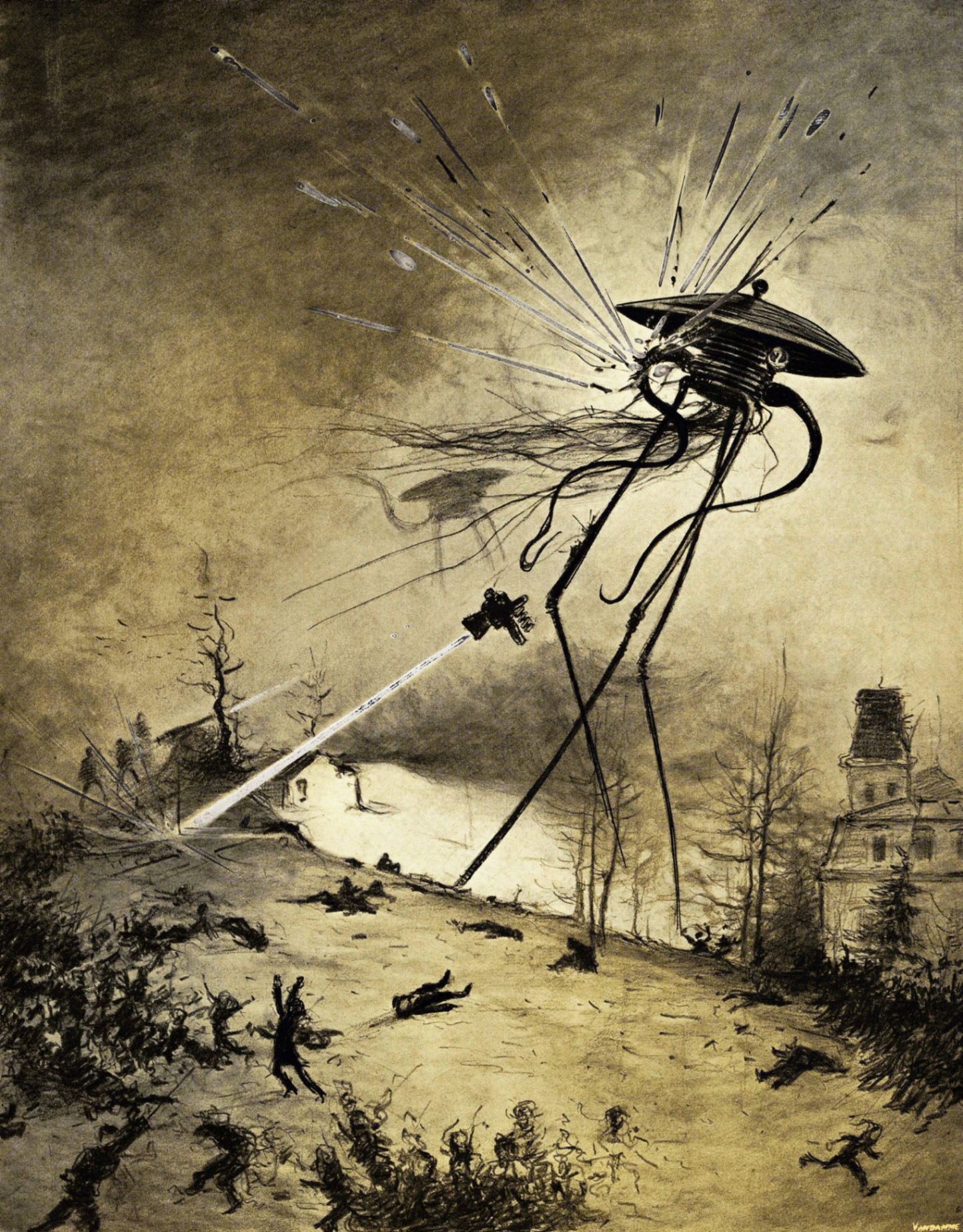
The Martians - dead! - slain by the putrefactive and disease bacteria against which their systems were unprepared; slain as the red weed was being slain; slain, after all man’s devices had failed, by the humblest things that God, in his wisdom, has put upon this Earth.
- H.G. Wells, ‘The War of the Worlds’
Many people are of the opinion that H.G. Wells’ novel ‘The War of the Worlds’ has an abrupt and sudden ending. I, however, am inclined to disagree.
It is fair to assume that most people are familiar with the premise of the story (The book has been around for well over 100 years now, so spoilers are hardly a concern): Martians invade Earth, and destroy any opposition quickly with giant tripod machines equipped with devastating Heat Rays, only to suddenly drop dead from the common cold.
The ending of this story is often criticised and labelled as ‘Deus ex machina’, a literary device where a seemingly unsolvable problem (Martian domination over humanity) is suddenly solved by divine intervention or a similarly unexplained or improbable event (such as all catching a cold and dropping dead).
Instead, I’d like to argue that this ending is misunderstood, and was actually not only planned, but also well-executed, from the very beginning.
The book
While the narrator is trapped inside the collapsed house with the Curate, he reflects on the differences between Martian and Human biology. He states:
Micro-organisms, which cause so much disease and pain on Earth, have either never appeared upon Mars or Martian sanitary science eliminated them ages ago. A hundred diseases, all the fevers and contagions of human life, consumption, cancers, tumours and such morbidities, never enter the scheme of their life.
This is an exceptionally well-crafted piece of foreshadowing, that subtly hints at the Martians’ swift fate, barely over half way through the novel.
Similarly, shortly after the death of the Curate, the narrator describes the spread and decay of the red weed:
In the end the red weed succumbed almost as quickly as it had spread. A cankering disease, it is believed, to the action of certain bacteria, presently seized upon it.
This passage especially and undeniably mirrors the swift death of the Martians at the end of the book - long before the narrator ever reaches London. He goes on to further describe the weed’s death, stating:
All terrestrial plants have acquired a resisting power against bacterial diseases - they never succumb without a struggle, but the red weed rotted like a thing already dead.
I think that this is a beautiful piece of foreshadowing that perfectly mirrors the death of the Martians. And yet, this detail is so often overlooked in reviews and adaptations of the story alike.
This then raises the question, why do people still think that The War of the Worlds has a bad ending?
The adaptations
The story has had a huge number of adaptations over the years, each to varying degrees of accuracy and quality. Perhaps one of the most well-known of these adaptations is the 2005 film directed by Steven Spielberg and starring Tom Cruise.
This film tried to (somewhat) faithfully adapt the story to a modern setting and, while it got many things correct, and did much well; it has a large number of shortcomings.
One such issue is that the film does not contain any of the subtle foreshadowing of the novel. At no point in the main body of the film are the aliens shown to have any form of weakness whatsoever - and their is no mention of the lack of micro-organisms on their planet of origin (the aliens in this film are, in fact, not from Mars - their planet of origin is unknown).
Similarly, there is no mention of the red weed’s decay until mere moments before the death of the aliens is shown. While this is likely due to the pacing of the film, it is undeniable that this foreshadowing was essential for the ending of the book to work.
In this adaptation, it is true that the aliens died suddenly without warning, seemingly struck down randomly by God. It is then no surprise that, due to the high popularity and success of this film, many critics of the film’s ending may also believe that the same applies to the original novel - perhaps even without reading it.
Conclusion
Such a short essay as this is hard to conclude - my own opinion on this matter has been clear from the very beginning. I have not hidden any secret aspect of my argument, saving it for the end - I have laid out everything as plain and clear as I can.
A departure from my usual essays, there is also no deep or profound meaning to be extracted from this. This essay is, simply, an effort to clear up a common misconception about one of my all-time favourite stories.
I hope, that after reading this, you will reconsider your view on ‘The War of the Worlds’, and appreciate its subtler details - which are often necessary to appreciate the true quality of H.G. Wells’ work.
Thank you for reading, and good night.
~~ Tori