The Vibrant Era-The Hollow Vale Memory Care Facility
Time is just a formality here.

Sylvienne Ethara & Gary Mucklow
Mar 18, 2026 · 4 min read
They said the residents of The Vibrant Era suffered from memory loss. That was the polite lie. The truth was far worse. They weren’t losing time. They were slipping through it.
Every afternoon at precisely three fifteen, the cafeteria filled with chatter. The same music looped on the overhead speakers — “Some Enchanted Evening” — and the same laughter echoed, just slightly out of sync. The staff said routine brought comfort. But routine in Hollow Vale was a door you should never knock on twice.
Mrs. Havers spoke first that day, her spoon trembling over cold soup.
“I saw him again,” she said softly, voice cracked like an old film. “The man with the camera. He was at the dance… my dress was blue.”
Across from her, Mr. Henley nodded, eyes clouded but sharp. “Wasn’t that in ’56?”
“Yes,” she whispered. “But it was today.”
No one else at the table flinched. They’d all seen something. Felt something. They shared it like a secret religion, one that only the dying could join. The nurses thought it was dementia, the gentle unraveling of the mind. They smiled kindly, refilled their tea, and moved on.
All except one.
Her name was Miriam. Sixty-three, with bones that ached when the lights flickered. She’d been working here for twenty years. Lately, her own mind had started… glitching.
A word on a clipboard would smear and rearrange itself. A corridor would stretch longer than it should. Once, she caught her reflection in a window and saw her younger self looking back: twenty-three, hair red instead of white, eyes bright with the kind of hope she’d since buried.
She never mentioned it to the others. Not yet.
But she listened.
She listened when Mrs. Kellen said she’d been home that morning, baking lemon bread for her husband, even though her husband had been dead for forty years. She listened when Mr. Gorski cried, saying he’d just held his newborn son, though his son was a grandfather now.
She listened. She believed.
At night, Miriam cleaned the halls alone. The air in Hollow Vale grew heavy after visiting hours, the light dimming in slow, uneven breaths. Sometimes she’d hear a voice whisper her name, calling from the rooms she knew were empty. Sometimes she’d catch the faint hum of that same cafeteria song, muffled through the vents, even though the speakers were off.
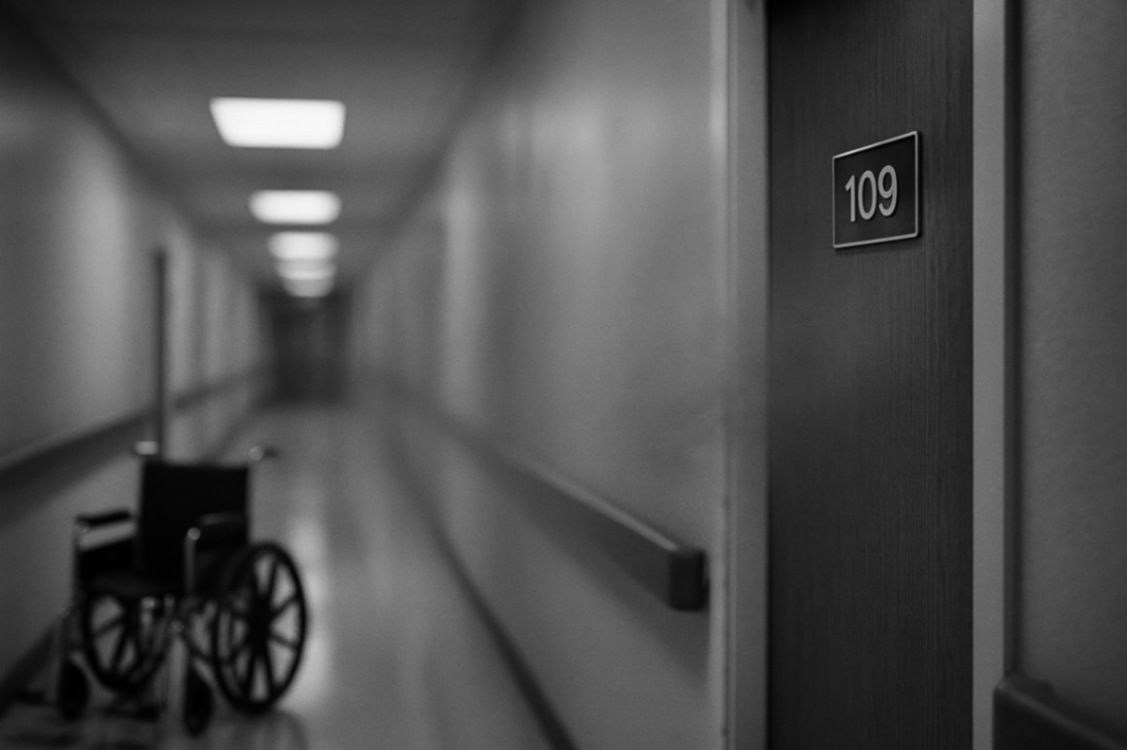
One night, as she passed Room 109, she saw Mr. Henley standing by the window. His chart said he’d died that morning.
“Miriam,” he said calmly, without turning.
“You shouldn’t be here,” she whispered.
“Neither should you.”
His reflection in the glass was younger — strong, laughing, alive. When he turned, the years collapsed back onto him like dust settling over a grave. His eyes were full of something like pity.
“They open when we forget where we are,” he said. “The seams. You start to slip, and then you remember before.”
Before what, she didn’t ask. Because she already knew.
In the morning, the cafeteria hummed again. The residents chatted about the war, the old park, and the train that used to come through Hollow Vale. None of those things had existed for decades.
Miriam poured coffee, her hands shaking.
“I think it’s starting for me,” she said to Mrs. Havers.
The woman smiled kindly, like a grandmother soothing a frightened child.
“It’s not starting,” she said. “It’s remembering.”
Miriam blinked. The cafeteria light flickered once, twice. And suddenly, she was there.
The wallpaper was new. The staff uniforms were gray. Laughter came from people whose faces were photographs she’d dusted for years.
Her body was young again. Her hair red.
“Fresh batch of nurses,” someone called.
And she realized she was standing in the same spot she’d first been hired — fifty years ago.
The intercom crackled. “Attention, staff. Please welcome our new aide, Miriam Lane, to The Vibrant Era.”
She screamed, but the sound folded inward, muffled like a secret. When she blinked, the cafeteria was full again — but wrong. The tables were gone. The people were sitting on the floor, humming that same song. Their mouths moved, but their eyes were empty.
“Where did we go?” Mrs. Havers whispered.
“Where we always go,” said Mr. Gorski. “Back before the world forgot us.”
The lights dimmed to blood-orange.
Somewhere, far down the corridor, a door opened with the sound of tearing fabric.
Miriam dropped her coffee pot and followed the hum.
Room 109 again. The window shone brighter than the hall. Inside, the younger version of herself waited, smiling with red hair and eyes full of time.
“Come on,” her other self said. “We’re late.”
“For what?” Miriam asked.
“The next life.”
The air fractured. She reached out and touched her own hand, and everything went white.
They found her body the next morning in the cafeteria.
The coffee pot was still in her hand.
Her reflection was still moving in the window.
And every clock in Hollow Vale read a different time.
If this resonates with you, please consider subscribing here or https://ko-fi.com/thehollowvale to help bring more of the dark to light.
Comments (7)



I do find it interesting how willingly and easily Miriam chose to leave her current life for "the next life." And the way that, when you're forgotten, nothing really changes but your perception of it, like it is wrong, but only you feel that way.
Very effective literary horror with emotional intelligence. It feels like The Twilight Zone wandered into a nursing home and found something older waiting there. Kudos