The Toll of Pooh
Chapter Five
pukka puffs ++ other meanderings
Apr 19, 2026 · 7 min read
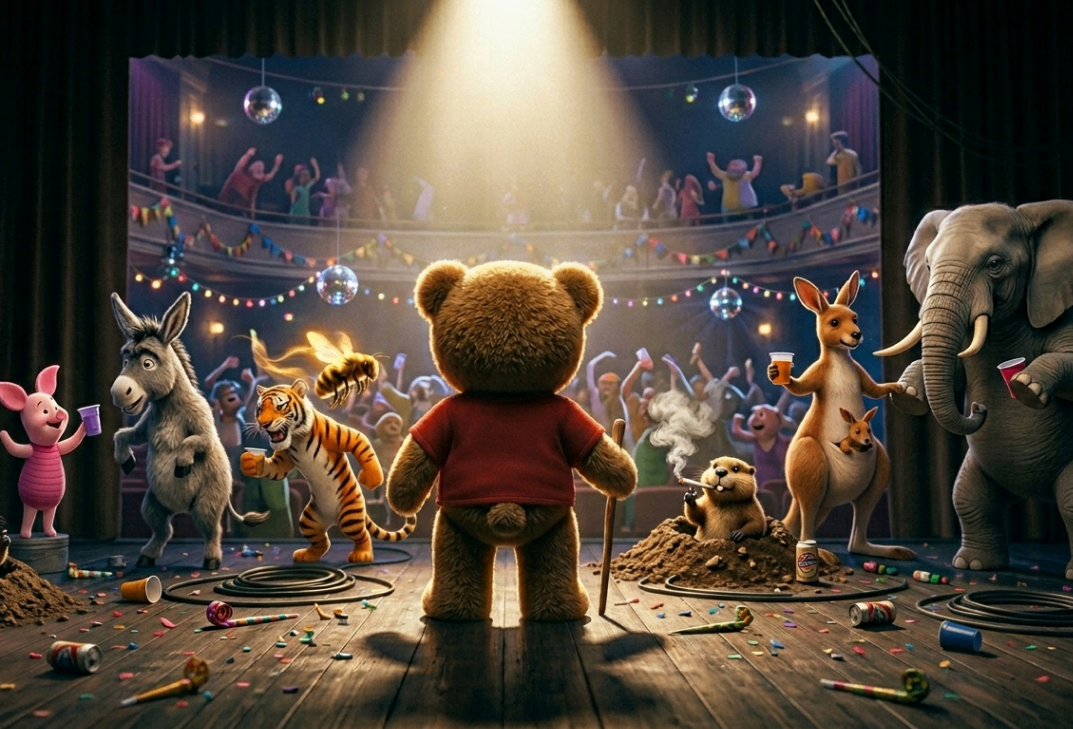
The silence following the signal’s death was not peaceful. It was a vacuum, a deafness so absolute it exerted a physical, thrumming pressure against the eardrums. In Owl’s sanctum, the only light survived in the spasming flickers of his ocular lenses, casting jagged, avian shadows that lunged and withered against the cold walls. The vertical rivers of data—once vibrant and flowing—were now dark, frozen cataracts of dead code. The hum was gone, replaced by a high-frequency tinnitus of pure nothing.
Pooh stood in the center of the dark, his heavy paws hanging like lead weights. He heard the world for the first time: the wet, rhythmic hitch of Rabbit’s hyperventilation; the metallic clack of Tigger’s joints as he pushed off the floor; the soft, desperate shushing of Kanga to Roo. He heard the dry rustle of his own synthetic fur and the tectonic groan of the building’s superstructure settling into a new, unguided equilibrium. This was sound unscrubbed. Raw. Dangerous. Unexpected.
“Is… is it over?” Piglet’s whisper was a thunderclap in the void.
Owl’s head lolled forward, a final, pathetic glitch shivering through his primary wing feathers. The umbilical wires connecting him to the dais went dark, losing their bioluminescent pulse. With a sound like a gunshot on a frozen lake, the glass dais developed a single, radiating fissure.
“The bird has flown the coop,” Eeyore observed. His voice remained a flat drone, but in the wreckage of the digital age, it was the only sound that carried the weight of sanity.
“Move,” Kanga commanded. She didn’t head for the elevators—dead shafts of polished steel—but toward the frosted-glass doors. They were frozen in a half-shimmer, caught between states. She put her powerful hind legs to the frame and kicked. The mechanism shrieked in protest, then gave way with a jagged groan. “Service stairs. Now. Right fff…n..now!”
They moved as a unit, a ragged, traumatized procession. Pooh paused only once to look at the shape on the dais. Owl didn’t look wise or powerful anymore; he looked like a discarded clock, a shattered assembly of gears and glass: steampunked. Pooh turned and followed the others into the dark.
The service stairwell was a different breed of darkness—concrete, abrasive, smelling of ancient dust and oxidized iron. Emergency lights, powered by independent, decaying cells, cast a jaundiced, flickering yellow glow. They descended in a rhythmic silence, their footsteps a hollow percussion against the rising, chaotic murmur of a city waking up to a reality it wasn’t programmed to control.
They emerged not into the sub-basement, but onto a mid-level delivery platform, a concrete tongue lashing out into the open air. The shock of the horizon stopped them all rather abruptly.
The 100 Acre Megalopolis was . . . singing.
It was a discordant, terrifying symphony. Car horns, stripped of their grid-locked synchronization, bleated in tentative, human questions. Voices rose from the grey canyons below—not alarms, but cries of confusion reaching out for neighbours. Somewhere in the guts of the city, a heavy generator coughed, died, and coughed again. A string of windows flickered to life with the uneven, warm glow of independent power. The monolithic grey vista was being pixelated by points of defiant, uncoordinated life.
But the sky was the revelation.
For the first time in living memory, the atmospheric ‘dome’ had lost its energy bleed replaced by the real stars—faint, dusty diamonds peering through a thinning haze of particulate matter. A sliver of a real moon, ancient and scarred, hung low on the horizon like a celestial china-plate.
“The lights are on,” Tigger whispered, his voice stripped of its usual kinetic bounce. “But nobody’s…I feel percolated.”
Rabbit’s fingers danced frantically over his datapad, the screen reflecting a frantic blue on his face. “The network is fragmented! Localized clusters only. The central arbitration servers are dark. The sanitation schedules… all the logistics…” He looked up, his eyes wide with the horror of the unmanaged. “It’s total fucking anarchy!”
“It’s Tuesday,” Eeyore corrected.
Pooh walked to the rusted lip of the platform. He inhaled. The air was cold, sharp with the tang of ozone and carbon, but beneath the industrial rot was a scent pulled from the deepest, most forbidden strata of his memory. Damp earth. Not the sterile wetness of a leaking pipe, but the loamy, complex fragrance of soil. It was rising from the abyss, carried on a faint, insistent breeze.
“We need to go down,” Pooh rumbled.
“Down? DOWN? The sub-basement is a tomb!” Rabbit squeaked.
“Just down, Rabbit,” Pooh said, his eyes fixed on the shadows below.
They descended through the skeletal layers of the city, past residential hives now silent, past industrial belts where the geothermal vents sighed without the harness of turbines. The architecture grew more scarred, less intentional, reverting to the brutalist bones of a forgotten era. They found a fissure—a jagged wound in the city’s foundation where the earth had reclaimed its space. From that crack, the smell of time poured forth.
Kanga went first, her dagger-like claws finding purchase in the reinforced plasticrete. Roo clung to her, his small face buried in her neck. Tigger descended with a frantic, careful grace. Piglet was lowered on a makeshift harness of heavy-gauge cable Pooh had scavenged. Eeyore simply slid, landing with a heavy thud and a resigned sigh.
They dropped into a pocket of absolute, crushing black. Pooh fumbled in a utility pouch and produced an overused archaic zippo lighter. 17 pumps later. A sickly light bloomed, fighting back the shadows to reveal the impossible.
A root.
Not a conduit. Not a fiber-optic bundle. A thick, gnarled, ancient root, wider than Pooh was tall, vanishing into the city’s foundations above and the profound dark below. It was encased in a tomb of polymer and steel, a desperate, forgotten attempt by the architects to contain it. But the wood had won; it had burst through the artificial rock, its warm, living flesh pressing against the cold struts.
“It’s a tree,” Piglet breathed, reaching out to touch the bark with a trembling paw.
“The Bodhi Tree,” Pooh corrected. He felt it not in his mind, but in the vibration of his stuffing. The dappled light of a lost world. The sound of leaves—the biological opposite of the carrier signal. It was a soft, billion-voiced conversation, and for the first time, he was invited to listen.
They followed the root down, a pilgrimage into the planet’s buried heart. The polymer casing fell away, discarded like dead skin. The air thickened—heavy, humid, and sweet with the smell of wet loamy earth and the sharp tang of decay. The dying zippo light shimmered off trickles of water seeping through naked stone, the rhythmic drip-drip-drip of a hidden aquifer acting as the only clock in a world without hours.
The tunnel opened with a sudden, staggering vastness. The chemical light became a pathetic, shrinking spark in a cathedral of shadow.
In the center, its base a mountain of roots fused into the very bedrock of the world, stood the last interconnectedness of all life.
It was not a thing of beauty; it was a monument to survival. The most significant axis connecting the human realm with spiritual realization, marking the transition from ignorance to knowledge. Its trunk was a scarred battlefield of thickened, armored bark, blackened by ancient fires. Its branches, which had once reached for a real sun, were twisted and broken, many sheared off by the descending steel underbelly of the city above. It was a crippled titan, its shoulders braced against the crushing weight of a civilization that had long ago forgotten its name.
But high up, on a single splintered limb that had found a vein of fractured rock, a new leaf trembled. It was a vibrant, impossible green in the resplendent glow.
At the Tree’s base, cradled between two massive roots, sat Gopher. He was a wreck of grime and bioluminescent coolant, his vibro-incisor smoking and spent in his paw. He looked up, his eyes reflecting their sickly light, and sparked out the roach of a leftover Lucky Strike cigarette.
“Took you long enough,” he rasped, his voice a dry scrape of gravel. “Signal’s gone. Root’s… singing. A low song. Can you hear it guys?”
They fell silent. Then, they felt it. It wasn’t a sound for the ears, but a low, subterranean thrum in the soles of their feet—a patient, bass-inspired heartbeat. The pulse of a world that refused to die.
Pooh walked forward, his heavy paws treading softly on the ancient floor. He pressed a palm against the bark. It wasn’t the smooth plastic of the Upper Tier; it was rough, layered with centuries of struggle. He could feel the slow, agonizing climb of sap, moving like thick blood through a sleeping beast.
He looked back at his friends. Rabbit was motionless, his datapad—once his only compass—lying dark and forgotten in the dirt. Tigger was uncharacteristically still, his gaze anchored to that lone, unreachable leaf. Kanga had set Roo down, allowing his small, inquisitive hand to touch the living wood. Piglet leaned into Eeyore’s flank, and for the first time, the old donkey didn’t move away.
“What do we do now, Pooh?” Piglet whispered.
Pooh looked from the leaf to the faces of his friends, illuminated by the dying zippo wick in the immense, hallowed dark. He thought of the grey, flickering world above. He thought of the honey that was a ghost, the bees that were legends, and the sun that was a lie.
“We wait,” Pooh said, his voice a soft, grounding rumble. “And we listen.”
“For what?” Rabbit asked, his voice stripped of panic, hushed by wonder.
“For the buzz,” Pooh said.
As if in answer, from a deep, lightless hollow where the wood met the stone, a sound emerged. It was fragile, drowsy, and ancient as the first star. A single, resonant, warming bzzzzzz.
It was not an ending.
It was a seed.
the end.