The Toll of Pooh
Chapter One:

pukka puffs ++ other meanderings
Apr 6, 2026
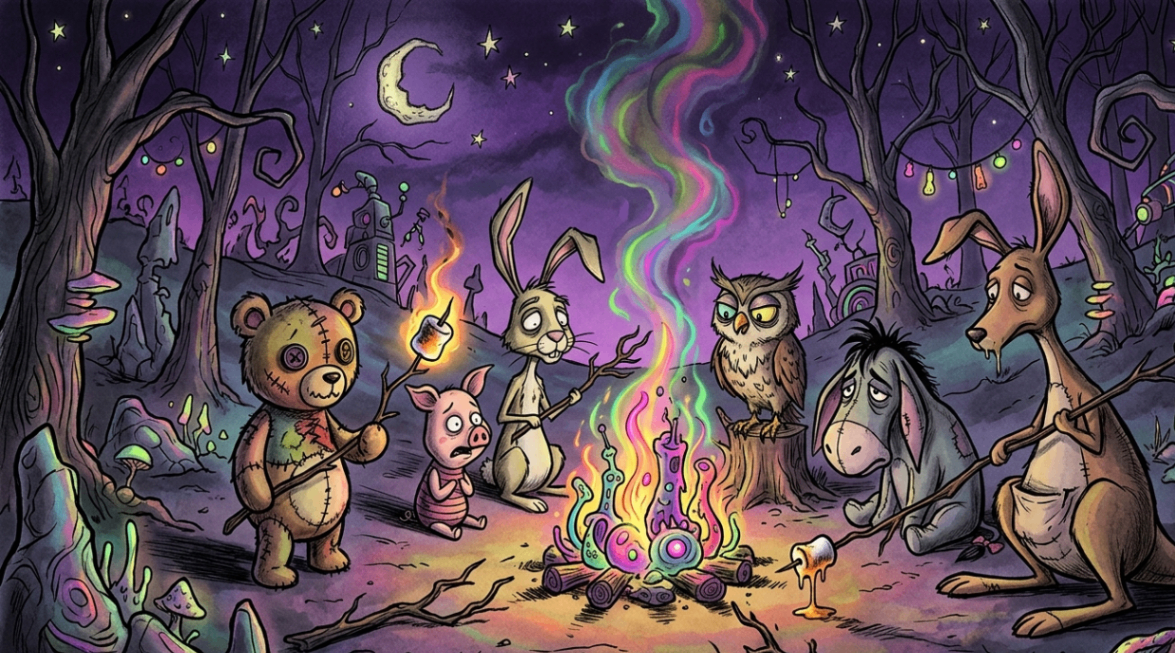
The neon lights of the Hundred Acre Megalopolis did not flicker. Electricity was far too expensive for imprecision. They hummed instead — a low, subsonic drone that vibrated through the damp concrete of the Lower East Side levels like a second pulse, one that belonged to the city and not to the creatures living inside it.
Pooh sat on a rusted fire escape and stared at the smog.
His red shirt — the only one he owned, the one he had always owned — was stained with grease and synthetic honey-substitute, a petroleum byproduct the local plant sold in bulk under the brand name Hunnii™, which contained no actual honey and was not recommended for direct consumption. He’d been eating it anyway for eleven years. The acid reflux had become indistinguishable from hunger, and hunger had become indistinguishable from his general condition of acid reflux.
He cracked open a lukewarm Pabst Blue Ribbon, drank without tasting it, and tried to remember where he’d left his wallet.
His personal filing system for overdrawn credit cards.
He could not remember. He tried to remember where he’d left his vape pen. He could not remember that either.
“Oh, my oh, oh my my um fff . . ,” he said.
There was no whimsy in it. There had not been whimsy in it for a long time. It was the sound a bear makes when he is too exhausted to select the correct word — a verbal placeholder, a shrug given phonetic shape. He sat with it in his mouth for a moment, then let the actual f-word fall out beneath it, quiet and shapeless, the way water finds a crack.
Below him, the ‘forest’ was an archaeological abstraction. Whatever had grown there — and something had, once, before the first towers broke ground and the sky-bridges multiplied, and the acid rain dissolved anything that photosynthesized — was now a memory belonging to those who were themselves mostly d e a d. In its place stood brutalist high-rises the color of old bone and moist cement, their facades stained with decades of particulate matter, their lower windows neo-noir-pigeon-feces art deco.
In the coffin-dimensioned studio of the adjacent building, Piglet was vibrating.
Not with fear — or not with the fear of anything so decipherable as a Heffalump. His nervous system had long since exhausted its capacity for named terrors and now simply ran at hi-voltage, a background hum of cortisol and caffeine pills and, on the nights when caffeine failed, methamphetamine, which worked until it didn’t and then worked in the other direction entirely. He managed three overlapping gig-economy delivery applications simultaneously, a feat that required the kind of sustained attention that was clinically unsustainable but financially necessary.
He was currently composing a formal dispute against a one-star review from a customer who had rated him negatively because, the review stated, the porridge had been delivered with a nervous energy that ruined the overall vibe of the meal.
Piglet stared at this sentence for a long time. Seething.
He did not submit the dispute. His hands were shaking too badly to type.
“Soft-prick-mother-fucker,” he hissed under his breath, the words tasting like copper and stale coffee.
Near midtown, Tigger was not bouncing.
He was pacing the length of a parking structure on the fourteenth floor, his tail snapping behind him like a live wire stripped of its insulation, as he waited to ‘score.’ The bouncing had stopped — he could place it, approximately, to somewhere between a hit-and-run charge that had been quietly settled and a run of losses that had not been settled at all — and what replaced it was this: the pacing, the jaw-grinding, the sensation that everyone around him was moving at the wrong speed, which was to say slower than him, which was to say that they were obstacles.
Annoyingly s l o w obstacles.
He owed money in four directions. His vintage 2024 Range Rover, which he could not afford and could not relinquish because giving it up would mean admitting what he already knew, was scheduled for repossession on a date he kept moving forward in his mind. The wonderful thing about Tiggers, the song had said, was that he was the only one.
This remained true. It had simply come to mean something different.
He tried to compose himself long enough to do a bump. And miraculously he succeeded, providing a much needed but quickly fleeting bounce.
The stairwell door swung open with the particular violence of a hare who had been waiting for a someone to make his day.
Rabbit stepped onto the fire escape landing, clipboard pressed to his chest like a breastplate, and surveyed the railing with the expression of a coney who has found, at last, the confirmation he required. He was the building manager. He had always been the building manager, even before the title existed, even when they were bunnies in a place that was green and the worst thing that could happen was a blustery day. He had a gift for hierarchy — for finding the architecture of a system and inserting himself into its law enforcement — and if the debt he carried privately, the kind not logged on any clipboard, was quietly enormous, that was not relevant to the matter of the trash.
“That fire escape isn’t a lounge,” Rabbit said. “The beer can buildup on your railing is a Tier-1 major violation. Throw that shit in the dumpster!” He did not soften the word that followed. “And tell Gopher to stop tapping the main line. I know he’s down there.”
He always knew who was down there. Knowing things was the only currency he could still reliably produce.
Down in the building’s sub-basement, Gopher had his face in a screen.
He had traded his tunnels for the dark web some years ago, a transition that had been less dramatic than it sounded and more total than he’d intended. A data miner now, or something in the taxonomy adjacent to one, he worked eighteen-hour days in a windowless room that smelled of solder and standing water, hacking into the municipal utility grid with the specific, joyless competence of a rodent who has discovered that his one talent is the only thing standing between eleven citizens and a water shutoff notice issued by a city council that categorized the Lower East Side levels as a rounding error in the annual budget.
His jaw, the original one, had been replaced. The prosthetic worked. He didn’t whistle anymore. Or, for that matter, blow his once perfect rings of smoke after habitually strong tugs of medical sativa.
A metallic thud from the alleyway below — the sound of something heavy settling against something hollow.
Eeyore stood against a dumpster, looking at a pile of discarded circuit boards the way a person looks at a grave that isn’t theirs yet but eventually will be. He had been downsized from the sanitation department a long time ago. Now, and again unemployed. The department’s official position was that his performance metrics had been insufficient; his own position was that he had always known it would end this way, and that being right about it brought no comfort, which he had also always known. And, it didn’t.
He held up a length of frayed CAT6 cable.
“Found a tail,” he said. “Signal’s dead, of course.” He set it back down. “Doesn’t matter.”
He meant the cable. He may have meant more than the cable. He didn’t elaborate, and no one asked.
Kanga came out of the loading dock moving fast, the way she always moved now — head down, bag slung low, the particular economy of motion that belongs to marsupials who have stopped pretending there is time to waste.
The fur along her arms had gone white. Not gray, not pale — white, bleached clean by the industrial solvents at the decontamination center where she worked the overnight rotation, stripping hazardous coatings from salvaged materials in a room with inadequate ventilation, for a wage that covered rent if nothing else went wrong, which things always did.
She carried a bag of black-market inhalers. She did not look at Pooh.
To look at a friend was to acknowledge what you had both become, and what you had both become was not something she could afford to sit with, not tonight, not with the bag heavy in her hand and Roo with her in a broken shopping cart, staring into the cracked screen of an Education-Module tablet, the blue light of it catching in his eyes.
He didn’t know what a tree was.
The module had taught him that he was a citizen of the Megalopolis, and that this was a privilege, and that the Megalopolis protected and provided, and there were assessments on Fridays. He had scored well on the last one. Kanga had not congratulated him. She had held his head against her chest for a long time without speaking, and when she let go she had gone into the bathroom and run the tap and stood there until the sound of it was enough. She had kicked the habit long enough to know it was still a habit.
High above them all, in the glass-and-gilt uppermost floors of the Owl Corporate Tower, the Chief Visionary Officer was dictating the closing chapter of his fourth memoir.
Owl had not been down to the Lower Levels in many years. His understanding of them was theoretical, rendered in the language of systems optimization — friction points, unallocated worker capital, the underperforming quadrant — and delivered at conferences to audiences who nodded with the practiced solemnity of people who charge a great deal to attend. He had introduced a Knowledge Tax eleven months ago: a licensing fee applied to access the municipal information network, the only network, the one through which medical advisories and evacuation notices and utility shutoff warnings were distributed. The lower-income brackets could apply for a waiver. The waiver application was on the network.
He was calling the memoir The Wisdom of the Grind. He previously decided “. . of God” might be a little too on the beak.
He felt this was apt. His mind made. His mind also presently focused on a crypto venture that could bankrupt someone for every dollar earned as he stared at a dead insect outside his bullet proof window, he was willing to crawl through the glass to remove. The Backson could rectify that problem, knowing they could be bought for cheap—albeit unnecessarily unreliable.
The sky-bridge trembled.
Lumpy came through the light slowly, the way large and damaged things often move — with the deliberate patience of someone who no longer needs to hurry because hurrying implies the possibility of being elsewhere. He had been a Heffalump once, which was to say he had been a child once, and the child had been playful in the way of all children who do not yet know what the world intends for them. The world had been clear about its intentions. He had a job now. He was good at it.
He stopped at the railing below Pooh’s fire escape.
He held up a repossession-like notice without ceremony — a single sheet, the kind that arrives with the weight of something that has already been decided.
“Interest rates spiked this morning,” Lumpy said. His voice was very quiet. People with quiet voices rarely needed to raise them. “Christopher Robin sold the block deed to an offshore holding company. Six hours to vacate before the drones come through.” He paused. “Permanent E-V-I-C-T-I-O-N.”
The word settled over the alley the way smog settles — not with violence, but completely, filling the available space.
Pooh looked at the notice. He looked at the sky, where the smog caught the neon and turned it the colour he remembered exhaling chasing the dragon—once, upon a time. He looked for his vape pen again, out of habit, out of the small need to defer even a few seconds the confrontation with what is terrifyingly real.
He did not find it.
He set the empty beer can down on the railing — carefully, as though it mattered where it went — and stood up. Every shift of the last eleven years announced itself in the motion: the lumbar spine, the left knee, the shoulders that had been carrying the same weight for so long they had forgotten what it felt like to carry nothing.
“Well,” said Pooh.
He looked out at the Megalopolis—at the towers and the sky-bridges and the neon that never flickered, at the hum that was not music but had become, through sheer duration, the sound he associated with being alive, and scratched behind his neck.
“I suppose it’s time to skee-uh-daddle-du.”
He didn’t say where. There was nowhere he was thinking of. It was simply the next thing, and for now that would have to be enough.