The Shoe
Mar 2, 2026 · 9 min read
Three days before, he had stood in the main square in Krakow and photographed everything.
The Cloth Hall, the pigeons, the castle on the hill above the city. Poland had given him more than he expected — a country that wore its history openly, in its buildings and its faces. He had watched the Poland Day celebrations from the edge of a crowd, people singing in the square, and felt something close to joy. A people who had been erased from maps, partitioned, consumed by empires on both sides, and were still here. Still loud in their own square. The stoicism in their faces wasn't resignation. It was the look of those who know exactly what survival has cost and have decided to celebrate anyway.
He put his camera away before he went through the gate at Birkenau. He didn't decide to. He just found, as he approached, that reaching for it was impossible.
Photographs don't prepare you for the size of it. He'd read the histories, studied the maps, knew the numbers the way serious students of the war knew them — as facts, carefully retained. Photographs have edges. Birkenau has none. It simply continues. Barracks and wire and more barracks, flattening toward a horizon that seems deliberately far away, as though the place had been designed to make escape unthinkable not through walls but through sheer scale.
He passes through the gate and into the first of the brick blocks.
The corridors are lined with portraits. Prisoners photographed on arrival, heads already shaved, wearing the striped uniform. Hundreds of them, floor to ceiling, each face in a small frame. Most carry the same expression. Resignation is the word that comes to him, though he isn't sure it's right. The look of people who have understood something he hopes never to understand.
He stops at one.
A woman. Head shaved, the way they all are. She is looking directly into the camera with an expression he cannot read and will not stop trying to. Not resigned. Something else. A half smile, or the ghost of one, a quality in her eyes that sits between pride and defiance and something further along than either, somewhere past the point where fear is still relevant. He doesn't know what she was feeling. He doesn't know what the camera cost her, what happened after, whether she survived. He knows only that she looked into the lens of a Nazi camera and gave it that face. Eighty years later he is standing in a corridor in the country where she died and he cannot look away.
Eventually he does.
Outside, the ground is wrong.
He notices it without knowing he notices it. The soil on the road coming in had been the reddish-brown of Polish farmland. Here it is grey. Pale and faintly powdery, different from any ground he has walked on.
The morning her mother tied her laces, Marta was thinking about the river.
Not the journey, not the cases packed in the hallway. The river at home, and whether it would still be there when they came back. Whether the small brown fish that gathered near the stepping stones would remember the bread she threw them. Whether fish remembered anything at all.
Her mother had already brushed her hair. This was the order of things — hair first, then shoes, then you were ready. The brush moved in long strokes from the crown down, her mother's hand following to smooth what the brush left. Marta's hair was blonde and long and her mother always counted the strokes under her breath, which Marta found both embarrassing and necessary, because if she stopped counting something would be wrong.
One hundred strokes. Then the laces.
Mama, do fish remember?
Her mother's hands paused on the laces. Just for a moment. Then continued, pulling them snug the way she always did, tight enough to hold, not tight enough to hurt.
I expect so, her mother said. I expect they remember the important things.
The shoes were brown leather, worn at the toes, shaped by a year of wear to the particular geography of Marta's feet. Her mother had packed a newer pair in the case. These were for travelling in. Comfortable. Known.
She was nine years old. She was thinking about fish.
There is a system to the museum buildings, a sequence the curators have designed with care. He follows it without deciding to, moving with the other visitors in something that isn't quite a crowd. People don't speak much. When they do it's quietly, and brief.
Between buildings he steps outside and sees a woman holding her phone up at the old cattle car near the tracks, adjusting her angle, checking the screen. A man beside her waits. He watches for a moment and feels something he can't name — not anger, not judgment. A bewilderment at the distance between where she is standing and what she is doing. He doesn't know how a person stands in this place and thinks about their own face.
Back inside.
The suitcases. Names written on them in chalk or paint, the owners told to mark them clearly for retrieval. He reads a few names. The brushes and combs. Personal things, the kind of objects that live in the backs of drawers for decades, unremarkable until they're here, behind glass, monumental in their ordinariness.
Then a room he was not ready for.
The hair is behind a long window, piled in a single mass. Tonnes of it, the placard says. He stands in front of it and his mind tries to do what it does with the numbers — file it, retain it as fact. It won't. The suitcases, the brushes, the shoes — those are things people had. This is something people were.
He stands there until he can move again.
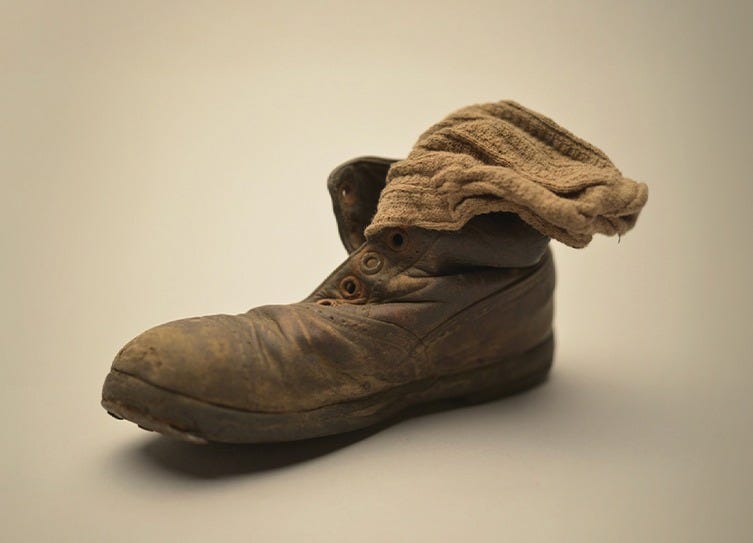
The shoes are floor to ceiling behind a long window. Thousands pressed together, a landscape of them, every size and shape and degree of wear. His eye moves across them the way it moves across any overwhelming thing, looking for somewhere to rest. It finds a child's shoe near the middle of the pile. Brown leather. Small. The toe worn pale where it met the ground with every step, the leather creased and shaped by a foot that is not here.
He looks at it for a long time.
There is nothing else to do.
On the train Marta counted telegraph poles.
This was a game from other journeys, long ones going to visit her grandmother, the train rocking through flat countryside while her father read and her mother slept. You counted until you lost count, then started again. The poles came in rhythms, faster through open fields, slower near towns.
Her father wasn't here. He had gone ahead, her mother said. They would meet him there.
She counted poles. She lost count. She started again.
For a while she pressed her face to a gap in the boards where the light came through in a thin line, and watched the countryside go by in strips. Fields. A road. The grey blur of a town. Her hair fell forward toward the slat and the movement of the train lifted it slightly, and she felt it rise and settle, rise and settle. Blonde and loose and still hers. Her mother said nothing about this, which meant her mother was not watching, which meant her mother was somewhere Marta couldn't follow.
At some point the train stopped being ordinary. She couldn't have said when. The light changed, or the sound of the other passengers changed, a new kind of quiet settling over the carriage. Her mother's hand found hers and held it, not the casual touch of someone reaching out but the grip of someone holding on.
Are we nearly there?
Nearly, her mother said.
Outside the strips of light continued. Flat and grey and going on.
Afterwards she kept touching it.
Her hand would go up on its own, the way your tongue finds a gap where a tooth has been. The same motion her mother made with the brush, crown to nape, but there was nothing to smooth. Just the strange new geography of her own skull. Soft, almost. Like the skin on the inside of a wrist. Like suede.
She didn't cry about it. There were other things to feel and perhaps there was only so much room.
She thought: when it grows back I will let Mama count the strokes again.
She thought: one hundred.
The ground here was grey. Dusty and grey. She filed it away beside the bread and the fish and her mother's grip on the train.
Then she walked where she was directed to walk, because she was nine years old and that is what you do.
He comes out of the museum buildings and the weight of the place settles on him properly.
It's physical. He'd expected grief, or the particular solemnity of memorial sites. This is different. A heaviness in the chest and shoulders, the air thicker than it should be. An hour inside and the objects and the numbers and the placards with their careful language have accumulated somewhere in his body without his knowing.
Beyond the barracks, beyond the main structures, open ground. A path toward a clearing. Water in the distance, glinting, still and green in the afternoon light.
He goes toward it.
The path takes him past the ruins of the crematoria, great collapsed slabs of concrete, the rubble of something the retreating SS tried and failed to fully erase. Beyond them the ground opens up.
The pond is small. Green with algae, still, the sky broken up in reflection between the weed. Trees around the edges. Quiet.
He stops at the edge and breathes.
For a moment it almost works. The trees, the water, the relative openness. A fraction of something like relief.
The feeling comes before he understands it. Heavy. Heavier than anywhere in the camp, heavier than the hair room, heavier than the suitcases with the names chalked on them. It moves through him in waves and he has no word for it and no explanation.
He was not a sentimental man. He stood at the edge of the water and sobbed. Ragged, sourceless grief for people he had never known, who had been dead for half a century before he was born.
Eventually he turns and reads the placard.
The last thing Marta thought about, in the ordinary way thoughts arrive without invitation, was the bread.
She had left it on the kitchen table. Wrapped in cloth, the good bread with seeds in it. She had been looking forward to eating it on the journey.
Her mother was not beside her. There had been a separation she hadn't fully understood, a direction given, a movement of people, her mother's hand suddenly not there.
She thought: I forgot the bread.
She thought: I'll tell Mama when I see her.
She was still wearing her travelling shoes. The comfortable ones. Brown leather, worn at the toes. The new pair was in the case. Papa had gone ahead — perhaps the case was with him already, waiting, wherever they were meeting. Perhaps he had the shoes.
She thought: one hundred.
Ash pond, the placard says. Into this pond were deposited the ashes of tens of thousands of victims.
He reads it twice.
He is very still.
After a while a slower thought arrives, the kind that comes when the mind has been circling something without knowing it. The colour of the ground since the gate. That grey cast he noticed and filed away. Pale and powdery and nothing like the soil on the road coming in. He had read, somewhere in the histories, that the SS strewed the ash deliberately across the grounds. That it was the ash that turned the earth grey. That visitors had pushed their hands into the soil and found it was not soil at all, several inches deep, threaded through with roots.
He thinks about where he has walked since the gate.
He looks down at his feet.
He thinks about the shoe in the display case. The worn leather toe. The creased shape of a foot that is not here.
The water is still and green. The sky is the same sky it has always been.
He came here looking for air.
He is standing in the ash. He has been standing in it since the gate.
He is still there when the light begins to change.
The other visitors have gone. He is alone at the edge of the water and he cannot think of a reason to move his feet.
He came to Krakow with his camera and photographed everything. The castle, the square, the faces of a people celebrating their survival. Three days later he is standing in what survival cost. The same soil. The same country. The same grey sky.
He stands there.
Inventory — Transport 842 Processing date: [date]
Item 847: Child's shoes, leather, brown. Size approx. 32. Condition: worn. Toe area scuffed. Interior shaped by wear.
Item 848: —
Reference: Subject 4291-F. Age: approx. 9 years. Non-viable for labour assignment.
Disposition: Standard.
Items 847–848: Warehouse 'Canada.' Catalogue and hold for shipment.