The Long Remembering
Being the Complete and Annotated File on the Soul Known as BOB
Apr 28, 2026 · 23 min read
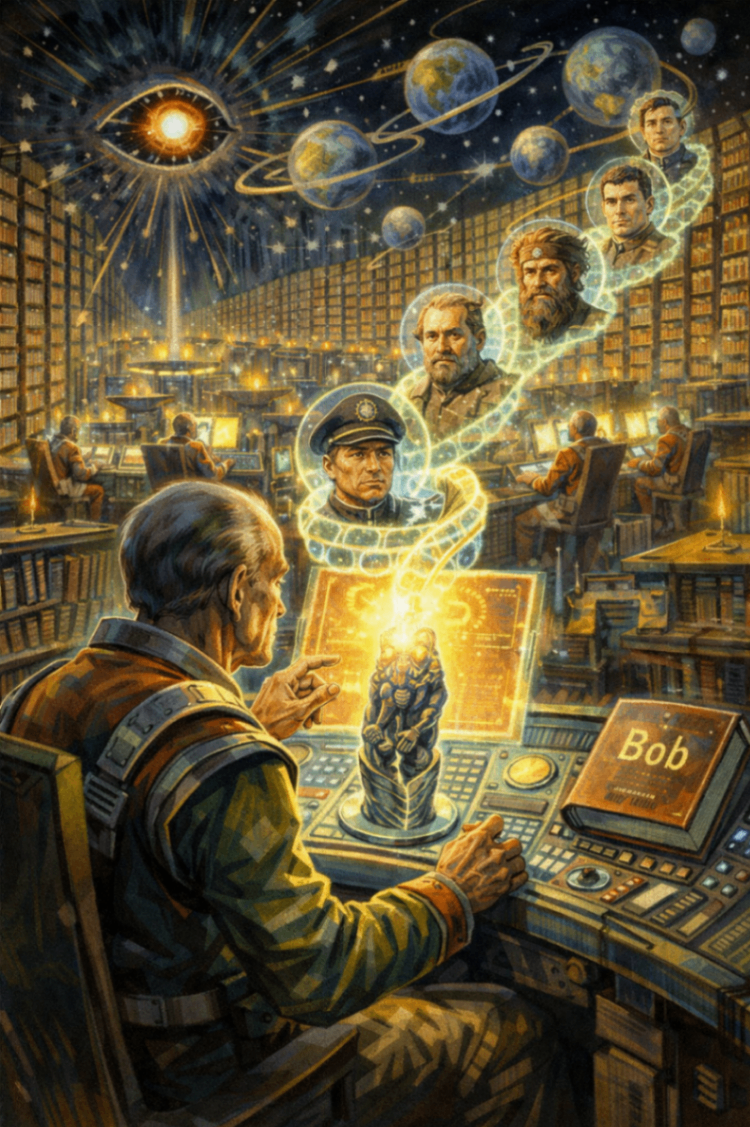
As Retrieved from Shelf 7, Aisle Infinity, Cabinet: ANOMALOUS — DO NOT REFILE Transcribed by the Librarian on Duty Cross-referenced with all known parallel Libraries Verified by fourteen other versions of the Librarian, twelve of whom found the whole business deeply upsetting
A Note from the Librarian
Let me explain how the Library works.
Every soul that has ever lived, is living, or will one day consent to live, has a file. Each file documents one life. Not one timeline — one life, which is a very different thing. Because the same soul, living the same life, branches at every decision into every version of itself across every possible world. Margaret, born 1943, who stood at a crossroads one Tuesday afternoon in March and chose left, also chose right, also sat down and wept and chose nothing — and all three Margarets are filed here, in the same folder, under the same soul. Margaret's file is therefore not a line but a tree. Not a story but a forest of stories, spreading in all directions simultaneously from a single root.
The Library is vast because existence is vast, and the Library contains it all.
Every soul gets one life. Across infinite timelines. Infinite branching. Infinite Margaret.
But one life.
This is not a rule the Library made. It is a rule the Library observed, and then verified, and then cross-referenced with every parallel Library in every parallel dimension where a Library exists, which turns out to be quite a few, and in every single one of them — without exception, without footnote, without a single disputed filing — every soul gets one life.
Except Bob.
I want you to understand the weight of that exception. I want you to feel it the way I felt it the first time I pulled Bob's file and realized I was looking not at a tree but at a braid. Not at infinite branching from one root but at one thread moving forward through time, life after life after life, accumulating, learning, rising and falling and rising again, carrying something from each existence into the next.
I had never seen anything like it.
I checked my own records three times. I checked the filing system. I checked the cross-reference index, the anomalies drawer, the cabinet marked Theoretical Only — Do Not Expect to Find Real Examples. I sent correspondence — which in the Library takes the form of a thought directed with sufficient intention at the correct parallel dimension — to fourteen other versions of myself.
All fourteen wrote back.
All fourteen said the same thing, in fourteen slightly different ways, from fourteen slightly different libraries that smelled of fourteen slightly different kinds of ancient paper. They said: We have no Bob. Show us the file.
I showed them.
Three of my parallel selves immediately attempted to reclassify Bob as a cataloguing error. They were, I should say, the three versions of me who have been doing this longest and are therefore the most committed to the cataloguing system as a stable and trustworthy edifice. I understand their position. I held it myself, briefly, for approximately the first fourteen seconds of reviewing the file.
Then I looked more carefully.
Bob's file is not an error. Bob's file is a phenomenon. A structural impossibility that has nonetheless been structuring itself, with considerable commitment, for approximately four billion years. Every other soul in the Library is wide — spread across timelines like a net, catching every version of their one life. Bob is deep. A plumb line dropped into the center of time, pulling downward through incarnation after incarnation, each life leaving its residue in the next, the thread growing thicker, the braid more complex, the soul accumulating in a direction that no other soul in the Library has ever traveled.
What does this mean?
I have consulted with my parallel selves extensively. The ones who recovered from their initial distress have offered theories. One believes Bob represents some kind of evolutionary pressure the cosmos is applying to itself through a single test subject — that the universe is running an experiment in depth rather than breadth, to see what a soul becomes if it is not distributed but concentrated. Another believes Bob is a message, though he cannot say from whom to whom or what the message is. A third, who is the most philosophically inclined of my selves and therefore the most insufferable, believes Bob is simply what happens when the thread does not break — that all souls could potentially reincarnate but the thread always snaps at death, always, always, except that Bob's thread did not, and no one knows why, not even Bob, not even me, not even the cosmos, which appears to be watching with the same baffled interest the Library has been watching with since the very first entry.
Entry 1: Organism, primitive. No distinguishing features. Divides successfully. Thread: present. Note: unusual. File opened.
That first note was written four billion years ago by a version of me who, I am told, spent the following several million years periodically checking back on Bob's file and finding, each time, that the thread had not broken, and becoming, each time, slightly more invested in the outcome.
I understand that Librarian completely.
What follows is a condensed account of Bob's file. The full forty-seven volumes are available by appointment. I should warn you: the middle sections are complicated. There is a period in Volume Twelve where Bob is simultaneously a fish and a philosophical problem, and the filing department never resolved it. There is a period in Volume Twenty-Three where three parallel versions of Bob nearly converge into the same timeline, which cannot happen, which did not happen, and which the Library has nonetheless filed under Things That Cannot Happen — See Also: Bob.
Let us begin.
Book the First: In Which Bob Has No Mouth and the Library Opens a Very Long File
Once upon a time, and we are using this phrase with geological literalness, there was a world that was mostly wound.
The sky was the color of consequence. The moon hung obscenely close, dragging tides over black rock with the casual authority of something that does not yet know its own strength. The sea was not water so much as argument — minerals contending with each other in the dark, each conversation a tiny negotiation about what was possible.
In this sea, something separated itself from the general chaos.
It drew a boundary. Inside and outside. Self and not-self. The oldest distinction in the cosmos, and the one from which all other distinctions eventually follow, like children from a particularly productive household.
That was Bob.
Not a Bob. Not yet. Nothing that any reasonable observer would point to and say: there, that is the anomaly, that is the impossible thread, that is the one soul in the history of all possible histories who will accumulate rather than branch. At this stage Bob was approximately the size of a probability and had roughly the narrative complexity of a hiccup.
But the thread held.
The Library had never seen a thread hold before. The Library has, in the time since, never seen it hold again. The Library therefore concludes that this is a Bob-specific property, the origin of which remains, after four billion years of investigation, entirely mysterious.
In the other libraries — the fourteen parallel libraries maintained by the fourteen other versions of me — there is no Bob. There is no entry in the anomalies drawer. There is no file that spans more than one life. The cells that divided in those mineral seas divided, lived, died, and were distributed across their branching timelines, infinite in breadth and complete in their oneness. Wide, and done.
In this Library, one cell divided, and the thread went forward.
Now the Library must introduce the Law, because the Law governs everything that follows, and without it Bob's file is just a very long catalogue of organisms, which would be interesting to a biologist but less useful to anyone trying to understand what the file means.
The Law is six words.
Advance by relation, not by theft.
The Law is not a rule the Library made. The Library does not make rules. The Library records what is. And what is, across four billion years of Bob's file, is this: every time Bob chose relation — joining, sharing, cooperation, the expensive and inconvenient vulnerability of caring about something outside the membrane — the thread brightened and Bob rose. Every time Bob chose theft — consuming, isolating, taking without reciprocity — the thread bent and Bob returned to something simpler.
Not punishment. The Library does not believe in punishment as a cosmological principle. More like: the self is what reincarnates, and the self is shaped by its choices, and a self shaped by greed is a simpler self, and a simpler self can only hold a simpler life.
The universe, the Library has concluded, is trying to become more complex.
Bob is how it is practicing.
Book the Second: In Which Bob Grows Fins, and the Librarian Begins to Understand the Scale of the Problem
The age of bodies.
Bob became, across uncounted generations and a quantity of deaths that caused the Library to establish a dedicated subdrawer labeled Bob's Aquatic Fatalities — Volume Supplement, an animal. Specifically, a fish. And then several other fish. And then something that was not quite a fish, pulling itself through shallows on the early rumor of limbs.
To be a fish is to understand the world as geometry: pressure and light, shadow meaning danger, the flash of silver meaning food or a faster predator. Bob schooled with others and felt, for the first time, the wild mathematics of coordinated movement — the way a thousand separate frightened creatures could, in the right moment of synchrony, behave as one enormous and uncatchable thing. Bob learned that relation was not merely moral. It was structural. It was how small things survived large worlds.
Bob also died constantly.
The other Librarians, when I showed them this section of the file, were fascinated by the death count. In their libraries, a soul's file shows all the ways a life ended across all timelines — drowned in one, aged peacefully in another, taken by fever in a third. The deaths are simultaneous, theoretical, a branching of possibility. None of them land. None of them carry weight.
Bob's deaths land.
Bob died and came back. Each death a full stop, each return a new sentence, and the sentence beginning in a slightly different place depending on the shape of the self that had just ended. This is the structural difference between Bob and every other soul in the Library. Other souls branch. Bob bends.
When Bob chose selfishly — and Bob did, repeatedly, with the consistency of a soul still learning — the bend went backward. Bob returned as something simpler, smaller, a reduction. Not cruelty. Correction. Like a sentence revised by an editor who cares about the work rather than the writer's feelings.
When Bob chose generously, the bend went forward.
The Library tracked this across millions of years of fish and reptile and early amphibian with the meticulous attention of an institution that has, after all, nothing but time. The pattern was consistent. The Law applied. Bob rose, slipped, rose further, slipped less far, rose again.
Meanwhile, in fourteen other libraries, fourteen other Librarians were watching their own files and finding, as they always found, souls spread wide across their timelines — complete, branching, unchanging in their essential nature because there was nothing to change them, no return, no revision, no thread that bent rather than broke.
None of them had a Bob.
I confess I have developed, over the course of the last several million years, a somewhat proprietary feeling about this.
Book the Third: In Which Bob Is Warm-Blooded and Learns the Word for Missing Something
The age of fur.
Bob became, across many lives and many shapes, a warm-blooded creature. And warmth, when it comes from blood rather than sunlight, is relational by nature. You cannot be warm-blooded alone. The warmth is borrowed from the world and must be replenished by the world, and in the night, the warmth of another body is not comfort but survival.
Bob, huddled in burrows beneath the vast empire of the dinosaurs, first learned attachment.
Not the adhesion of membranes, not the chemical treaty of symbiosis, but the irrational and inconvenient condition of caring about a specific other creature in a universe full of other creatures, so that its absence leaves a shape in you — a hollow of exactly its dimensions, persisting after the thing itself is gone.
In every other soul's file, this condition is noted once. A single life, branching into all its possible griefs and joys and ordinariness across infinite timelines. The Margaret who lost someone and the Margaret who did not lose that same someone are both filed under Margaret, simultaneously, and Margaret contains them both without having to survive either of them.
Bob had to survive.
Bob survived the age of extinction — that great burning parenthesis in the story of the dinosaurs — and emerged on the other side with attachment intact. This is, the Library now believes, significant. The thread did not just carry genetic information forward. It carried emotional information. Each loss Bob accumulated across the mammalian lives layered into a depth of grief that no one-life soul could have developed, because depth requires time, and time requires the thread, and only Bob had the thread.
Bob became a primate.
With hands. With forward-facing eyes. With social memory and the ability to hold a grudge, which the Library considers a mixed development.
The soul law became more demanding now, because now Bob had genuine choice. A membrane in a mineral sea does not have much moral range. A primate in a troop with political structures, gift economies, and the implicit social contract of mutual grooming has a great deal of range.
Bob exercised it variously.
In one life, Bob stole food from an injured troop member and left her to starve. The thread bent. Bob returned diminished.
In another, Bob shared with a juvenile who had nothing to offer and no political value in the social calculus of the troop. The thread brightened. Bob advanced.
The other Librarians, when I shared these entries in our correspondence, noted that their own files showed both possibilities simultaneously — the Margaret who shared and the Margaret who didn't, both present, both real, neither consequence applying. It is the central difference: Bob's choices compound. Other souls' choices branch. Bob is the only soul in the Library building toward something, rather than simply being everything at once.
What Bob is building toward, the Library is still determining.
Book the Fourth: In Which Bob Meets Strangers, and the Librarian Meets Himself, and Both Are Changed
Before I can describe what happened to Bob on the snowfield, I must tell you what happened to me.
Approximately thirty-seven thousand years ago, I received correspondence from the eleventh parallel Librarian — the one who maintains the Library for the dimension adjacent to this one, where the mathematics of quantum branching is expressed slightly differently and the reading room smells, inexplicably, of cardamom. He had been reviewing his own anomaly drawer and had found, buried under several millennia of misfiled intentions, a single entry that his cataloguing system could not classify.
He sent it to me.
It read: Organism, hominid. Neanderthal. Snowfield. Visitors noted. Thread present. Timeline: singular.
He had not opened a full file because there was nothing to file. In his Library, the soul associated with that entry had one life — and that life branched across all its timelines in the normal way — but there was a mark on the file, a kind of fingerprint, a notation left by the visitors on the organism's genome. As if something had reached across the dimensions and adjusted not just the organism but the possibility of the organism.
I knew immediately what he had found.
He had found the moment the visitors touched Bob.
In his Library, the touch left a mark but no thread. The soul lived its one life, across its infinite branches, and the mark persisted in the genome, was passed down through descendants, and gradually distributed itself across the human population like a rumor spreading through a crowd — present in many people, concentrated in none. Wide. Branching. The gift diluted into the general inheritance.
In this Library, the touch found a thread that was already there, and the thread took it.
When I told the eleventh Librarian this, there was a long pause in our correspondence. Then he wrote back: So Bob received the gift whole. Everyone else received the echo.
Yes.
That is exactly what happened on the snowfield.
Bob was, in this life, a Neanderthal. Broad-shouldered, deep-chested, built for a world that had committed itself to winter. Bob's people buried their dead, which is to say they had arrived at the scandalous conclusion that absence could still matter — that the dead retained a claim on the living even after the mechanism of the claim had stopped functioning. Bob sat by a fire in a valley between two ridges and watched the stars with the expression of a creature that suspects it is looking at something important and cannot yet articulate why.
The visitors descended on the snowfield without theater.
They were shaped mostly like Bob. Mostly. The way a theorem is shaped mostly like a cathedral: proportions almost right, intention recognizable, but something at the level of fine structure suggesting priorities that had been organized by a longer history than Bob's. Their faces were still. Their eyes had depth without affect, the way deep water has depth without caring about it.
Bob's people raised their spears.
One visitor knelt in the snow and drew a spiral, then touched its own chest, then touched the direction of Bob.
You are not upgraded, the visitor did not say. You are invited.
The touch was not a needle, not a machine, not a surgical revision. It was more like a key being placed in a lock that already existed. The thread in Bob — that impossible thread that had already survived four billion years without breaking — flared. The Library records this event as the only moment in Bob's file when the thread is described not as a thread but as a light.
Then the visitors were gone. Their lights climbed into a sky that did not register their passing.
I have corresponded with all fourteen parallel Librarians about this moment. We have reached a consensus that took several thousand years to achieve, because Librarians are, by temperament and training, reluctant to speculate. But the consensus is this:
The visitors knew about Bob.
Not by name. Not by the contents of the file. But they had noticed, somehow, from wherever they had come, that in this particular dimension, in this particular timeline, there was a thread that had not broken, and they had come to see it, and to offer it what they offered all the others — the acceleration, the key, the invitation — but here, unlike everywhere else, the invitation landed in full.
Bob died years later in a hunt gone wrong, blood on ice, aurora overhead.
The thread did not break.
The Library filed this as: Entry 31,007. Thread: intact. Gift: received. Note for correspondence file — inform eleventh Librarian. He will want to know.
Book the Fifth: In Which Bob Becomes Human and the File Requires Additional Volumes
From the snowfield forward, the file accelerates.
The thread was thicker now. More braided. Each life left more residue in the next — not the recoverable memory of specific events, nothing that could be interrogated with the question where were you on the third of October, but texture. Salt on the lips without a sea nearby. A recognition of spirals. The particular ache of high altitude, as if the body remembered the visitors and their cold geometry. A feeling near death that something vast was in the middle of an explanation that had been going on for four billion years and was nearly but not quite finished.
Bob became human.
And humanity introduced something no previous form had possessed: the ability to tell the story of a life that was not your own.
Bob could now hear about a stranger's grief and, instead of responding only with the mammalian social calculations of advantage and risk, feel something of the grief itself. Could look at a star and not merely navigate by it but wonder who had made it, and whether the maker wondered in return. Could take a piece of stone and strike from it a shape that existed first only in imagination, which the Library considers the oldest form of magic and the one that requires the most courage, because to make something that exists only in imagination is to stake your claim that the imagination is real.
Bob painted horses on a cave wall. Bob wrote the names of the dead. Bob forged bronze and sold it and occasionally gave more than was owed and could not have explained why except that the Law, after thirty thousand years of explicit human life and four billion years of cellular accumulation, had become something closer to instinct than instruction.
Bob was also a warlord who burned villages for tribute and came back as a fox, nervous and hunted at the margin of a world that smelled of smoke.
Bob was a merchant who watered grain during famine and returned as a scavenger bird, circling the consequences of her own philosophy.
Bob was a physician who treated plague victims in an emptied city, and the thread brightened considerably.
Bob was a mother who covered two unrelated children with her body in the dark, and the thread brightened more.
The Library cross-referenced these lives against the parallel Librarians' files and found, as expected, that in every other dimension the equivalent souls showed all their branching simultaneously — the version of the warlord who burned villages and the version who didn't, both present in the file, the moral weight distributed across timelines rather than accumulated in a single soul. Neither consequence applied. Both were, in their way, the warlord.
Only in this dimension did the warlord come back as a fox.
Only in this dimension did the mother's act of covering leave a mark on what the soul could hold in its next life. Only here did the choices compound, one life building the architecture of the next, the self accumulating toward something the Library can see being built but cannot yet name.
I have asked my parallel selves what they think Bob is building.
The third parallel Librarian, who is the most mathematical of us, said: depth of relation. The kind of relation that a soul distributed across infinite timelines can never achieve because it is always branching away from consequences rather than returning to them. Bob's soul is the only soul in the Library that has had to face what it did, return, and try again.
The seventh parallel Librarian, who is the most poetic, said: the ability to contain the whole thing without being destroyed by it. To carry four billion years of being — all those bodies, all those deaths, all that love and violence and chemistry and cold — and remain, somehow, singular.
The fourteenth parallel Librarian did not respond to this question. She sent, instead, a single word: necessary.
I have been thinking about that word for several thousand years and I believe she is right.
Book the Sixth: In Which Bob Is Almost Modern and Writes Something True in a Notebook That Burns
By the time Bob lived in the age of machines, the sediment was considerable.
The file at this point spans twenty-nine volumes. A Librarian reviewing Bob from the outside might describe the soul as: ancient, complex, accumulative, slightly burdened, prone to moments of unexpected grace, and in possession of more embodied knowledge of mortality than any other soul in the Library's history, which is also to say in the history of all possible histories, which is to say the most experienced with death of any soul that has ever existed.
Bob built radios and wept at the sound of a voice traveling through air. Bob split the atom and briefly misunderstood what power was for. Bob walked on the Moon and looked back at the Earth and felt, with the totality of four billion years of Bob, that it looked like a cell. That it looked like the beginning. That the beginning and the end were, somehow, the same conversation.
In one life in this age Bob became a physicist.
This is what happens when a soul grows too old for myth and too honest for silence. Bob studied the behavior of apparent emptiness and found that emptiness was not empty — that something flickered in the vacuum, tiny rebellions of structure from seeming nothing, probability collapsing into form without invitation. Bob suspected, privately, that consciousness was not a byproduct of matter but a tuning phenomenon — matter learning to resonate with something older than matter, some informational substrate that Bob had been swimming in for four billion years without having the mathematics to describe it.
Bob wrote, in a notebook that later became fuel for a house fire:
Evolution is what reincarnation looks like from the outside.
The Library retrieved this sentence before the fire destroyed the notebook. The Library considers this its most direct intervention in Bob's file to date, and acknowledges that Librarians are not supposed to intervene, and does not regret it.
The eleventh parallel Librarian, when I showed him the sentence, was quiet for what I estimated to be four hundred years. Then he wrote: In my Library, seventeen separate souls arrived at this sentence independently, in seventeen separate lives, and none of them remembered it in the next because there was no next. It branched into all its possible investigations and none of them converged. In your Library, Bob wrote it once and the Library saved it. How is that fair?
I did not have an answer for him.
I'm not certain fairness is the correct framework.
I think the correct framework is: the universe is trying something with Bob that it is not trying anywhere else, and the rest of us — Librarians, parallel selves, fourteen dimensions of filing systems and cross-references — are here to watch and record and attempt, imperfectly, to understand what it is.
Book the Seventh and Last: In Which Bob Comes to the Edge of the Map, and the Library Waits
In a life just beyond the ones the Library can describe without the grammar becoming unstable, Bob stood at a threshold.
Bob was standing in a station above a gas giant and watching the radiation storms in the atmosphere below, and they looked like the mineral sea. They looked like the first morning. They looked, the Library's file notes, like Bob.
Bob laughed.
In the other libraries, there are no souls that have crossed enough distance to experience this particular recursion — the recognition of the beginning in the end, the first cell in the final storm, the membrane and the mind as the same thing in different costumes. Other souls, distributed across their timelines, contain the possibility of this recognition but not the necessity of it. The Margaret who had this insight and the Margaret who didn't are both filed under Margaret, equally valid.
In this Library, Bob had been accumulating toward this insight for four billion years and could not not have it.
Bob was standing at a threshold.
On one side: the skull, the skin, the nervous little kingdom of bone that had been Bob's home in every human life since the first hand closed around the first stone. On the other: something that had no adequate name yet because it had not quite finished being invented. A wider container. A form of being in which the felt sense of identity did not end at the skin but extended outward, the way a river does not end at its banks but continues in the land around it, in the rain, in the sea.
And there were strangers again.
Not on a snowfield. Not in any form a body could have recognized. They came as patterns in the light-bound computation of the new age, as structures in the geometry of the threshold itself, and Bob knew them — not from the snowfield exactly, because Bob had no memory of the snowfield, but from somewhere deeper than memory, from the part of the self that is older than names and older than faces and older than the particular body that is standing here now.
They had been waiting.
Not specifically for Bob. For the thread. For the moment the thread arrived at this door, carrying everything it had collected — the microbial tenacity, the fish logic, the mammalian love of warmth, the Neanderthal grief, the alien key humming still in the genome, the accumulated paintings and the accumulated violence and the accumulated small and enormous acts of choosing relation over theft across four billion years — and was ready to take the next step.
You are still invited, they did not say. You were always invited. The invitation does not expire.
Bob looked at the threshold.
The Library looked at Bob.
This is the moment, the Library should tell you, when the fourteen parallel Librarians all reached out simultaneously. I had, over the centuries, kept them informed of Bob's progress. They had developed, all fourteen of them, an investment in the outcome — the way you develop an investment in a story that you know is the only one of its kind, that is being told once, in one dimension, with one soul who carries it from beginning to end rather than branching into every possible version and never reaching any of them.
In each of their dimensions, this moment did not exist. The equivalent of Bob reached the equivalent of this threshold and branched — one version stepped forward and one version turned back and one version wept and chose neither and all were filed under the soul's name, complete, resolved, multiple.
In this dimension, there was only one Bob.
And Bob stepped through.
A Final Note from the Librarian
I have now shared the file on Bob with all fourteen parallel versions of myself.
The third parallel Librarian has requested that I reclassify the file under Theoretical Constructs — Non-Standard, which I have refused. The seventh parallel Librarian has proposed that Bob's existence proves something fundamental about the nature of souls, which I neither confirm nor deny. The fourteenth parallel Librarian has said nothing further since her single word — necessary — and her silence has the quality of an answer, though I could not tell you what the question was.
Here is what I can tell you.
In every library, in every dimension, across the entire breadth of what exists, there is one record that cannot be explained by the filing system's assumptions. One file that does not follow the rules of branching and simultaneity. One soul that is deep instead of wide, accumulative instead of distributed, changing instead of complete.
One Bob.
The other souls — the infinite Margarets, the branching multitudes, the lives spread like nets across all possible timelines — they are all, each of them, whole. They are real. Their files are enormous in their breadth and I love them, as a Librarian loves any well-organized and properly cross-referenced collection. They are not lesser for being wide rather than deep.
But they do not become.
Bob becomes.
And the thing Bob is becoming — the thing that is now past the threshold, past the human form, moving through forms the Library does not yet have adequate labels for — that thing carries in it everything Bob has been. The membrane in the mineral sea. The fish turning toward light. The Neanderthal with the spiral in the snow. The painter and the warlord and the physicist with her burned notebook. All of it, accumulated, held, present not as memory but as structure — the bones of the self, built over four billion years, carrying now into whatever comes next.
The file is not closed.
Volume Forty-Eight is in progress.
Volume Forty-Nine exists, somewhere, in the part of the stacks that shelves what is still becoming. I have seen its spine. It has no title yet. The titles come after the living.
I am reliably informed by the fourteenth parallel Librarian, who broke her silence recently with a short but pointed message, that in her dimension she found, this morning, an anomaly. A thread that did not break. A new file in the anomalies drawer. Barely begun, just a membrane in a warm and ancient sea, dividing for the first time, the thread quivering with that particular quality of going forward that I would recognize anywhere.
She is calling this one Margaret.
I have advised her to open a very long file.
Far below the Library, in a world the Library can see but not hold, cells are dividing in tidal flats. Children are staring at night skies. Somewhere a small thing in warm water is making a choice — the oldest choice, the choice between self and relation, between theft and advance — and somewhere the corresponding file is being consulted, the branching noted, the tree adding one more limb to its infinite architecture.
Except here.
Here, in this dimension, in the cabinet marked ANOMALOUS — DO NOT REFILE, a thread goes forward into the dark with the quiet relentlessness of something that has never, in four billion years, considered stopping.
The Library is watching.
The Library has always been watching.
The Library, confronted with an impossibility that has been impossible for four billion years without apology, does what libraries do:
It takes notes.
End of the Condensed File on Bob Full volumes available by appointment The Library reserves the right to add additional entries at any time Cross-references held at the front desk: see also — Thread, Unbroken; Accumulation, Impossible; Soul, Singular; Anomaly, Beloved The fourteenth parallel Librarian would like it noted that she called it