The Intimacy of Journalling
On keeping a journal, consistent journalling, a 'journal orbit', and getting to know yourself more intimately.
Feb 27, 2026 · 5 min read
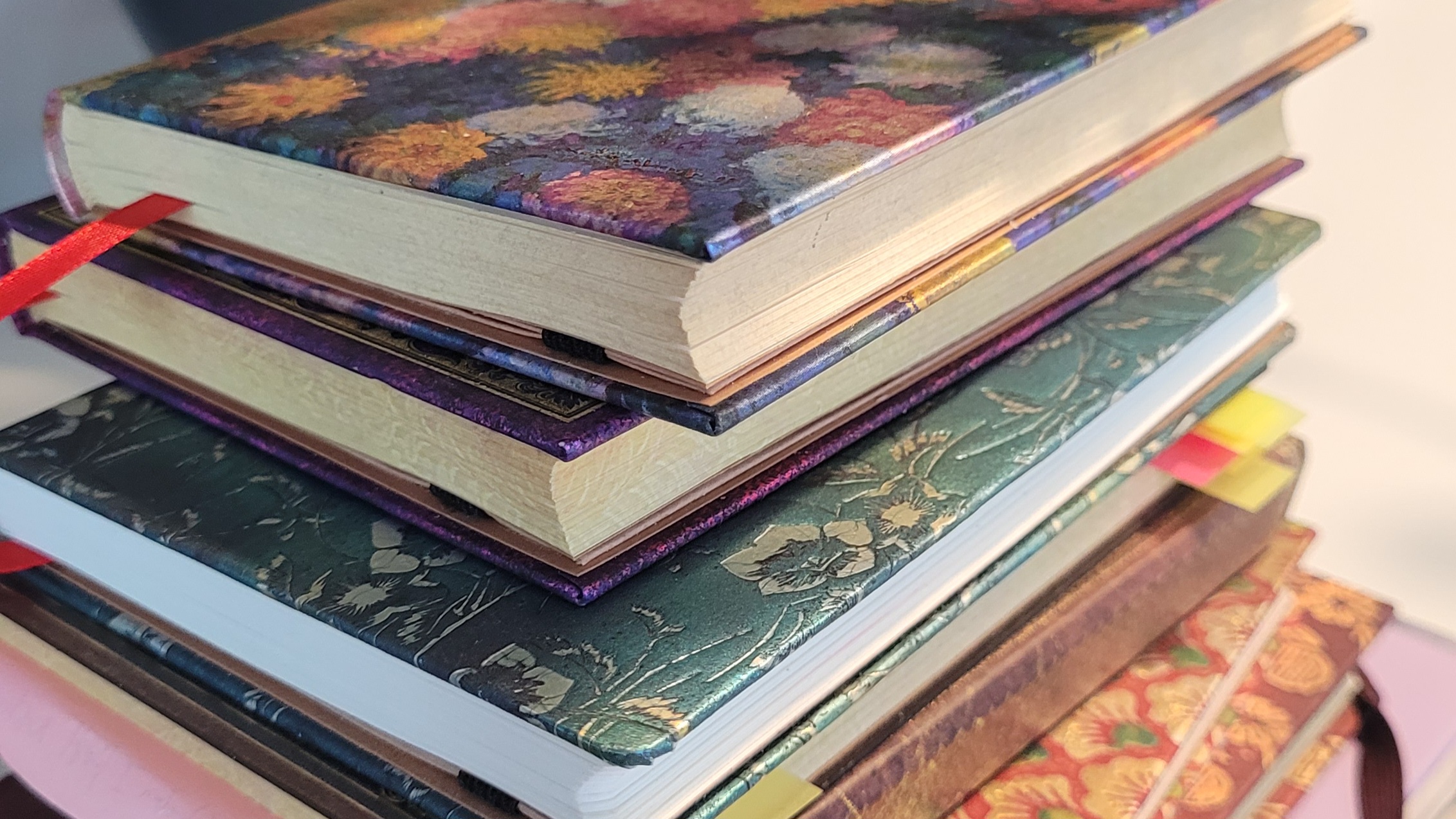
From journal to journal to journals.
Ever since my early twenties—I’m turning a quarter of a century in less than a few months—I’ve been consistently writing in my journals. Now ‘consistently’ doesn’t have to mean daily.
I’ve times where I write day after day—and I’ve times where I’ve written one page covering the past few months of my life. Although, lately, I check in more often by my almost daily poetry or prose¹ entries.
I’ve created what I like to call my journal orbit—a system of journals: each journal has its own purpose within the system. Often termed as a ‘journal(ling) ecosystem’ on Substack, Instagram, TikTok, the list goes on and on.
Before I further explain my journal orbit, I want to discuss the intimacy of journalling—and why it is important to write down your thoughts, your memories, by hand.
The Intimacy & Importance of Journalling
I could begin with some lecture on the historical development and value of journals—I rather save that for another essay and focus now on the personal value of keeping a journal.
Keeping a journal can feel intimidating at first—especially with the growing aesthetics and romanticised practice of journalling. Use it as an inspiration but never let it distract you from the true purpose of journalling: getting to know and understanding yourself better. The more intimate you get with the page, the more there is for you to later (re)discover.
I’ve this somewhat philosophical, somewhat poetic notion that my journals are an extension of who I am, who I was, and who I will be.
Every moment we live is a moment in which we see the world through different eyes than the ones we had a moment ago. This is why journalling is such an intimate—personal—process no other person can do in the same way as you. It is beautiful—almost magical—to keep a journal only you can write.
You’re going to connect with yourself in ways you haven’t thought of before as you fill these pages with whatever comes to your mind. I consider the intimacy of journalling an art which you develop over time. Consistency is the nurturing act to (further) grow a habit in journalling—to explore different layers of vulnerability as you write and age.
When I look at my older entries—or older journals—they invite me to reflect on how much I’ve changed since that moment of writing. Occasionally, I surprise myself and find that I still share that thought, which isn’t necessarily a bad thing either.
In regards of memories and personal events I wrote down, I often appreciate being able to remember or relive whatever I get to read—but there are days when memories can be confronting and certain entries can make you want to repeat the past, old sport.² Rereading those old entries can turn into a wave of sadness—or madness—because you are seeing yourself word for word. A journal is the biggest look-in-the-mirror you can have—you are, after all, facing yourself both in new and old entries.
Therefore, I must say that, in a certain way, keeping a journal is much like a relationship. You’ve good days being honest with yourself—writing down every word that comes to mind—and you’ve days that make you feel that one line is already too much. That is okay. There is no right or wrong way to keep a journal. Journalling is meant to be an ongoing process of inner change and, or, personal documentation.
My Journal Orbit: Types of Journals You Can keep
This brings us back to my journal orbit and the type of journals you can keep. I’ll discuss each one of my journals briefly:
The classic diary: this is the most common and easiest form of journalling. In this journal, I write down my thoughts and personal experiences. Entries vary in length. I tell my ‘life story’ in this journal.
The gratitude journal: I am a firm believer that gratitude is the core of being. Naming—and remembering—what you are grateful is the key to all good things in life.
The prose journal: this is similar to a classic diary. In this journal, I write non-fictional work—prose entries—with occasional poetic elements. Entries are always dated—but usually brief; a few pages at most. I started this kind of journal in 2024—but before I considered it a prose journal, I used this journal as an everything journal.₃
The poetry journal: in this journal, I write poetry—and date every entry. I’m currently on my fourth poetry journal since I started my first one in 2023. That was the year I decided to switch to writing (many) poems by hand. Nowadays, I only write my poems by hand before digitalising them. I’ll discuss my poetry journals and poetry process in a future essay.
The author’s literary (legacy) companion: I started this journal as a guide to my literary work. It is an intimate way to explore the deeper and hidden meaning of one’s work. I mostly give notes on my poetry; giving context and, or, explaining my metaphors or references.
The reflection journal: this is a more philosophical approach to journalling. Entries are usually based on my non-fictional reading list. My non-fictional reads are the starting point of what I am reflecting on. Started in 2025.
The reading journal: Since 2023, I began collecting quotes from books in a journal. I added my thoughts on them—or the book itself—and that was my reading journal routine. However, once I started commonplacing, I turned this in an actual reading journal—a journal that contains dated entries on what I’ve read that day and other book-related entries. I use it for my literary musings, a reading log, lists of books I want to read, books I bought from bookstores, etc.
And that is my journal orbit—but not all the journals I keep. As a writer and journal lover, I have many more journals but I don’t use all of them daily or even weekly depending on how busy I am. Thus, I do not consider them part of my journal orbit. Here are some other journals I keep:
The film & show journal
The sketch/art journal
The love letter journal
The creative writing journal
The poetry club journal
The scrapbook (journal)
Journal Recommendation & Final Thoughts
As I said earlier, there is no right or wrong way to keep a journal. When I was a child—and later on, a teen—I kept just one (classic) diary. I didn’t think much of what or how to keep a journal. You don’t even need a journal orbit. You just need one journal to get started with. Start with the classic diary, or choose something completely different. It is your journal to make your own.
Be you. Be honest. Be real.
Write whatever is on your mind. Write what makes you happy, sad, angry, etc.—express your emotions. Face your emotions.
Get to know yourself. Intimately.
Because that is how we explore the Poetic Existence, my Sunbeams of life!
—Aitana Hendriks
Manual Footnotes:
1 ‘prose’ refers here to non-fictional work.
2 ‘repeat the past’ and ‘old sport’ are literary references coming from the classic American novel The Great Gatsby by F. Scott Fitzgerald.
3 ‘everything journal’ is the term I use for a journal that contains everything from poetry to prose to sketches to lists, etc.
Originally published on 9 November, 2025. From 'Poetic Existence by Aitana Hendriks'.
Comments (1)