The innocents

May 1, 2026 · 11 min read
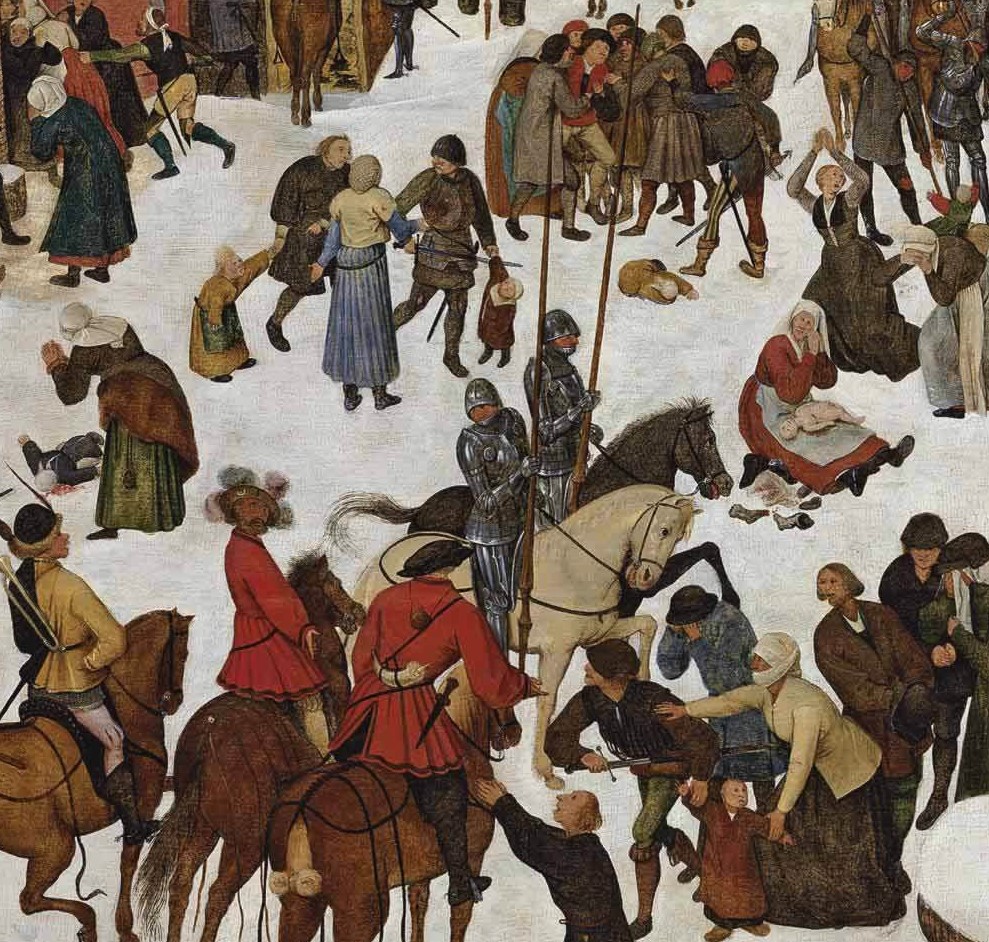
The trees were kind, and they scattered quick leaves over the dead where they lay in their hardening blood. The clouds had the simple decency to cover up the sun so it couldn't glare down on eyes empty of all gaze, eyes which would not blink from intrusions of grit or the transit of foraging ants. The wind blew away the iron perfume of tumbling viscera whenever it felt need to lighten the burden of the air’s stink. All told, the place where the dead now lay scattered could have been a lot worse than this.
All tumult had been wafted away by the hours and there was only silence in this place, a level place in the midst of town, a plaza, say, or call it a square. A place without much in the way of landmarks or any kind of particularity. It was remarkable only for all the dozens of dead large and small that slouched, that sprawled around so lazy, that exposed the glistening indecencies of their innards like so many slovenly libertines.
It was unsanitary to have such massacre lie untended in this public place.
This is where Meeva came in. She’d been drafted, alongside a handful of other plebs, to clear up this mess, she’d been offered a few copper coins to load up her donkey cart with bodies and carry them over to the great mass grave that the soldiers now were digging just outside town. It was understood that if she discovered any plunder on the corpses, she could keep it; understood also that there was unlikely to be much loot, since these dead were common folk and not overburdened with pricey trinkets.
So she filed along with her cart, hoisting the women and the few men onto its flatbed, feeling through their robes for coins, unclipping earrings, unfastening necklaces. Poor stuff, no gold, only brass and pewter with bits of coral for decoration, no pearls, no gems. The babies and small children she could lift onto the cart easily, and they had no valuables at all, so it was much quicker. Generally there were two babies for every adult, most of the adults women. Only once was there the cadaver of a man which she couldn’t lift alone, and had to bid a guard come over from his sentry spot to help, for which she paid him two coppers.
All day this work went on, driving the cart to the big trench on the outskirts where soldiers would unstack the dead from the flatbed and chuck them in. Then back again to the place which was a kind of square where most of this morning’s killings had been carried out at the orders of the king.
Meeva was not young, not old. Not rich, but not as poor as most of the ones who lay dead this day with shameless guts opened out to all the world. She had a cart and a farm outside town and two grown-up boy children serving far away in the king’s army who had, for all she knew, taken their part in today’s events, had killed their fair share of the babies wherever they were stationed.
Now she returned for what could well be her cart’s last load. The sun was declining, the golden hour was upon them, the decent clouds had done their task decently and had now departed. Meeva’s back ached and she was hungry. Her rough work clothing, little more than brown burlap rags, was stained through with what had spilled out of the corpses she’d handled. No matter – it would either wash out or she could make some more such workwear with sack cloth and sisal thread.
Buzzards and crows had gathered in the square by this time, and were doing their work in the soft glow of early evening, diligent in their rippings and the tugging out of flesh strips that shone like bronze set with ruby in this golden light. The soldiers who remained now and again poked their halberds at the birds but showed little heart for it. Most were drifting away towards the barracks and a bowl of warm lentils with beer. There were no others clearing bodies, and soon Meeva alone remained on the square.
Shooing away the carrion birds, Meeva stooped to her labor, bending her sore back to the scoop and lift of these last few bodies. As she lifted one woman, about her own age, too old one would have thought to be the mother of the babies, too young perhaps to be a grandmother, there was a sudden sharp noise beside her like air bursting through a bladder and a flash of green movement on the ground.
She dropped the body on the cart and looked down: there was a serpent just two yards away, hissing at her and shaking its smooth slick tail in warning. Green, egg-green, and glossy scales all over like stones in water. Head not diamond but smooth and coming to a point. Dark yellow eyes and tongue-flicker ghosting so fast as if only half-present in this world.
A viper? Meeva stood still and gazed at the snake. It bored its yellow gaze at her like a gimlet and hissed again. They stood there this way for an uncertain time, mistrustful woman and green serpent, suspended in mutual fascination.
And then, next moment, the snake blurred. It uncoiled itself the other way and darted faster than she could have imagined possible across the open space to a broken burned-out stable at the edge of the square and was gone. She found she wasn’t frightened by this encounter but roused, somehow, stimulated. She turned once more to pick up another body, but saw something and stopped.
There was a clutch of eggs, three in all, two broken with tiny perfectly-formed serpents leaking out of their cracked eggshells, flailing slow, dying, dead. But the third egg, the size of her thumb, was still intact. Clearly the snake she’d disturbed, a female, had come to lay its eggs beneath the corpse and with Meeva’s disturbance of this nest the eggs had broken. But that third was still whole. Pale green, colored like the mother serpent that bore it. Laying on the ground in the chilling evening air.
Without thinking, she picked up the unbroken egg, firm but gentle, forefinger and thumb, in her right hand. She squatted down slightly and with her left hand raised her blooded burlap skirt. And it was in. Safe and warm, nesting now within her.
Meeva was a mother once again.
On completing her task, she looked back across the open space, the square. Adobe bricks formed a low well with a leather bucket suspended from a gallows-like rig. Beyond, the uneven walls of huts and lean-to’s formed the periphery of the place. Dark fluids patterned the ground in irregular stains and small puddles. All the guards had wandered away, the buzzards and ravens too were gone.
She made as if to get up on the cart, then hesitated, looked back. There was a new body leaning against the well. Had it been there before? How could she have missed it? It moved, now it made as if to lean over the wall. It was a living person.
Meeva’s job was complete. She’d loaded her cart with the last of the bodies, picked up a few trinkets and a coin or two. The guards had gone, and nobody would object if she went away at this time, leaving this struggling survivor behind at the well. Yet she hesitated, made as if to mount up, stopped, and then turned back again.
The man – for it was a man – was dressed in creamy woollen robes, was old with a longish gray beard and a small cap made of shiny red leather, a foreign thing like they wear in the lands to the east. And was that? Yes, the glint of something golden at his neck, a thick chain.
Meeva turned the cart laden with all its burden of the dead toward the well at the square’s center and led the donkey that way. She moved slow and stiff, for her joints all ached.
The man heard the clopping and looked up wearily. He was old, his face lined, deep lined and dark, though now becoming ashen in the sunset light like soft sands raked with dead embers. His soft wool robe was stained crimson across the belly.
“Water, my child.” He spoke low and foreign. A plea from a foreign man at the end of a day of mass death. These two only in this great open space without birds.
Meeva lowered the leather bucket into the well, and drew water for him. The donkey tried to nose its way to the drink, but she pushed it away and lifted the bucket to the man’s cracked lips, his moustache and beard cracked with snot and dried blood.
He drank from the discolored water and was content for now. She watched him. He gasped. His face was tight and pale now, the dark olive skin in its deathliness like a dry earthen vase.
“They attacked me,” he said. “The soldiers did.”
“Did you lose a grandson?” Meeva asked him.
“What grandson? They stabbed me in the guts!” He coughed and a little blood came up with his sputum. She passed him the water and he drank again.
“Can you move?” she asked.
“No, it hurts too much. You could help me...”
“I have things to carry. Things to do.”
“You could help me, I can pay!” He put his hand in his robe and pulled out a purse, opened it. Shiny gold coins.
“Who are you? A foreigner, no children. You know the soldiers were here to kill the babies, yeah? The king ordered them. If you hadn’t...”
“I told the king,” he said.
“What?”
“We told the king, my colleagues and I. Then he killed them.”
“What?”
“My colleagues, dead. I got away but he sent his soldiers. Now I’m...” he coughed again. “Help me, I’ll pay,” he repeated. He pushed the purse to her and she took it.
“Who are you, old man?”
“I’m an astrologer. I came here in search of a great king, a new prophet, to be born in this place. I came from far to the east, along with my friends.”
“Astrologer?”
“We cast the charts, we saw the signs, we followed the bearded star traveling high in the night. But we couldn’t find the child, the new prophet, when we came here. So we went to see the king.”
“To see our king? Don’t you know he’s a...”
“...a degenerate, yes, we found out. We told him: a great young king is born in this place, we’ve come to venerate him. Majesty, would you wish to come with us and reverence him?”
“Him? The king, our king, reverence?" She spat her words at the old man. “He reverences nothing, he's a man purely of blood, a monster of greed,” The donkey leaned forward and she allowed it to drink the water in the bucket. The old man moved his cracked lips silenly, then spoke:
“We didn’t know, we told him... and he put us in his dungeon. I – I escaped, I bribed a guard, but my brother mages, they were slaughtered. I walked out of the palace by night as he was sending out his guards to kill...”
“...To kill all the babies,” she said. “You! It was you who set the mad king to murder all the children! Male babies under the age of two, but they didn’t stop there.” She shook with an anger that overcame her now, after a full day of accepting it, of working round it. All her rage swam back big as a wave crashing on a stony beach. “They took them from their mothers and they bashed their brains out on the walls!” she screamed. “They sliced their small necks like geese. They...”
“I’m sorry,” he said. He was weeping and coughing, sobbing and folding his hands across his abdomen to hold in his reddening guts. She reached over and tugged at his thick chain, and the clasp gave. She held the piece in her hands: a chain with a talisman, a serpent curling round on itself, eating its own tail.
“We didn’t know that the king would do... that... this... We wanted only for him to share in this glory...”
“You bastard,” she said, cold and soft. “It was you, it was your stupidity, which killed all the babies.”
“...this adoration,” he choked out.
Meeva felt nothing. Meeva felt the coldness in her that was nothing at all and was her zero rage. Something moved within her. Something cracked inside. The egg.
Now the serpent was born. The serpent her child, her viper child of vengeance.
It slithered out of her vulva and down her leg onto the dry ground. Bigger than expected. Well nurtured. Intelligent, agile, her hatred, her daughter. She looked up at her, up at her mother. Mother nodded at her daughter and consented to this retribution.
Meeva grasped the donkey by its bridle around and began to turn around her burdened corpse cart. Behind, there was a sound like the sudden bursting of air from something. The old man screamed out in fear and pain, but once only.
On the flatbed of the cart the eyes of mothers and their children looked up into the sky as the last rays of the sun fell behind the shattered buildings. There was a sudden shiver of wind through the square and the trees dropped their kind leaves onto those eyes so they could see no more.
