The House That Sighs
A twist on Rebecca, by Daphne du Maurier.

Mar 6, 2026 · 29 min read
Foreword: This piece is dear to my heart. Rebecca is my favorite novel, and in times of hardship, I often find myself going back to it for inspiration. This time, I took it literally. That being said, I know that the reading time might be intimidating to some. But the story is broken into easy-to-read chunks, which makes it quite digestible. So grab a cup of warm something and a blanket. And in any event, I thank you for reading it.
Ireland, 1931.
Last night, I dreamt I went to Holloway again. I ventured along its driveway like a visitor—the kind that wonders in awe at the spires and frivolous eaves, or that cranes their neck to watch the angry sea from the mullions, lips shaped in the ‘o’ of fascination.
I passed the walls of rhododendrons, their heads bursting in nightly colour, then made my way up to the house. Encroaching on each side were tall foxgloves and hollyhocks, both fighting for a shred of wilderness and a grain of sun amidst the flowery ruin. But the front lawn belonged to the snowdrops; a constellation of white-blue, of drooping napes and enduring blooms, swaying not in the wind, but at my arrival, as if they recognised me.
And ahead of me stood Holloway. A manicured cluster of sandstone bricks, stained with the sea’s breath. And if the house itself was unchanged, it now slumbered under a chokehold of vines and the conquering ivy.
I climbed the stone stairs, but I dared not push the front door open. I stayed firmly rooted to the front porch, knowing all too well that the house would not let me enter, for, in her eyes, I was not the new mistress of the house, but a passing soul, like those that come and go with the tour guide, gaping in admiration at the minstrel’s gallery and at the jungle of centennial portraits.
I was never welcome here.
I was never furniture.
All I was was a stranger.
And strangers don’t stay long at Holloway.
We all read about Helena de Warden’s disappearance. For weeks, it was all the newspapers could drool over. I knew from the columns that she was Holloway’s mistress; that her life was twice as grandiose as the halls she commanded.
‘A force of nature,’ one woman said to her friend in the tearoom as we waited for the train to steam into the station. ‘Helena was unstoppable. She would never have abandoned Holloway willfully. I reckon there is something foul at play. And Julian, her husband? The poor soul is aggrieved beyond comprehension. Eight months since her disappearance. I wonder if he’ll ever get over her.’
I leaned close. For gossip fuelled my author’s pen, but the train’s horn tore right through the conversation, ending it promptly. We all shuffled aboard, the huffing engine bound for London where I would take a boat, then another train to the French Riviera. And, most crucially, to the next chapter of my so-far uneventful life.
Monte Carlo’s air held something saline about it. Not the salt that patiently erodes the Irish coast, but the kind that weaves deep into fabric, settling between the fibres like a connective thread.
I was suffering from a bad bout of writer’s fatigue at the time and my words, otherwise flowing like water, were now refusing to mar the paper. I thought that a change of scenery would help loosen the knot, so I purchased the boat ticket on a whim.
The first week at Monte Carlo was unremarkable. I spent most of my time out and about, gathering vistas in the corner of my eyes, bending my tongue around the jagged spine of oysters, sitting alone at luncheon and listening to French’s slow drawl drifting to my table.
It was in the second week that everything took a turn when I stumbled upon Julian de Warden, a face I knew from the English papers.
It was a scorching afternoon. I had driven the convertible to an esplanade overlooking the city, and after half an hour of sightseeing, I went back to the motorcar as Julian was parking his own. We did not strike up a conversation (I knew to leave a grieving widower well alone) until my car engine refused to start. He swiftly came to my rescue, and I was able to make this medieval beauty of his up close.
He had all the rusticity of the English countryside, hair the colour of damp hay, and eyes of blue—pellucid in their hold. An angled jaw, square and imposing, and a freshly shaven face. He wore a mustard-yellow suit and cared not an iota to dirty it with motor oil. He appeared stubborn too when the car refused to roar in compliance.
It did not yield that afternoon. So Julian drove us to the hotel we found out we shared. This would be the start of the best two weeks of my life. Of seaside jaunts and beach outings. Of restaurants visited too late and conversations that would stretch well into the night. We never spoke of Helena. I never asked about Holloway, yet the thought of its splendours moved my hands on the typewriter and, soon enough, I wandered its grounds in my reveries, conjuring the augustness of its halls on paper, my inspiration at last surrendered back to me.
We both extended our stay.
And at the end, Julian de Warden proposed to me.
And of course, I said yes.
Italy charmed with its Byzantine splendours. Then came proud Paris, with its gardens in bloom.
But nothing would compare to Holloway. Not in grandeur, no, but in meaning. For it had come to me that the sea air would invigorate my hands, that the dark plenitude of the Irish countryside would wet my thoughts with ink.
So we travelled to Ireland after half a month of honeymooning. By then, I was so kneaded with expectations that I sat on the edge of my seat the moment the motorcar turned onto the sinuous road leading to it.
‘It’s not as grandiose as you make it out to be in your head,’ Julian told me from behind the steering wheel, the shade of a smile on his full lips. ‘It’s a fistful of stone with an arrogant history, nothing more.’
I turned to him, a chuckle on my tongue. ‘I’m not excited by the architecture as I am by this arrogant history you speak of. When I was younger, I bought a postcard with Holloway on it. It was only a facade in my mind and, try as I might, I could not picture what lay beyond the windows and the stone walls.’
‘Not even with an imagination as fertile as yours?’
‘Not even.’
Julian teased me about what pertained to my job, and a certain levity perfumed the surrounding air while we were abroad.
But I know now that the mirth of early wedlock would dissipate with time. That Holloway would cast a shadow so vast on our brows that we would wander in blind rooms like lost souls, the frolic gone as soon as we opened our luggage and buried the souvenirs of our travels in the attic.
But on that day, all I had a mind for was the awe of driving towards the estate. I watched with childish wonderment the walls of rhododendrons like a hedge of honour escorting the newlyweds through a canopy of trees to the house. And it felt just like a second wedding.
And what an altar Holloway was—a behemoth of a manor, riddled with half a hundred windows on its frontispiece, shingled roofs and valiant friezes.
I took in the seven chimneys, slavering smoke in this crisp morning hour, and the circular driveway, flanked with a garage.
As we approached, I noticed a row of people, all in livery, hands gloved white, and demeanour ironed out.
‘I hate when they do this,’ Julian said as he killed the engine.
An old man broke ranks to open the door for me, offering a hand that I took.
And then came the first breath of saline, mingling with the rotten damp of petrichor.
From this angle, we couldn’t make the sea—or its toss—but it was resolutely there, its salt clinging to the sandstone, white as grout.
‘This was unnecessary, Porter,’ Julian said, removing his driving gloves.
The butler bowed a white head in courteous contrition. ‘Mrs Morland insisted on it, Sir.’
Julian’s chuckle was glum but resigned. ‘Then if we must do things proper…’ One swoop is all it took for him to take my feet off the ground and nestle me over his shoulder. And, as I protested with a laugh, he climbed the stairs to the mansion, easing us under its threshold into a vast foyer.
My first glimpse of the manor was taken upside-down.
All I saw at first was dark wainscoting and chequered floors.
Until Julian let me go.
Then, the history hit me all at once.
First, a grand staircase hemmed with paintings of the previous inhabitants.
Then, the heady spice of wood laden with years of groaning under the rain.
At last, the echoes and the cold. Not the kind that develops in gaudy openness, but the kind that lives in corridors too vast, too old to ignore.
And then a sigh.
Almost inaudible.
Yet placed there, in the shell of my ear, as if a ghostly attempt to draw my attention.
But I could not linger on it for long, for already heeled and assured footfalls boomed from the next room, and a woman made her way to us.
Her hair was slicked tight against her nape, her suit and skirt tailored and ironed to perfection. Her eyes were lined, her lip austere, and her smile polite but stiff. Her hawkish blue eyes were what I noticed last.
They chilled me with their sharpness as they roved about me, as if appraising a racehorse.
‘Welcome to Holloway,’ she said with a cutting voice and a sharper smile. ‘I am Mrs Morland, the housekeeper.’
Julian was taken away by the estate manager first thing. Papers that required the stain of his name, matters that pertained only to a ruler. And I was left in the care of Mrs Morland.
She guided me through rooms so tall and so heavy with absence that they stitched cold deep into my skin. Yet despite their vacuity, they were all freshly done up. Roses drowsing into silver bowls and vases, not a speck of dust on the mantels, and richly-coloured upholstery brushed or oiled clean.
‘How old is the house?’ I inquired as we made it to a drawing-room.
‘Three centuries old, Madam.’ Her hawkish blue eyes cut to mine. ‘Although it has been refreshed over the years, it is mostly intact.’
My gaze went up to the massive ceiling cases. ‘I see.’
We resumed our silent tour. And at no point was it disturbed by the whine of the sea, which I found strange. And stranger still was the fact that the primary suite did not give onto its tide, but onto a small rose garden.
The draperies were august, the bedposts thick ebony, but the first thing I did was not to run a hand on the damask, but rather to approach the window. ‘There is no view of the sea here.’
‘No, Madam. Mr de Warden had the new room done up in the west wing.’
I turned to her. ‘How so?’
‘I didn’t ask, Madam.’
My lips curled faintly. For I did not wish to pry further. Not while I still wore a stranger’s clothes. ‘Well, this room is beautiful. It will do.’
‘However, the rooms in the west wing are much grander,’ she added. ‘There, the bay can be seen. The sunrise is breathtaking. It turns the waters copper in the morning and golden at dusk.’
She spoke as if the sight were a long-dead relative of hers. The kind you remember fondly, questing for the shape of their voice in a too-heavy silence. The notion made me uncomfortable, for there were in her eyes many unspoken things—memories that belonged only to her and those who inhabited this house. Shared by the maids, by the footmen, by Julian.
But not by me.
We did not tour the east wing that day.
Instead, Mrs Morland left me alone in the parlour to order some tea.
‘Things are done properly at Holloway,’ she said to me before departing. ‘Tea is always served at three o’clock. The house wouldn’t have it any other way.’
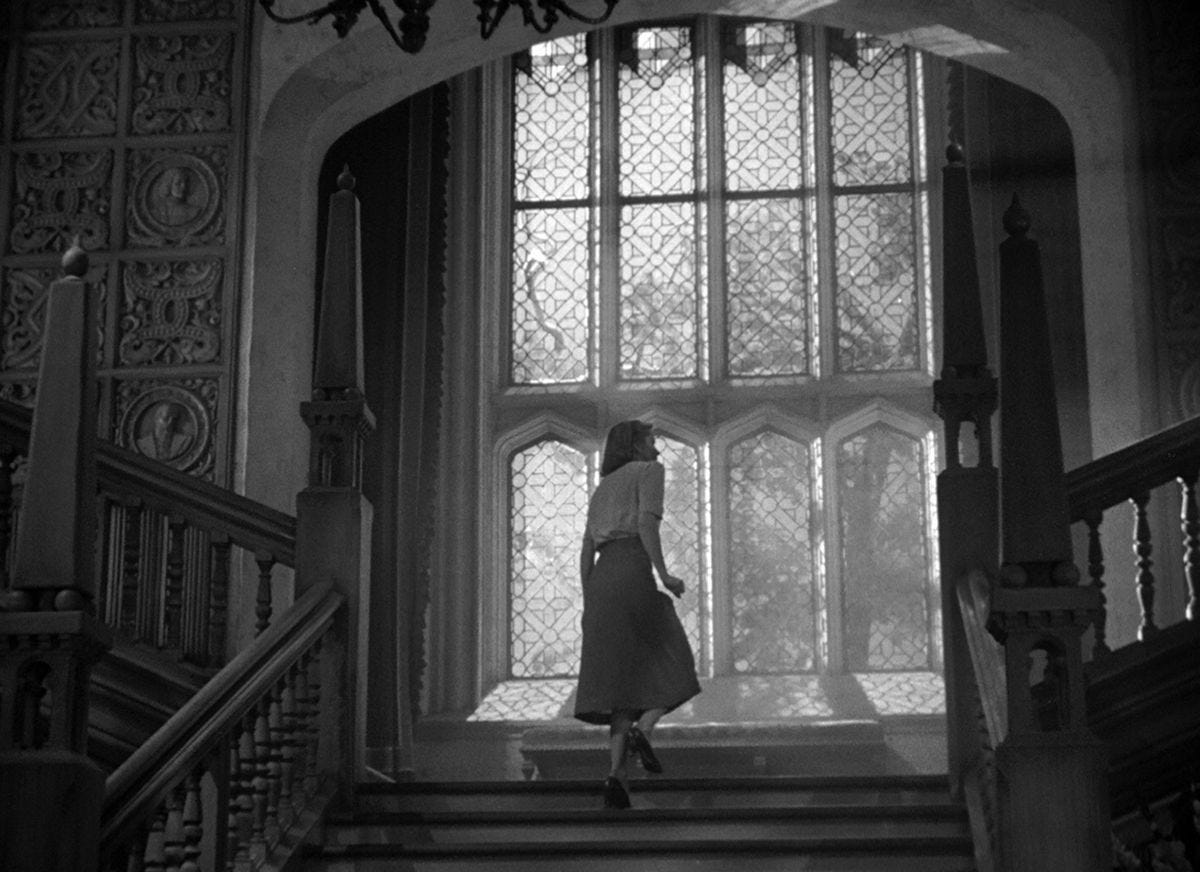
Credit: Pinterest, from the movie Rebecca (1940).
Old houses tend to breathe. There, time carved a space between the beams and the sheathing; it long exhaled in the eaves where birds roost. Holloway was far from dereliction, yet centuries of age eroded at it like old teeth.
My first night was uneventful. Sure, there were stray noises that whispered their way to the master bedroom. But I woke up fresh-faced. And after the estate manager had stolen Julian from me, I ventured out into the lazy September heat.
Sea salt moistened my lips the moment I spilled onto the lawn.
And all at once, I could make out the relentless toss of water in the bay despite the morning’s calm.
I crossed the vast expanse of grass, then made my way to the head of the cliffs where I found a narrow staircase leading down to a crescent of dark shingles. And there I saw it: this fathomless mass of water whipped into a froth, crests of milky white rolling to the littoral.
The beauty was indescribable. A thing of coastal legend, and I half expected a ghost ship to materialise against the gash of the horizon.
I made my way down stone stairs lined with brine-curdled ropes, then spilled onto the beach where a small seaside cottage drowsed.
The spray oiled the rocks proper, still my curiosity pushed me to make for the lonesome cottage. I traipsed there to avoid rolling my ankle, then stood before the dwelling. Salt had rusted the door’s hinges, but with one twist of the knob and one push of my shoulder, I was able to pry it open. It creaked in protest, but it loosened. And if I expected to be welcomed by the saltish damp, I was instead met with the spicy tang of fresh lavender.
There was a double bed pressed against the western wall, a small fireplace at its foot; a dresser crowned with an empty washbasin; a vanity, where bottles of perfume awaited a woman’s pulse.
On the vanity lay a small wooden box that I opened to find a stack of letters within.
I pulled one from the pile.
An elegant and elongated penmanship stared back at me.
And there, at the very bottom, a sign off boldly stabbed into the paper:
Yours, forever,
Helena de Warden, May 1930.
My fingers trembled on the page’s relief, and I sat at the edge of the bed, perusing through the letters—all of them correspondence from Helena to Julian. And I found my trespass obscene.
Still, the unease was not enough to deter me.
For there was something unsettling about reading Helena’s words, knowing she had disappeared. Stranger still, to read a one-sided exchange of letters, for I wondered how Julian had responded to it.
Alas, I would never know.
Or, rather, I would never dare to admit to my shameful voyeurism enough to ask.
And perhaps I should’ve, knowing what I know today.
I did not ask Julian about the cottage. I left it there, a lonesome memory on the beach, and I returned to Holloway, to the tight rhythm of the house’s schedule. I learned it after a while. Luncheon and tea on the dot, the day’s menu sent by Mrs Morland at breakfast for me to revise, long sessions of writing my newest manuscript in the afternoon, a walk in the gardens with Julian at dusk, as the air turned crisp.
I settled into this routine like one would a glove. Its clockwork soothed my tired mind—a metronomic ease with which I could sit in front of the typewriter and let the words loose on the page. And if they had fought each other prior to my arrival at the house, they now lay on paper composedly, as if an army tired of fighting.
We received the photographs of our honeymoon two weeks after we returned to the countryside. Julian left them in my care, and I endeavoured to trap them in a picture frame before setting one on the drawing-room’s mantelpiece. I found the photograph naked, so I went to the garden to shear some autumn flowers that I arranged in a vase. I placed it on the mantel, then sat on the davenport to read through the first chapters of my manuscript.
Three o’clock came too swiftly.
The tea bell rang and I rose from my seat.
One glance to the mantelpiece and my brows met.
For there, on the lintel, the asters and the hydrangeas had browned and curled onto themselves like burnt fingers. I approached, finger pads grazing the dead petals, and caught a whiff of spoilt water. Taking the vase in my hands, I went to the gaping window, then gazed down at the garden, wondering if I had picked withered flowers, but the beds were thriving still, the blooms fat with vitality. I found it strange, but I discarded the water, then threw the dead sheaf out the window.
The tea bell rang again, impatient in its trill, so I left the drawing room behind and, that day, thought of the flowers no more.
I remember a vibrant day at Holloway. It was a mid-September day, the kind that chills the fingertips but stitches sweat in swaddled pleats. Julian and I had driven through the countryside, shared a picnic on the parched moors, and made it back to the estate only late in the afternoon.
The estate manager came to us at teatime, stealing my husband away once more, and I was left alone, the afternoon still seething against my fingertips and an invigorated animus pushing me to tidy up the drawing-room. I gathered the days-old newspapers leaving them near the fireplace as kindling, then endeavoured to move some sundries around—Julian’s pipe left on the coffee table, a box of matches on the mantelpiece, and a porcelain cherub, poised on the desk, that I moved to a shelf for safe keep. The bibelot was intricately made, and in my curiosity, I gazed underneath to make out its provenance. I saw it then: an engraving—To my dearest Helena—and I wondered who had gifted her the trinket.
There was something profane about moving her belongings, as if she would come home to Holloway one day and notice first the things that had been moved by my hand.
Still, I set it on the shelf, telling myself it was too exposed to gaucherie on the desk, and I moved to the study to get some writing done before supper.
We dined as we always did: slowly and tardily. We seldom spoke about Julian’s work or about the ebb of society—we had no interest in the idle prattle that moved the Irish countryside. Instead, we spoke of my manuscript, and I recounted my latest chapter for his quiet entertainment.
Except on that night.
On that night, he sported a headache, so we spent supper in silence.
But it was a shaky quiet. And Julian must have felt it too, for he commented on the meal choice. ‘Roast lamb isn’t my favourite, if I’m honest. Perhaps we could remove it from the menu?’
I smiled then. ‘The gravy redeems it a little, don’t you think?’
‘It is too bland. Helena preferred a black pepper sauce. Something with spice to it.’
The name swished through the conversation like a blade.
Julian hadn’t spoken her name aloud once, and on his tongue, it sounded soft. Too soft.
The tick of the grandfather clock drew us further apart. And for a moment, it seemed to me as if Helena’s heart was still beating underneath the floorboards.
‘I’m sorry,’ he said. ‘I don’t know what came over me.’
I smiled again. ‘It’s okay. It’s no trouble, dear.’
The clock wheezed some more as Julian resumed his course. And maybe the slip of his tongue had emboldened me, but I let my words loose: ‘I went to the beach a few days ago.’
His blue eyes cut to me. There was a strange glow to them, and his lip stiffened. ‘You have?’
My fingers reached for the wine glass. ‘I saw the cottage, and I must admit my curiosity got the best of me. I entered it.’
‘Wasn’t it latched?’
‘No. It was open.’
His jawbone shifted, knuckles pale around his fork. ‘I ought to have it locked again. It is derelict, unsafe to visit. The stone is crumbling, the beams likewise.’
‘It had been freshly done up,’ I insisted despite the cooling air around us. ‘It didn’t seem derelict to me.’
‘The cottage hasn’t been used since she disappeared. It is unsafe. I don’t want you near it, let alone inside it.’
His voice went from chill to metal, and despite my desire to retort, I thought it smarter to stop talking about it.
I excused myself from the table to write before bedtime.
And when I passed the drawing-room, I glanced inside. There, on the desk, the porcelain cherub gazed right back at me.
Did the maids put it back where it was?
I did not ask them.
I kept walking down the corridor to the study.
But years from then, I would still dream of it. Not as a nightmare, no. But as the first breath of an impending battle, when the arrows have yet to be notched and the banner still flies boldly over the virgin moor.
Once a week, a small crowd came to Holloway. Hatted couples and other gawkers keen on undressing the house from the inside out. The tour guide would shepherd them like a flock of sheep through the gardens, the foyer, the minstrel’s gallery, and the east wing. They would not disturb the rooms, no. But they would croon at the vastness of the sea lapping at the foot of the cliffs as it crested low against a shapeless horizon.
Julian would not make an appearance. He avoided small talk by travelling to Galway for business purposes. And I was left alone—the mistress of the house—to welcome guests and give them to the tour guide like an eager father would a difficult bride. Then, I would move to the study or the drawing room to work on my manuscript.
On that day, however, I had woken with heavy limbs, an exhaustion so deep that my bones ached around it. I stayed in bed for an hour longer until the maid came to straighten the room.
I turned to her the moment the door creaked on its hinges and she went livid at the intrusion, her cheeks pink.
‘I’m sorry, Miss, I—’
Miss?
‘It’s no problem,’ I said, too cottony with slumber to correct her. ‘I need to get up, anyway.’
I dressed, combed my hair, had a quick breakfast alone, and when the clock cooed nine, I made my way toward the foyer. The group came and, just like the previous and the one before, it came with craned necks and roving eyes.
I greeted them, then surrendered them to the tour guide as was my custom, and when he corralled them away, I turned heels aiming for the drawing room to work on my novel.
I must have been caught in a reverie, for I nearly collided with Porter as I rounded the angle of the hallway.
My heart startled out of its rhythm; I scarcely had enough time to mutter an apology before the butler said:
‘You ought to return to the guide, Miss.’
Had he mistaken me for someone else?
‘I was heading for the drawing-room. Are the maids doing it up?’
He blinked at me for a few seconds, then said:
‘I’m sorry, Madam. Of course, Madam.’
We said not a word more to each other. He returned to his duties and me to my design.
Surely, the staff was overexerted, I told myself as I reached my destination. The day of the tour was busier than usual and all these unknown faces must be hard to keep track of.
And I, too, was a fresh face at Holloway.
The drawing room swam in sunlight. I did not go to the typewriter straight away. Instead, I unlatched a window to let in fresh air, then heard a noise behind me. My attention leapt to the mantelpiece where our honeymoon photograph lay on its face.
I went to prop it up—
Only to find myself gone from its frame.
There, right before my eyes, stood Julian. A smile on his face, a groom suit on, standing before some wistful castle ruins without a bride at his arm.
Without me.
And I heard it then.
I even felt it against the slope of my neck.
This long exhale I heard when I first came to Holloway.
And it sounded like relief.
‘Everything alright, Madam?’
Mrs Morland’s voice boomed from the doorsill. I almost dropped the photograph. And when I turned to her, she had a wicked air about her. As if she knew. As if she had erased me from the film herself. But I didn’t dare bring the matter up with her. I didn’t want to risk her contempt.
‘Yes. All is well.’
Her gaze went to the photo frame and she smiled coolly. ‘You look tired, Madam.’
‘I am well, Mrs Morland. Thank you.’
Her smile did not falter, nor did her attention. ‘If I may, I don’t think you have it in you to stay, Madam. It will only get worse from now on.’
Vertigo prickled at my fingertips. ‘What do you mean?’
Her lips stretched tauter. ‘Nevermind that. I came to tidy up. Mr de Warden rang—he is on his way. I should run a bath for you.’
‘I don’t want a bath. What did you mean, Mrs Morland?’
Her hands joined before her lap. ‘You are tired, Madam. The house senses it.’ She gently steered me out of the drawing-room. ‘Come, I’ll have tea served in the library for you.’
The sky was already knotted black when Julian came back from Galway. I had occupied my evening with light reading in the library, the photograph on my lap, the absence of me stamped on film and Mrs Morland’s words still heavy on my mind.
Around nine o’clock, Porter came to tell me Julian had returned, and that he had gone to the bedroom to change clothes. I made my way to the suite. And there my husband was, distance-worn and ragged from his trip.
He turned to me as I clutched the photograph. ‘Is something the matter?’
I extended it to him. ‘I disappeared from the frame.’
He took it with a curious air about him. His brows sharpened, then he surrendered it back to me. ‘I’m not sure what you mean, darling.’
My heart dropped at the sight of it.
Of me.
Dressed in my wedding frock, smiling at the camera.
I felt the heft of Julian’s gaze as he awaited an explanation.
‘There are strange occurrences here,’ I said at last. ‘The flowers brown too quickly. The staff forgets who I am. I hear and feel some kind of sigh, as if the house itself breathes. I disappeared from the photograph, I swear it. And Mrs Morland is acting strangely with me. She speaks of the house as if it has a life of its own.’
He gave me a pitying smile. ‘You’re tired, my darling. You’ve been working on your book relentlessly. Perhaps you need a pause.’
‘My book has nothing to do with this—’
‘The house is old. It sighs in the breeze. The flowers are tired already. As for the staff, they see so many faces, who can fault them?’
A knot, this is what my tongue gave in response.
For Julian’s pity was twice as shameful as the confessions themselves.
I said nothing more. Instead, I set the photograph down on the vanity, then went to the fireplace. Julian kept silent as he changed.
The budding fire leapt cheerily as if the house taunted me.
It was then I saw it—
Sheets curling onto themselves.
And ink melting on their face.
My manuscript.
‘No!’ I fell to my knees, hand stretching to the flames. The heat pressed taut against my fingertips. But already, Julian was on me, pulling me away.
‘What are you doing, you little fool?’
‘Mrs Morland,’ I said, her name bitter on my lips. ‘She was in the drawing-room last.’
‘Why would she do anything like that?’
Tears bloomed as my typewritten words agonised in the grate.
‘She doesn’t like me.’
‘You don’t know that. Mrs Morland can be austere, but she isn’t hostile.’
My cheeks flamed hot. ‘Who burned my manuscript then?’
‘I’ll ask the staff tomorrow. Maybe someone saw something.’ He propped me up. My limbs were lead. ‘I’ll ask the maid to draw you a warm bath.’
‘I don’t want a bath.’
He pressed a kiss on my crown as if I were a child afraid of the dark. ‘I’ll have one myself, then. You should go to bed, mh? I’ll join you shortly.’
I had no speck of fight left in me to interject.
Instead, I sat back on the carpet, my legs gathered in my arms and watched the last curls of hope crumble into silence.
Night twirled around Julian’s neck, but the noose of slumber eluded mine. My tears had long dried into salt when I rose from the bed.
I found the hallway ticking faintly with the grandfather clock in the study, and I out-walked the pulse until it was nothing but a sluggish echo. The east wing was protected by double doors I pushed in unison, letting myself into a different throb—that of the ocean and its relentless hunger for the shore.
I followed the corridor to the main suite, then breached that rampart likewise, feeling my way through the dark for the interruptor.
Electricity seethed, the bulbs protesting with a flicker, and I faced, at last, the sea-like grandeur of the room.
The furniture was heavy ebony, the velvets aquamarine, the sconces a milky silver. A vanity drowsed against the northern wall, still busy with perfumes, creams, and powders. And there, on the baldachin, lay a robe, gauzy and black as night.
I trespassed further, my hand reaching for a bottle of scent that I uncorked and brought to my nose. White musk left its powder between my brows, and there, right underneath, slept the tang of lavender, the spice of vetiver.
‘Helena wore this on Sundays to church. But she had much bolder scents.’
Mrs Morland’s voice came again like a dagger in the dark.
I set the bottle back on the vanity, then turned to her.
The housekeeper stood in the doorway, veiny hands joined before her lap.
‘You’ve noticed them,’ she continued. ‘The house’s small rebellions.’ She walked in. The door clicked shut behind her. ‘Holloway took a while to accept her. It tried to scare her away—but my mistress never relented.’ Her hawkish eyes roved about the room, as if she were watching a memory grow limbs. ‘When the house decayed the flowers, Helena would have a hundred more brought into the drawing-room. When it stoked the flames into a fever, she would weather the heat with a laugh. And when it erased her from the frames, she would burn the film and taunt the house to throw more at her.’ Mrs Morland’s hand extended to the negligee, fingers grazing the organdy with reverence. ‘She patiently whittled at the house’s tricks until Holloway accepted her. And when it did, when Helena bent it to her will, the house could never forget her.’ Her attention leapt back to me, her thin red lips curling into a contemptuous smile. ‘I’ve read your manuscript. Uninspired, insipid. The words of a trembling hand. My Helena would never tremble—she never did. Not when the house tried to reject her, not when it tried to evict her. But you are different. You are tired. And, my dear, you don’t have it in you to replace her.’
Her words festered the air, unbelievable in their architecture, and yet I knew in my gist that they were true.
‘Did you burn it?’ I said. ‘My manuscript?’
‘The house wanted it gone. It always erases what doesn’t belong within its walls.’
‘Did you burn it, Mrs Morland?’
Her smile reamed, a thing of pity. ‘I suppose nothing can be proven. Mr de Warden will not believe it. He never did. For men are blind to the evidence that disproves their narrative.’
‘I am letting you go,’ I said coldly. ‘I give you until tomorrow night to pack your things and leave Holloway.’
She chuckled then. Not defeated. Knowing. ‘It will only get worse from here. With or without me.’ Her neck bowed curtly. ‘Good night, Madam.’
Turning heels, the housekeeper left me behind amidst the humming globes.
And fear gripped me.
The walls shrank.
The ceiling hung lower.
And I knew then that I had made a mistake to come here.
I had found myself an enemy, and worse—
I was living with her.
I did not wait for the night’s ink to thin. I clambered back to the bedroom, slid under the covers, and watched indigo flake to grey. Julian moved, stirred out of torpor, and when he kissed me good morning, the confession squeezed past my ribs:
‘Mrs Morland burned my manuscript. She implied as much. I am letting her go.’
A shade came over his brow. ‘Why would she burn your manuscript?’
‘She doesn’t want me here. She said the house likewise.’
He propped himself onto an elbow, fingers threading through my hair as if to chase the notion from my head. ‘You’re being ridiculous. Come here.’
He pulled me closer, but all I did was shake away from his grasp. ‘She said Helena bent the house to her will. Is that why she disappeared?’
The name hung low like fog. Something so thick, so brackish, my teeth curled around it.
Julian’s hold withered. He said nothing at first. Peeled the covers away from his frame, then sat on the lip of the bed, fingers kneading at his nape.
Minutes shaped distance between us.
‘I don’t want to talk about it,’ he said at last.
‘You never want to.’
His head whipped to me then. ‘Drop it, would you?’ His voice was strained, his throat shifting.
I rose. ‘What happened to her, Julian?’
‘Drop it, I said!’
The air curdled. My scoff cut right through it. ‘I gave Mrs Morland until dusk to pack her things and leave.’
He did not look at me. ‘Have it your way.’
We spoke no more.
He dressed in a hurry, then left the room. I stayed behind, ruminating over the edge of his words, contemplating whether I had made an impulsive decision.
And instead of correcting my course, I gave myself to another impulse.
I dressed for the cold, then made my way to the cliff’s edge and down to the beach.
The sea toiled, the buoy bobbing madly on the throes. There was an angry air about the bay. A storm was building.
Undeterred, I walked up to the cottage, then let myself in.
Brine and sweetness hit me all at once. The scent was fresh; a June field salted with the ocean. On the dresser there was a young bouquet: gardenias, rhododendrons and roses—a bouquet Holloway could not rot.
I proceeded further. The furniture had been dusted, the grate swept, the windows stripped of the sea’s grime.
I heard the door creak before I saw her.
‘You kept the cottage in order,’ I said to the housekeeper before turning to face her.
She still wore red lips, cracked at the edges with a sorry smile. ‘Yes. Helena loved the place. It was where she gathered her strength in the house’s shade. Where she planned her next move.’ Mrs Morland looked around. ‘Holloway still belongs to Helena. I was her maid, you see, when she was a child.’ Her hawkish eyes cut to me. ‘You should have seen her at sixteen. Broke a stallion that would respond to no one, rode him until he was nothing but froth and blood.’
I looked at her hands. These timeworn and veiny hands that burnt my manuscript. I wished them broken to pieces. I wanted them held above the very flames.
‘How did she disappear?’ I asked.
Mrs Morland’s smile only reamed. Her hand settled on the dresser, her fingers following the grooves like a seam. ‘You will not last here, Madam. It isn’t I who will be cast out, but you.’
‘Julian won’t let it happen.’
‘Mr de Warden isn’t Holloway’s true master. He is tolerated here only. He hasn’t earned the house’s respect, you see. Not like Helena. He inherited the house, but he does not command her.’ She got closer. And there, under the sea’s thumb, I could make up her perfume, how astringent it was. How artificial. ‘You are tired, Madam. One of these days, Holloway will break you and you will leave. It is a shame I won’t be there to witness it.’
I felt it then. This leaden heft on my chest. As if Mrs Morland’s words had teased the very fatigue from my limbs. All of my words were gone, coiled tight and washed away like chimney smoke.
Was that all there was? Attempts to bloom in September’s decay?
I had to believe there was more to it than that.
So I straightened my spine and I chuckled. ‘That’s the thing with fatigue, Mrs Morland: just like the sea, it can be turned away by a second wind.’
I brushed past her and I let myself out into the white expanse.
The rickety steps carved into the rock did not outlast my resolve.
And I made for Holloway.
The house was silent. A sinister sentinel overlooking the ocean. She let me in, as if she knew I had come to lay arms at her feet.
I found Julian in the drawing room, the day’s newspaper stretched on his lap.
I rooted myself before him. ‘What happened to Helena? I want answers, Julian.’
He folded the newspaper. His head tilted. ‘I already told you I’m not talking about that.’
‘I am leaving. You owe me that before I depart.’
‘What do you mean you are leaving?’
‘I cannot heal in a place that refuses it… What happened, Julian?’
There was a shade of confusion on his lips and then he chuckled in disbelief. ‘You want to know what happened? Helena tried to bypass the inheritance. She tried to take the house away from me.’
‘What do you mean?’
His eyes were dark then. ‘She said I was never Holloway’s true master. She went behind my back to sign the property away from me. We fought that night. And in the morning, Helena was gone, the drawers scrounged clean.’
My breath collapsed. Nothing made sense.
‘Mrs Morland said Helena tamed the house.’
‘There is nothing to tame. It is nothing but an old house. Helena was hysterical. And you are inching toward hysteria all the same.’
He would never believe me; that much was clear. And perhaps Mrs Morland was right. Maybe the house would slowly whittle at me, erode my resolve and stitch fatigue so deep into my bones, I would grow to be placid, resigned—
Conquered.
‘I thought coming here would heal me,’ I said. ‘That a new life would whip some vim into my bones. But there was nothing wrong with the old one, was there?’
Julian just looked at me. ‘So you are leaving?’
‘I’m making the choice to heal far away from harm. This is the mercy I can award myself. Good bye, Julian.’
With this, I turned heels, then made for the primary bedroom. I stripped the dresser, folding my clothes into my luggage.
And, as I expected, Mrs Morland joined me.
‘You crafted that haunting, didn’t you?’ I said to her. ‘You poured something into the water to brown the flowers. You moved the bibelot back where Helena put it.’
She smiled. ‘And the photograph, Madam? However would I be able to erase you from the frame?’
‘You were the one who ordered the photographs from London. You could have altered a copy.’
She chuckled then. ‘What a fertile imagination you have, Madam.’
‘You lied about many things, Mrs Morland. Helena’s resolve, for one. She tried to sell the house. She wanted out, and you fabricated this image of her courage like you did the photograph.’ Her smile vanished then and I knew I had inched close to the truth. ‘The house is no ghost. Why did you haunt Helena? So she would keep you close? So she would confide in her oldest friend when the house became too much? Perhaps it was a fear of irrelevance that pushed you to stage everything. And the day Helena walked away, you couldn’t follow. This is the greatest tragedy, isn’t it?’ In the light of truth, the lines in her eyes appeared much deeper. Fatigue hung on her own traits. Like it had encroached on mine. ‘So you keep the house empty in case she comes back. And should she find me here, she might stay away… Your existence is sad, Mrs Morland. I pity you.’
Her hand delved into her skirt pocket. She pulled a folded sheet from it, then extended it to me. I took it. And there, in typewritten ink, lay the last page of my manuscript with the closing words ‘The End’.
‘I was still able to make you leave, in the end,’ she said, her voice soft as the mizzle.
‘I suppose you did. Adieu, Mrs Morland.’
‘Au revoir, Madam.’
I finished packing my things. A footman hauled my trunk into the motorcar. Julian let me go without a fuss. And when I crossed the threshold, I felt and heard it again—
This sigh of relief, raising the hairs on my nape.
I smiled, then climbed into the cabin.
Craned my neck one last time to find Mrs Morland watching me through the drawing room’s window.
‘Let’s go,’ I told the driver, and the car rumbled alive, carrying me away under the gaping mouth of the rhododendrons.
Last night I dreamt I went to Holloway again. I ventured along its driveway like a visitor, walked past the walls of wilderness encroaching on each side as if a phantom undisturbed by the knives of thorns. I drifted quietly uphill, heard the pull of the sea in the distance, and followed the gravel up to the house. It stood there, drowsing peacefully, and it awoke at my presence. I saw it in the glow of lamps behind the windows, the slow curl of vegetation pulling away at my passage.
I climbed the steps one by one, then rooted myself before the front door. It clicked open, then screeched taut on its hinges, revealing the dark mouth of the foyer beyond its threshold.
And no matter how persistent the dream had been, it took a different turn when I lifted a can of gasoline and painted the floor with a first streak.
I worked quickly; the alkaline tang of petroleum contrasting oddly with the breath of flowers.
I struck a match.
Then tossed the flame into Holloway’s belly, watching orange build against my pupils.
I climbed down the stairs, then sat in the driveway.
And I watched the house that sighs agonise slowly.
She did not resist.
She did not wail.
She stayed silent as fire devoured her.
And I smiled at her courage.
Seeing my own reflected at me.
Author Notes
Thank you sincerely for making it this far. This story was very dear to me, and I hope I was able to make Rebecca justice. This is my first short story since my burnout worsened, and it unlocked so many fresh ideas for new stories. Sometimes you have to go back to your roots to replenish the creative well, and this story did that for me.
I would love if you’d consider sharing this story or quoting your favorite part. It goes a long way. Thank you again for reading and making it this far.
Conversations
What do you believe the house is a metaphor for? And what about Mrs Morland?
Would you have left Holloway or stayed and faced the housekeeper’s tricks?
How many easter eggs from Rebecca did you find?
© 2026 C.C. Harlow. All rights reserved. No part of this work may be reproduced or transmitted in any form without permission of the author.