the beauty and terror of the secret history
a literary analysis

Feb 25, 2026 · 4 min read
“There is nothing wrong with the love of Beauty. But Beauty - unless she is wed to something more meaningful - is always superficial.” - Donna Tartt
i have recently reread the secret history and i have many thoughts and even more questions. tartt’s writing is elegant, refined, and a thing of literary beauty. although it dragged a bit, the plot is creative and impactful, something that i prize in books (don’t we all?). the moral of the story: aesthetics can be dangerous, and idolization is even more so. a message that is becoming more and more relevant with the rise of social media and the aestheticization of life itself.
it’s a message so strong, yet it is woven into every aspect of the story so subtly that you barely feel its presence. it’s gradually realized, but never fully known. in short, the secret history is a book that requires analysis and inferences to completely reveal its mastery in all its glory.
the beauty, and one could aptly say terror, of the secret history is not in it’s writing, quality, or prose (though all are incredible). it’s in its shockingly accurate portrayal of humans: our minds, emotions, and actions. richard papen may be the most unreliable of narrators, but we, my friends, are the most unreliable of readers. every portrayal of human nature and interaction in the secret history has been mirrored back in the reader’s reactions.
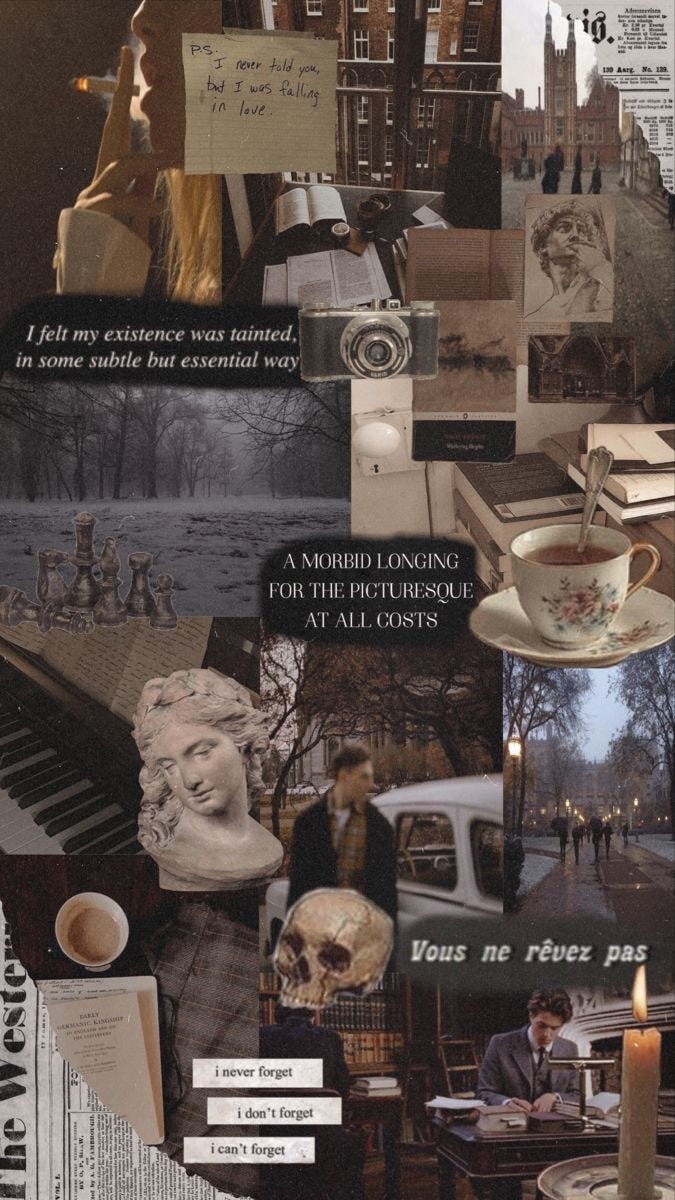
i scroll at least one tiktok promoting the aesthetics of the secret history or how fine henry winter is at least once a day, which is concerning to say the least. there is truly nothing more alarming than seeing people read a book about the problems with obsessing over aesthetics, and then posting pictures of the, you guessed it, aesthetics of the book. is donna tartt laughing or crying?
just as richard was blinded by his “morbid longing for the picturesque,” we are blinded by our need for pretty pictures and neat summaries. we need tropes, aesthetics, and romanticization to survive. why dig deep when you can be shallow? it looks better. but it also distracts from the true meaning of things. over and over, we fall into the same trap as richard did.
“It is is better to know one book intimately than a hundred superficially.” - Donna Tartt
and while this may seem like nothing more than a slight error, it was absolutely devastating for richard. his obsession made him malleable. his obsession made him blind. i want you to stop and think about this for a minute: do you really think that they ever truly cared for him? considering how prejudiced they were against poverty, knowledge, and emotion, i doubt it. richard was so enraptured by appearence and appeal of the classics group that he was incredibly open to their manipulation. and in the end, he was the one who suffered for it.
the human psyche is malleable, which is shown by richard’s actions and the impressions made upon the reader. he told the story in the way that perfectly fit his own manipulated narrative. he wanted them to like him, so it appeared that they did. he wanted to be valued over bunny, so he cast him in the worst life imaginable. he liked camilla, so his portrayal of her was exponentially more innocent than the others. in short, he was so convinced of this storyline that he managed to convince us.
and so many of us, just as he once did, reach to justify the unjustifiable. we comprimise ourselves and our morals out of longing to fit in with others. in the world of social media, plastic surgery, beauty standards, buzzwords, and celebrities, this is harder now than ever. while briefly sacrificing yourself for an end goal may seem like not that big of a deal, think again. unlike richard, i doubt that you’ll be driven to kill someone else. but just like richard, who masked his poverty, upbringing, and opinions, you’ll slowly start to kill yourself. not literally, but in the sense that you’re subtly yet systematically eradicating and ignoring what makes you you.
“Your worst sin is that you have destroyed and betrayed yourself for nothing.” - Fyodor Dostoevsky
don’t be mistaken, this is not a personal failing. rather, it’s showcasing the brilliance of tartt’s novel: she used richard to reflect our own psyche back at us. so dig deeper, think critically, analyze everything, and remember your values. do not sacrifice yourself for the aesthetics of others.
“A morbid longing for the picturesque at all costs,” - Donna Tartt