THE BANSHEE
Mar 19, 2026 · 17 min read
I am sorry for the state of the footnotes, they were messy in the original, it’s my only excuse. And also the spelling, the original is quite old, and is supposed to be in dialect.
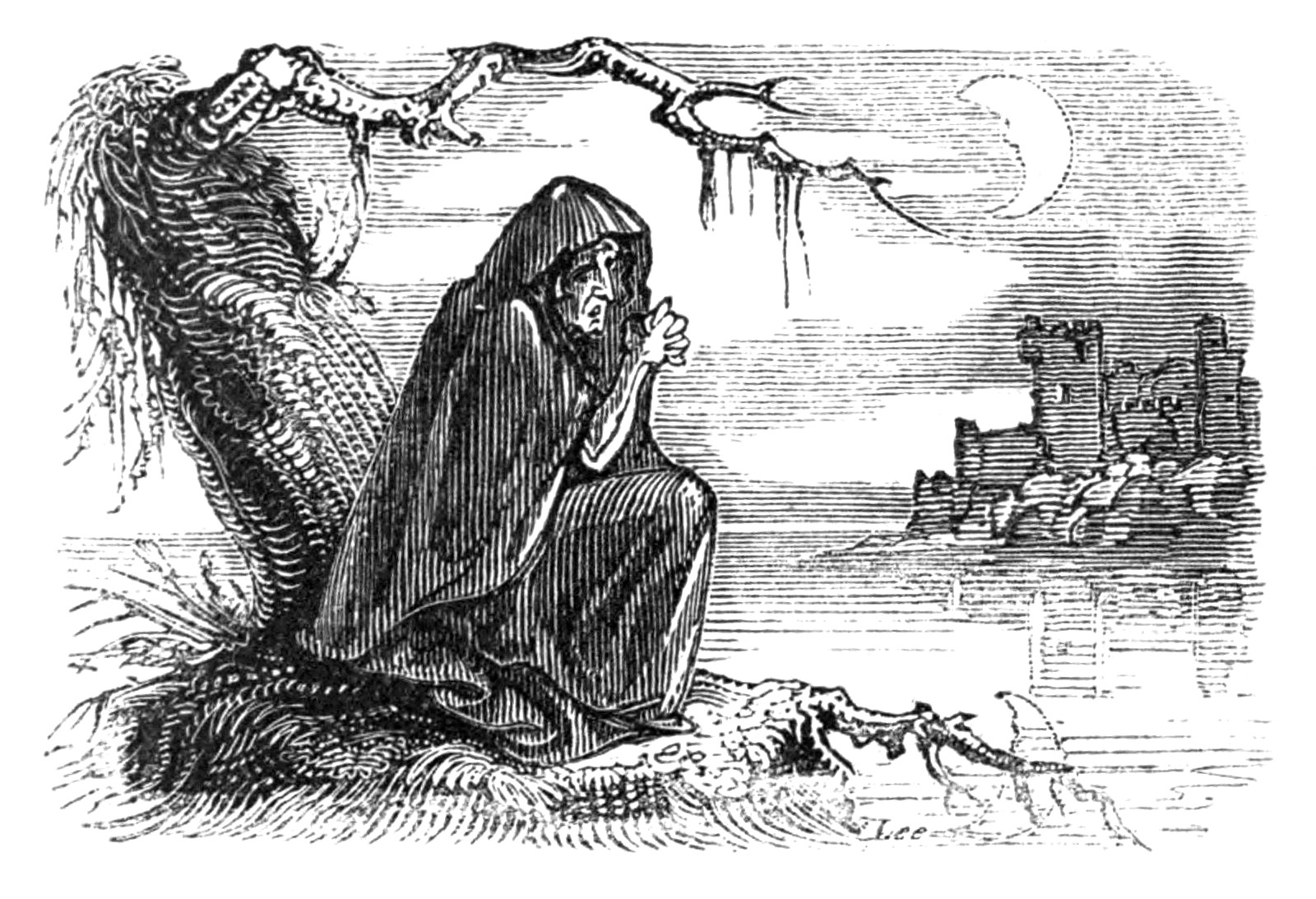
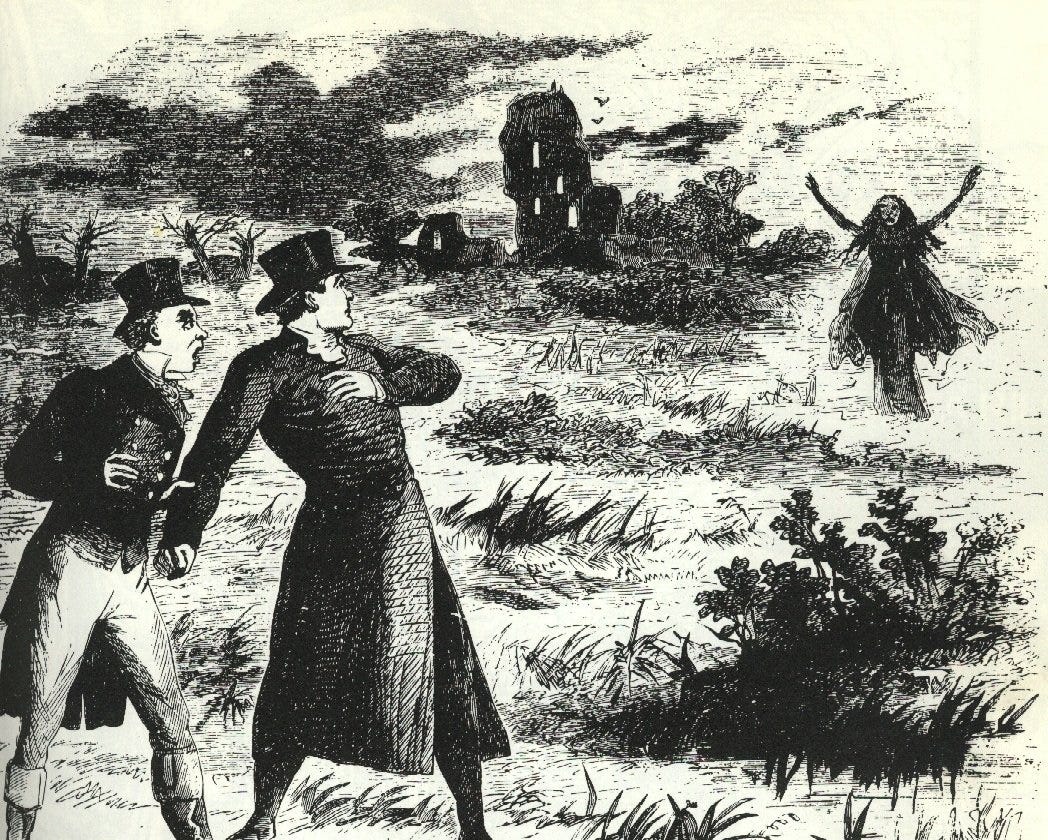
Any person however partially acquainted with the wild superstitions prevalent amongst the peasantry of Ireland, must have heard of the banshee. To those who are unacquainted with the terrible and more than eastern wildness and magnificence with which the people of Ireland clothe their legend of unearthly beings, and the depth of imagination that characterizes every belief associated with their world of spirits, some short explanation may be necessary. The banshee is believed to be an unearthly attendant on certain ancient families in this country, and it is only seen or heard previous to the decease of some of its members. It is usually represented as a small though beautiful female, dressed in the fashion of the early ages, and who, with a particularly mournful and melancholy cry, bewails the misfortune about to fall upon the family she loves. I have read* it somewhere given, that some of those fair forerunners of sorrow are actuated by a feeling inimical to the line which they lament.—This, however, is not the opinion of the people among whom the superstition is entertained, and even cherished. Their belief is, that the spirit is the friend of the family it follows; that it at one period enjoyed life, and walked the earth in the light and shadow of loveliness and mortality. This, I think, is the more natural turn for such things to take in the human mind, however rude; and the very fact of its always crying its sweet dirge bears me out, for if otherwise than a friend why not rejoice? It is also said to be very shy of encountering a mortal eye; and the slightest sound wafted on the breeze of evening drives it from the sight like a thing of mist. Now for my tale.
On the borders of the small and ruinous village of Ballintobber,† in the county of Roscommon, there lived a small farmer, named James Moran, or as he was stiled by the country folk, in their own peculiar manner Cooleen baun,‡ alias Shemus Gal.§ He was married but a short time to the servant of a gentleman in the neighbourhood, in whose family she had lived for a good many years, and being of careful habits, she brought to Shemus the better part of her earnings. One fine evening in the month of April, when the grey gloaming is beginning to extend itself, dim and shadowy, into the long nights, giving promise, at intervals, of the glory and beauty of the approaching summer, Madgy (Marcella) sat alone in her cottage, plying her household affairs with a happy heart, and expecting her husband to his evening repast after the toils of the day. Night came, and the hour that should have brought her husband to his home, passed away without his coming. She began to grow anxious and uneasy, and setting his supper by the fire, to keep it warm, she closed her door, and sat down beside her spinning-wheel with a sigh. Another hour passed away, and sad thoughts began to rise in her mind. All the wonderful and fearful stories she had heard about ghosts and fairies, and all the goblins that haunted the castle of the O’Connors, and all the blood that was spilt around it, crowded upon her imagination; and as the blaze of the sprightly fire cast flickering shadows about the house, the agitated and imaginative Madgy would start, and look around her with frightened glances. “I’ll sing a song,” said she to herself; “it will relieve my mind and prevent such idle thoughts from disturbing me, besides making the time pass quickly until Shemus comes home;” and she began singing in her native Irish a wild legend, still in connexion with the subject that haunted her imagination, and which being translated might run pretty much like the following:
BALLAD.
Fair Eveleen sat in her tower high,
On a calm and a silent night;
And she gazed on the twinkling lamps of the sky
Than her own blue eyes less bright.
And the silver moonbeams bathed her brow,
But her cheek was as cold and pale;
“Darmuid’s fleet foot is lagging now,
Ah! what means that dreadful wail!”
For wofully sad was the thrilling strain,
Now borne upon the breeze;
And it fell on her brain like an icy chain,
And her heart’s blood began to freeze.
And still as the dying pauses swept,
In their wailing sounds of fear;
The sobs and the plaints of one that wept,
Rose sadly upon her ear.
It was the banshee! and she came to tell
A tale of sorrow and death;
For Darmuid that night ’neath a rival fell,
Upon Móin-more’s* dreary heath.
Such unearthly sounds!” poor Eveleen well
Their meaning could discover;
For the morning sun-beams fairly fell
On her corse, beside her lover!
By R. Prowse - Wicklow Heritage, Public Domain,
The wild song was scarcely concluded when Moran entered. He was much agitated, and looked about him with a haggard glance. Madgy started in alarm at his bewildered air, and tenderly enquired what was the matter with him.
“Oh, sit down, Madgy, aroon, sit down, and give me my supper, for I’m scarcely able to faint, then I’ll tell you all about it—ochone, ochone!”
While Madgy was preparing the humble repast, he became more composed, but still the thoughts of something terrible seemed to linger about him.
“Now, Shemus, asthore, tell me what in the world frikened you out of your life.”
“Arrah hould your whisht, Madgy, ’tall I gather up the bit ov gumption that I had afore this night, Och, wirra sthrue.”
“Were you murthered or kilt, Shemus, jewel—or what came acrass you at all at all?”
“Och, thin, it’s yourself that’s the foolish woman antirely; don’t you see I’m neither cut or bleedin’, an’ how can I be murthered? an’ iv I was kilt, itself, sure it’s nothin’ to what came over me this blessed night!”
“Arrah, then, maybe it’s somethin’ that happened the mare, or the heifer, or the pig, or the—”
“Ochone, ochone! thin I b’lieve it’s yourself that’s mad, or ravin’, or murthered in arnest, for one woman like you, that couldn’t let a misforthenate man alone for a while; will you just sit down, an’ say nothin’ an’ show that you didn’t lose your seven senses as well as myself!”
This was too much for the fond Madgy. She thought some unheard of misfortune, too terrible for her even to conceive, had befallen her husband; for murdering or killing was only a trifling injury; the next in the scale of evil would be any damage done to the mare, or the cow, or the sow; any thing beyond that should be something out of the common line of calamity: so, unable to restrain her emotions, she threw herself on a seat in a paroxysm of grief, and began the Irish cry, in all its tones and variations, from the wild burst of lamentation, rising into a shriek, to the low, sorrowful moaning of smothered anguish.
“Och, och, ochone, gra ma chree ma cuishleen baun,† is it yourself that’s come to the black misfortchen unknownst to the world, an’ your own Madgy, that used to be your Colleen asthore,‡ och, ochone!”
This touching appeal was too much for the feelings of the tender-hearted Shemus. He started up, clasped his arms about her neck, and joined in the thrilling chorus to this particularly sad and melancholy wail. After exhausting the fountains of their tears, and in some degree easing their hearts, for tears bring relief, they sat down quite composed at the fire.
“Och, Shemus, a vick sa goltha,*” began the anxious wife, “what, in the name of all the saints and angels came over you?—do tell your own Madgy.”
“Oh! then, just listen now Madgy, an’ I’ll tell you all about it; an’ don’t say a word to stop me or stay me till I have done.”
Madgy did not answer, but bent herself forward with eagerness to hear the tale.
“Well, you know Miss Norah at the big house,” began Shemus; “she’s sick with a head-ache these two days.”
“Aye, Shemus—I hope the crather’s betther anyhow.”
“She’ll die as sure as a gun, Madgy—I know it all.”
“Ah, dont’t say that now, Shemus; sure the Lord wouldn’t take the masther’s one daughther from him that way.”
“She’s a dead and gone corpse, I tell you, Madgy; didn’t I see the banshee, and hear her too, this very evenin’, comin’ through the grove at the ind ov the garden, as I crossed the stile. I thought I heard somethin’ at first cryin’ and keenin’ down by the sthream, and every hair on my head stood up as stiff as a hackle, an’ I thought my caubeen would have run away off my head, so I stood where I was, an’ didn’t say a word; then the screechin’ came nearer and nearer, an’ the sorra such a murtherin’ screech did I ever hear afore, for I thought it was comin’ up out ov the wather all along; at last up come the banshee to the very turn of the sthrame, where the big sally tree (sallow willow) hangs over it, an’ there she sat down, an’ roared as iv her heart was bruck in two; rockin’ herself backward and forward, and meltin’ herself down into the wather wid the parfid (perfect) grief; an’ then she stood up, an’ I was afeerd she was goin’ to come to myself, so took to my heels, and never cried crack till I was inside the door with you.”
“Och, wirra sthrue, an’ did she look at you my darlint?”
“All the saints in the calendhar forbid—no she didn’t; for iv she did I’d have dhropt as dead as mutton.”
“But didn’t you tell the masther and the misthress ov all this, Shemus?”
“Arrah no I didn’t—ketch me at it: Oh, no, faix, I’m not such a fool as that, an’ have to come back an’ face a banshee.”
“An’ you wouldn’t go an’ warn the good family ov their misery. I’ll go this very minit.”
“Is it you, Madgy, ma gragal;† and will you go over the sthrame this night, after all that came across me?”
“I don’t care, Shemus—come what will I’ll go to the big house this mortual night.”
“The blessed Vargin’ purtect us—it’s myself that wouldn’t let you go alone. Come, Madgy, we’ll go together;” and both stood up to depart. Madgy put on her warm cloak, and pinned her kerchief tightly over her cap, and under her chin, and together they jogged towards the mansion of her former master. Silent and tremblingly did they pass over the stile that led by a short cut to the rear of the house. Cautiously and slowly did they approach the haunted stream, and with hasty steps did they glide by the shadowy Sally tree, and up to the door. They rushed in about the apartment, like people pursued by some dreadful spectre, and gazed about with wild and haggard looks, while the servants thronged around them with anxious and curious enquiries.
“How is Miss Norah?” were the first words uttered by the affectionate Madgy.
“Why she is purty well, I thank you,” replied one of the servants.
“Where is she, let me see her?” said Madgy, doubtingly.
“Did yous hear nothin’, said Shemus.”
“Yes—we heard that the poor widow Conry was dead; and Miss Norah went down to bring up poor little Aylee, her daughter.”
“Thank heaven!” said Madgy in a relieved tone of voice.
“Oh, then, it was for her the banshee was cryin’ as sure as I’m alive,” said Shemus.
“Banshee!” said one. “Banshee!” echoed another; and all took the alarm.
“Ah, thin, did you see the banshee, Shemus?” was ventured as a question by a third.
“Did I ever hear father Con ov a Sunday, do you think?” said Shemus with an air of consequence; “did I ever hear the banshee! Ah, thin, it’s myself that did; an’ its she that cried herself sick alther poor Shawn, (Julia, alias Judy) Conry, below at the three, at the turn ov the sthrame.”
“What sort was she?” “How did she look?” “How was she dhressed?” “What did she say?” was asked by all the listeners in a breath.
“Iv yous want the knowledge,” said Shemus, “go down an’ take a peep at her yourselves, an’ I’ll be bound that she’ll insince yous into the ins and outs ov id in a hurry.”
“No but Shemus, what did she say to you?”
“Why then I’ll tell yous—sorra resave the word at all, nor I to her; but I ran away an’ left her there.”
Here Miss Norah entered with a girl of about fifteen years of age, all in tears, and the whole circumstance of the banshee was explained. The widow’s poor daughter had broken away in the excess of her grief, and wandered by the lonely stream side to indulge in and give vent to her sorrows and miseries alone; and, as Shemus expressed it, was “near frikenin’ the life out ov him, an’ sure she might as well kil him out and out at once.” So he lost his consequence in the country as the wonderful man who had seen a banshee. Miss Norah was pleased with the affection evinced for her by Madgy, and blamed Shemus for giving way to such absurd superstitions; wondering how people could give up their reason to the chimeras of their own heated imaginations, and allow themselves to become the fools of every passing shadow or idle sound. This was received with doubtful and uneasy looks by the auditory, and one old man who was almost a silent listener to all that passed before, now broke in upon the wondering audience.
“Then maybe, Miss Norah, I was never tellin’ you,” said he, “about the banshee ov the O’Connors ov the Castle, in the ould ancient times.”
“No, Malachi,” replied Miss Norah; “but won’t you tell us now, for though I don’t believe all I hear, still I like to hear the old stories of other times.”
“Indeed—an’ I will, Miss Norah,” said the old man; “and may you never meet with such a cross either before or afther your marriage, for it’s yourself that’s good, and kind, and purty, may heaven bless you;” and the whole crowd collected round the old man, who related his legend of other days in nearly the following words:
“Well you must know in the ould times ov all, when the kings and princes were as plinty about the counthry as jackstones on the shores of Lough Ree,* that was the time that the O’Connors lived below there, at their grand palace ov Ballintobber, in the middle of the deep woods that are now all cut away. The O’Connors were the ould kings ov Connaught; an’ a mighty grand sort ov high kind of people they were antirely, an’ as wicked as murdher. Well, there was one ould king that they used to call Phaudhereen Grumagh,† and he had but one son, and a fine young jontleman he was, by all accounts. He was out huntin’ one day, not very far from his own place, and at that time there was plenty ov deers and other wild bastes about the counthry, and the right sort ov fine sport they used to have ov it.
“Well, you see, the stag took down by the little river, near Toemonia,* and the young king, being a rale mad cap, was the first in with him, as he turned at the rock by the end ov the pool; an’ by my conscience, ’twould be betther for him to be a hundred miles off, for the stag made a dash ov a burst on him, and, afore he could cry ‘the Lord have mercy on me,’ he was whipt off his horse, and soused, all tore to pieces, into the middle of the pool, ’ithout a word in his cheek. Then up come all the noblemen and jontlemen, powdherin’ on their horses like fire, and they fished him out of the pool, and carried him to the house ov a dacent man nigh hand, a farmer or a cottier, or somethin’ ov the kind, where he was put to bed, an’ docthered about, for he was in a ragin’ fever for three weeks.
“‘Och, murder in ecilish, where am I at all,’ sez he one evenin’ after comin’ to his senses.
“‘Your with friends,’ my Lord, sez a purty, rosy-cheeked colleen that was sittin’ at the foot ov the bed watchin’ him.
“‘An’ who brought me here,’ sez he, ‘or what ails me?’
“‘Why, my lord,’ sez the purty girl, ‘you were kilt an’ dhrownded there beyant, near Toemonia, by a big baste ov a stag, bad win’ to him, and all the jontlemen carried you here; an’ faix, my lord, I’m glad to see you gettin’ betther.’
“‘An’ have I no one to watch or nurse-tindher me but you, avourneen,’ sez he.
“‘Oh, yes, my lord,’ sez she, ‘the docther ’ill be here immegently, an’ sure I thought no one could take so much care ov you as myself.’
He began to grow well from that day out; and the little Noneen used to take care ov him and bring him his whay and his tay, an’ whatever kind of dhrinks the docther used to ordher him; an’ the sorra the least hurry he was in to lay (leave) the house, for they were deep in love with one another; an’ who can help such things.—At last the wars broke out, an’ he was forced to go, but afore he went he come to take his leave of Nona.
“‘I’m goin’ away from you, my darlint,’ sez he, ‘in the coorse of a week to the fightin’, achorra; an’ maybe I’d never see your purty face agin;’ and then she began to cry as iv her heart ’id break antirely. ‘But hould up your head, Nona,’ sez he again, ‘I’m just come to marry you afore I go. I’ve a friend, a priest, here beyant at the abbey, an’ he’s just at hand, an’ ’ill do the job for us out ov the face;’ an’ then he kissed her, an’ she cried more an’ more. At any rate they got married, an’ in the coorse of a week he went to the wars. They had fine fun murdherin’ an’ shootin’ one another, till it was all over; and then they come home, and the ould king sez to his son one day,
“‘Come here, Phelim, my own boucheleen,’ sez he.
“‘Well, your honour, what is it you want?’ sez the young prince quite polite.
“‘I want to get you a wife,’ sez the ould grumagh, mighty grand.
“‘Oh, then you may spare yourself the throuble,’ sez Phelim, ‘for I don’t intend to have done with myself that way for a couple of summers longer.’
“‘What would you think ov the King of Munsther’s daughther,’ sez the ould king.
“‘I don’t think she’s half so purty as the people say she is,’ sez the prince.
“‘But you know, I suppose, that I past my word ov the matther when I was makin’ the pace,’ sez his father.
“‘More shame for you, iv you did, ’ithout axin’ me,’ sez the prince, very stout; for you see he had the right sort iv blood in him—‘more shame for you, afther I gettin’ myself all smashed to pieces fightin’ for you.’
“‘Bathershin,† sez the ould chap; but it’s done, you know now, an’ there’s no back doors, so you must marry her.’
“‘Why, then, an’ that’s more than I can do,’ sez the prince.
“‘How so?’ sez the Grumagh.
“‘Bekase I’m marred already,’ sez the prince, ‘an’ there’s no man can have two wives accordin’ to the laws ov God an’ man,’ for he was mighty well larned.
Then the king got into a murdherin’ big passion, an’ swearin’ a great oath, sez he, ‘iv I had another son, I’d knock your head off you spalpeen, an’ then you might go look for a kingdom where you liked. But who are you marred to?’ sez he, somethin’ cool agin. So the prince ups and tells him the whole of the affair from beginnin’ to end; an’ the king sed nothin’ but shook his head. Well, that very night, a party of sodgers, with their guns and bagnets, surrounded the house where Nona lived, and took her away, body an’ bones, an’ no one could tell what become ov her.
The prince was like a mad man for the loss of his wife: he sarched the kingdom from one end to the other, but he couldn’t hear a word about her, no more than iv the ground opened and swallowed her; an’ a whole year passed away, an’ the prince’s grief was dyin’, an’ the ould king again proposed to get him married, and he was so tormented about it, that at last he sez,
“‘Sorra may care,’ sez he; ‘my heart is a’most bruck in two, an’ I don’t care what yous do with me.’ So the day was fixed, and the king of Munsther and his daughther, and all their noblemen came to Ballintobber; an’ there was fun there you may be sure. Bullocks and sheep were roasted, an’ whiskey an’ wine galore was goin’ about ’ithout end. Such doin’s were never seen in the counthry since or before. Well they were all in the chapel, and the ould bishop was marryin’ the young couple, and just as he was takin’ the first kiss o’ the bride, a terrible big screech was heard, and the people were all started; an’ who should run up to the very althar, but Nona herself. Well she looked about her, first at the bishop, next at the king’s daughther, and then at the prince. ‘My husband,’ sez she, quite easy, and her head fell upon her bosom, and before any one could stretch out a hand, she dhropt dead on the stone steps. Well the young prince lifted her up, and kissed her, and cried over her. The bishop sed the marriage was no use, and the King ov Munsther and his daughther went home ashamed ov themselves. The prince never went near his father afther, nor never married, but its said that the night he died, little Nona was heard cryin’ at his window, an’ that he knew her voice. And when he went, another branch of the family came in for the crown, but there was none of the family that ever died but Nona comes to cry them. Didn’t I see her myself the time the last young masther died in Jarmany at the wars, cryin’ round the ould towers, and in through the arches; and when the misthress got the account ov her son’s death, wasn’t that the very night he died.”
The most breathless attention was paid to the story of old Malachi until he finished. All expressed their pity for the innocent and unfortunate Nona, and their wonder at the concluding part. “But,” said Miss Norah, “where was she, Malachi, during the year that they were looking for her?”
“’Tundher an turf,’ Miss Norah, ‘didn’t I tell you that she was confined in one ov the dungeons of the very castle of Ballintobber; an’ the night ov the weddin’, when all the sarvints got dhrunk, she made her escape, and come to the chapel, where her heart broke.’”
“You did not, indeed, tell me that before,” said Miss Norah.
“Well, then, if I didn’t, I ought, alanna,” said old Malachi.
Such is the legend of the banshee of the O’Connors.
Source: “The Banshee,” by J. L. L., in The Dublin Penny Journal, vol. 3, no. 109, 2 August 1834, pp. 38–40.
* I think by no less a personage than Mr. Crofton Croker, but I do not give this as fact, that is, I am not certain, but I believe it.
† Ballintobber, situated in the barony of the same name, county of Roscommon; here are the ruins of the ancient residence of the O’Connors, kings of Connaught; it was at one time surrounded by deep woods, which have all disappeared. The extensive ruins stand in an angle where the road divides, and are very picturesque.
‡ Fair hair.
§ James of the fair hair, or fair James,
* The great bog.
† The love of my heart—my fair darling.
‡ Dear girl,
* Son of my neighbour.
† My white love.
* Lough Ree, or “the King of Lakes,” situated between Roscommon and Westmeath, is a very extensive and beautiful lake, formed by the Shannon: it has several wooded islands, in one of which are some very romantic ruins. On the banks of this lake stood the celebrated convent of Bethlehem.
† Patrick, the stern, or severe, or churlish.
* In Irish, Touathmona, was formerly a place of some consideration; for there was a large monastery for Dominican friars founded here by the O’Connors: here are also the remains of a very ancient castle belonging to the same family, but there are no other vestiges of its former inhabitants. It is near Tulsk, county of Roscommon.
† Perhaps—maybe so.
Comments (2)

Loved the story 👏. Not sure I understood all the words though 🥺. My “ould Irish” is a little rusty ☘️.