Salt Crown
The first thing Mara noticed was the water breathing.
Mar 12, 2026 · 7 min read
Not moving. Not lapping. Breathing.
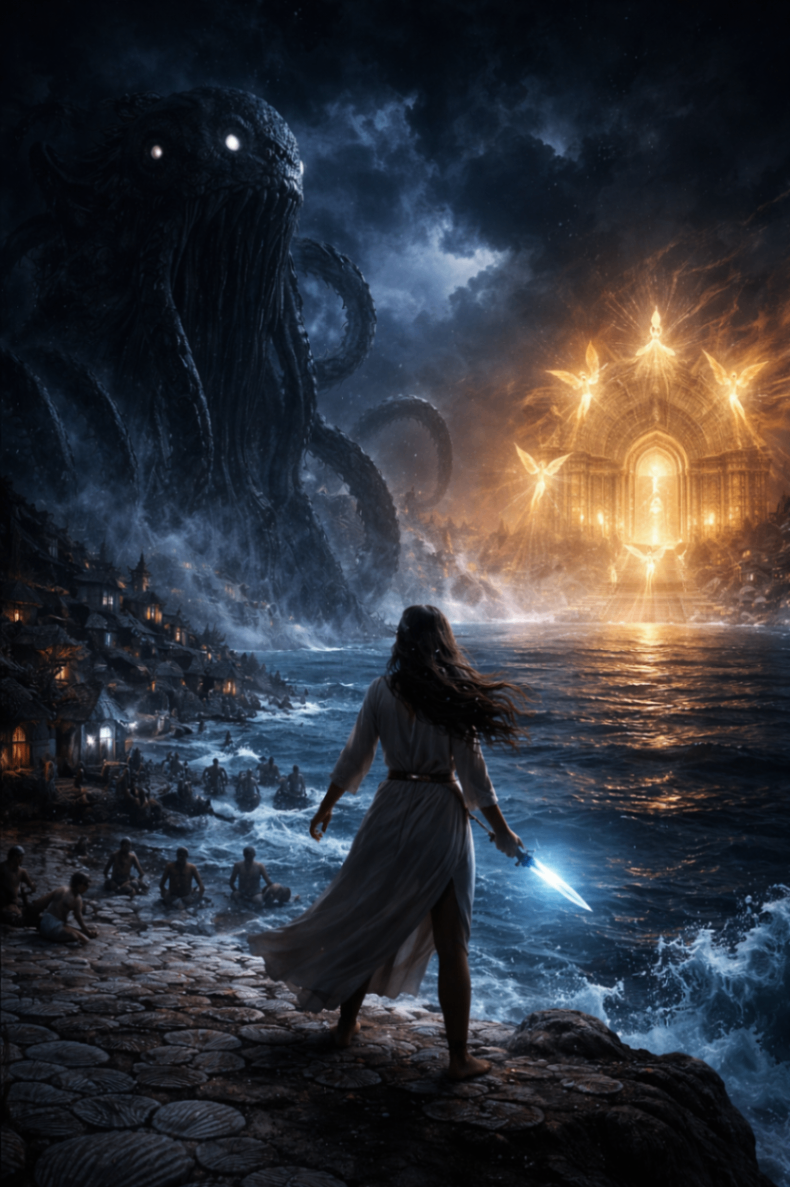
The sea rose in the dark beyond the black stone cliffs, exhaled silver mist across the sleeping houses, then pulled it back in as if reconsidering mercy. Below the village, lanterns hung from hooked poles and swung in a wind that never touched her skin. Every light burned blue.
She stood barefoot in the center of a street paved with shells.
Not crushed shells. Whole ones. Pearled spirals, scalloped fans, long ivory slivers like teeth, fitted together so tightly they formed a shining mosaic beneath her feet. The houses around her were grown, not built. Coral walls climbed in slow curls. Roofs arched like folded fins. Nets of translucent thread shimmered between the chimneys, catching moonlight and tiny glints of things that twitched as if they had not realized they were dead.
A bell rang somewhere out by the water.
The sound hit her ribs and stayed there.
Mara turned in a slow circle, dizzy, clutching nothing. No phone. No purse. No keys. Just a long white tunic belted with braided cord and a silver knife hanging at her hip that felt too familiar in her hand.
Above her, the sky bent lower than any sky she had ever seen. No stars. Only drifting shapes beneath the surface of the clouds, as though something vast moved on the other side and occasionally brushed its belly against the dark.
A voice behind her said, “You’re awake.”
She spun.
The girl who stood at the end of the shell road could not have been older than sixteen. Skin the color of rain-wet cedar. Hair braided with fishbone charms and tiny glass beads. Her eyes were a pale, stormy gray, and in each pupil something luminous turned slowly, like a tidepool catching the sun.
“You took longer than expected,” the girl said.
Mara stared at her. “Where am I?”
The girl frowned, not in confusion but in disappointment, as if Mara had forgotten a line in a play they both should have known.
“In Nerith,” she said. “At the edge.”
The bell rang again.
More doors opened. Figures stepped into the blue lantern light. Men and women and children in white and ash-colored robes, each wearing silver knives or hooks or coils of rope at the waist. No one spoke. They only looked at Mara with an attention so complete it felt like a hand pressed flat against her face.
Mara swallowed. “I don’t know this place.”
A whisper moved through them. Not panic. Worse. Recognition.
The girl took one step closer.
“You do,” she said softly. “Or you will. The sea always teaches what it takes.”
Mara laughed then, short and breathless and wrong. She hated the ocean. Always had. Not in the cute way people claimed to hate cilantro. In the real way. Bone-deep. Evolutionary. Something in her body went cold and electric at the sight of open water. Cruises were floating coffins. Beaches were lies. The ocean was too large, too hidden, too full of mouths no one had named yet.
And now it was breathing just below the cliffs.
“No,” Mara said, backing away. “No, absolutely not.”
The whisper became a sound.
The villagers dropped to their knees.
All of them.
The shell road clicked softly beneath them as they bowed their heads toward her. The girl was the last to kneel, her eyes never leaving Mara’s face.
“Our Tidekeeper,” she said.
The knife at Mara’s hip turned to ice.
The bell did not ring a third time. It screamed.
Every blue lantern shattered at once.
Glass burst outward. Flames went black. The village fell into a darkness so sudden Mara heard her own heartbeat stumble. Then, from the cliffs, came a sound like mountains grinding their teeth.
Something was rising from the sea.
The villagers did not move. Their foreheads remained pressed to shell and stone. A prayer began, low and trembling, spoken by dozens of mouths at once.
“Beloved Deep, spare the houses.”
“Beloved Deep, spare the children.”
“Beloved Deep, spare the edge.”
Mara turned toward the water because some terrified part of her had to know.
At first, she saw only mist.
Then shape.
Not one thing. Many. Columns of black, slick as fresh blood, lifting out of the ocean in segments. They climbed higher and higher, jointed and ridged, each thicker than the oldest tree she’d ever seen. Barnacles clung to them in white clusters that opened and shut like eyelids. Between the rising limbs, something vast and rounded heaved upward, draped in ropes of kelp and long streamers of silver membrane that dragged against the cliff face with a sound like wet silk.
Then the eyes opened.
There were dozens.
Some set where eyes should never be. Along the limbs. Buried in folds of flesh. Blinking sideways beneath translucent film. Every one of them shone the same pale gray as the kneeling girl’s.
Mara could not breathe.
The great thing leaned toward the village. Toward her. Its scent reached the cliff road then: salt, rot, cold iron, and something sweet underneath, like flowers left too long on a grave.
The girl beside Mara spoke without lifting her head.
“It knows you are frightened.”
Mara nearly choked. “No kidding.”
“That is why it came.”
The nearest eye rolled toward her.
In the center of it floated a reflection she did not understand at first. Not the cliff. Not the village. Not the black sea. Something gold and wavering, framed in stone. A vaulted room full of candles. Sunlight through stained glass. A woman kneeling before an altar with her face lifted in joy.
Mara’s joy.
Her favorite thing.
Not candles. Not churches. Not even God exactly, though He was tangled up in it. It was worship. Stillness. Sanctuary. The feeling of being held by something good and vast and pure. The opposite of the ocean. The opposite of all this wet, watching hunger.
The eye blinked.
The reflection changed.
The golden room was underwater.
Candles sputtered behind veils of rising bubbles. Hymn books floated open, pages dissolving. The altar cloth dragged in the current like a body trying to flee. Hands pressed against stained glass from the outside, not human hands but pale, webbed things with too many knuckles, each fingertip ending in a soft white nail.
Mara stumbled back, gagging.
“No.”
The villagers’ prayer broke. Several began to sob.
The girl rose slowly this time, as though afraid sudden movement might anger the thing at the cliff. “It has found the breach.”
“What breach?”
The girl looked at her with an almost pitying steadiness. “Your love.”
Mara stared.
“In Nerith,” the girl said, “fear governs the gift. Whatever we dread most becomes what we carry. The eel-farmers fear darkness, so they weave light. The midwives fear silence, so they call children from the womb with bells. The deadkeepers fear forgetting, so their memories can rot flesh from bone.”
A wet, dragging sound rolled over the cliff edge. Another limb finding purchase.
“You fear the sea,” the girl said, voice thinning, “so the sea obeys you.”
Mara turned toward the village, toward the kneeling figures, the broken lanterns, the coral homes trembling as something enormous pressed its weight against the world below.
“And my favorite thing?”
The girl’s mouth tightened.
“What you love most can kill us,” she said.
Far out beyond the cliff, gold began to gather under the water.
At first, it looked like moonlight trapped in waves. Then it intensified. Lines of molten radiance unfurling through the deep. Arches. Columns. Towers. An entire city of light waking beneath the black sea, rising with cathedral slowness.
The villagers began to wail.
“No,” someone whispered. “No, not the Burn.”
Mara felt it before she understood it. Warmth against her skin. Real warmth. Not the sea’s clammy breath, but the dry, aching heat of candlelit chapels and noon sun through colored glass. The warmth spread across the cliff, through the shell road, into the bones of the houses.
The ocean shrieked.
All those pale eyes snapped shut at once.
The golden city rose higher. Within its towers moved vast winged shapes made entirely of light. Not birds. Not angels. Not anything with a clean name. Their bodies were built from the geometry of prayer, sharp and radiant, and wherever their wings brushed the sea, steam exploded upward in white columns.
Mara took another step back.
The girl reached for her wrist. “You must choose.”
“What?”
“If you call the Deep, it will spare us and drown your sanctuary forever.”
Below them, one of the coral houses cracked open down the middle.
“If you call the Burn,” the girl said, and now there were tears on her face, “the sea will boil. Nerith will not survive it.”
Mara looked from the rising thing on the cliff to the city of light under the waves.
Her greatest fear.
Her favorite thing.
Each one is destroying the other.
She laughed once, sharp and unbelieving, because of course that was the design. Of course this world would take the two strongest doors inside her and hinge them on the same frame until one had to crush the other.
The silver knife at her hip pulsed cold, then hot.
The great thing on the cliff lifted one dripping limb and laid it gently, almost lovingly, across the broken lantern-post at the road’s edge. The wood snapped under the weight. Somewhere beneath the sea, the golden city tolled a bell so deep it made blood run warm from Mara’s nose.
The girl gripped her wrist harder. “Tidekeeper.”
The title felt like a joke told by a cruel god.
Mara looked down at the kneeling village, at the homes grown from salt and bone, at the children with their foreheads pressed to shell. Then out toward the light beneath the sea. Toward the sanctuary she had loved all her life, now risen in monstrous beauty, capable of burning an entire people because she had loved it too completely.
When she finally lifted the knife, the villagers began to scream.
Not because they knew what she would choose.
Because something in her face told them she had.