Reading abroad: reading in Canada is different
when I moved countries, reading habits was not on my list of possible cultural shocks

Apr 23, 2026 · 8 min read
In January 2025 I left Brazil and headed north with my entire life packed in two luggages. Destination: Canada. Ten thousand kilometres away.
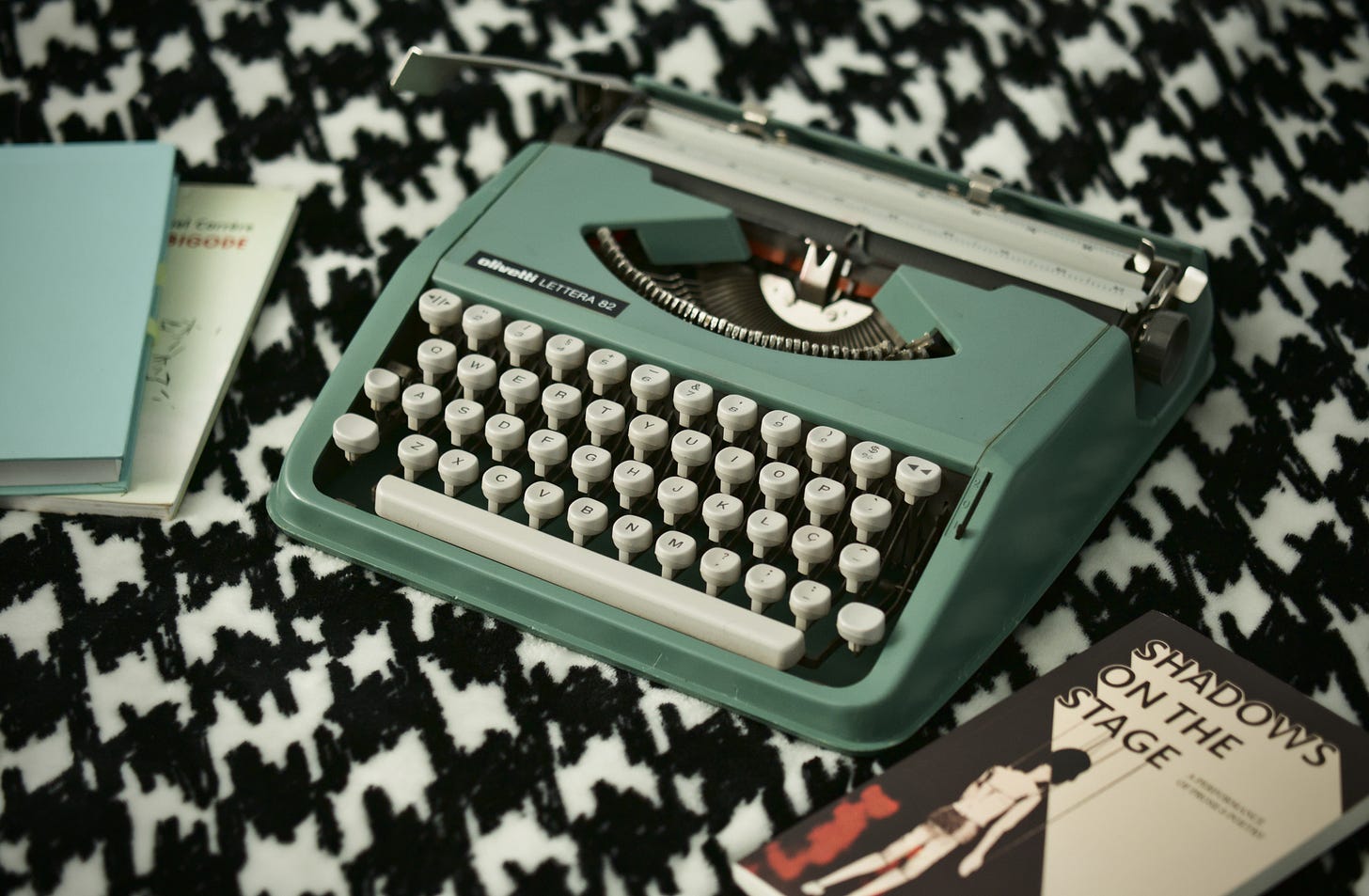
Lettera, my typewriter, tucked inside one of those luggages, was living her own separate adventure, being tossed from one cargo compartment to the other. Here she is after a 36-hour journey and three flights, tired but well:
It was first-times season: first time leaving my country, first time travelling by plane, first time seeing snow, first realizing that snow... kinda sucks?
This last one was a difficult truth to accept. As someone cursed with vampire genes and a taste for wearing black, Brazil’s tropical weather has been my life-long nemesis. I thought I would love the Canadian winter.
But before Canada, the coldest temperature I had ever experienced was 4ºC, in an abnormally harsh winter’s night that made the whole São Paulo population chatter their teeth. Suddenly I started experiencing -17ºC on a daily basis, and in 4ºC weather Canadians were going around in shorts and t-shirts.
Granted, I do find snow to be beautiful but now, living my second winter here, the negative temperatures are starting to make me feel like a eighteenth century tormented Russian novelist, slowly going insane in a Siberian prison for rebel intellectuals.
Beyond the dramatic difference in weather between Canada and Brazil, there were, as expected, many cultural differences too.
And when it comes to cultural differences it is natural to think about the most screaming ones, right? Differences that, since they are so far from the daily experience, prompts us to imagine an exaggerated version of another culture.
For example, some people here in my part of Canada believe that Brazil is a dangerous jungle all around, packed full with poisonous snakes and spiders. Honest mistake. I mean, I used to think that what Canadians did all day was hunt bears and drink maple syrup straight out of the jar. Of course, I was wrong. They actually drink it out of cups.
In reality though, cultural differences often manifest in simpler ways, sometimes in the details.
Reading habits was one of those details that was not on my list of possible cultural shocks when moving countries. But soon I caught myself noticing more and more small singularities that drew a distinction between Canadian and Brazilian reading habits. Here are some of the differences I noticed:
The Library
Library check-out
The machine in front of me seemed like something out of a sci-fi movie.
Unsure if I was using it correctly, I put the book in the scanning surface, which looked a lot like a digital scale. After some seconds, the book’s details were displayed on a small screen above the scanner.
Magic.
Quick like that, the books were linked to my library card and ready to be taken home.
Like a country bumpkin I searched for answers about the machine’s workings. Bar code scanner? Perhaps a camera? The book has a little chip inside it, my husband explained. ooooh!
The returns were simplified, too. Quickly made by dropping the books on a metal chute outside the library.
All very different from what I was used to. In my local Brazilian library, to borrow, return or renew a loan on books, I always had to talk with the librarian.
It is usually some lady with exotic glasses and perfect-made nails that will click-clack the book’s info into the computer, and warn you about the return date. They are the same people that will ask you to please, sign the visitor’s book. Which is a black-covered, old-looking notebook that stays by the entrance, chaperoned by an equally old-looking pen. Both always attached to the front desk by little silver chains.
The self check-out machine and the chute may be practical, but I miss the human element.
More than once I engaged in some interesting conversation or got a good recommendation from the librarian based on books I was checking out or returning.
All the machine gives me is an unenthusiastic beep when the operation is done. And when I drop the books into the chute, all I get in return is a metallic complaint.
99 books
I thought I had misheard it but, while handling me my brand new library card, the librarian confirmed: I could borrow up to 99 books at once. Now, that’s a huge difference from my local library in São Paulo, where one can only borrow a maximum of three books at a time.
This information keeps resurfacing in my mind. Who would need to borrow 99 books in one shot?
Then I imagine this hermit living in a cabin in the mountains. No TV, no internet, no radio. Their sole entertainment: books. This mountain person devours page after page after page, giving true meaning to the term bibliophile.
The only time they leave their cozy, isolated refuge is to make a trip down to the local library to refill their vice. And to avoid contact with civilization for as long as possible, they borrow piles and piles of books.
The auto-renew system
My local Canadian library also has this auto-renew system, so I can keep borrowed books for three weeks, and if I don’t return them by the end of that period, the library sends an email auto-renewing my loan. And it can be auto-renewed up to three times!
On the other hand, in Brazil I could keep the books for 15 days, under the threat of being fined if they were not returned by the due date. If I wanted to borrow them for longer, I had to bring the books all the way back to the library and renew the loan. And if someone else was in the waiting list for one of the books, I had to let it go.
I have to admit that the fine and the possibility of not being able to keep the books for longer added some adrenaline to the readings.
That section at the market
There are some species of books that some people love to hate, while others can’t live without. These paper-made creatures usually inhabit the book section at the supermarket.
In Canada that section of the supermarket seems to be heavily populated by erotic books, and a good amount of hard-boiled mystery and crime fiction.
In Brazil, although one can find a shy expression of spicy romances on the supermarket shelves, reading such books is still a little taboo. So it’s hard to see them in the wild, and when you do see one it is usually with a toned-down version of the cover.
I guess that’s because Brazilian culture tends to oscillate between two extremes: Over-sexualized and hyper-prudish. Perhaps this is a historical result of the Portuguese Conquistadors forcing catholicism down everyone’s throats while also behaving like this:

So in Brazilian supermarkets what’s usually present in the book aisle is a surplus of self-help and religious books, and translated biographies with New York Times Best-seller stamped on the cover.
Why those genres specifically?
Well, the average Brazilian always has too many problems to solve and not enough time to solve anything. And in a system that highly favours the rich and enslaves the poor, the people want to know: how can I succeed? From half-baked self-improvement tips, to religious juju and inspirational life stories of the rich. Any book that promises a snake-oil, quick answer to said question sells like water.
Magazines
I always find it amusing going to the market here and seeing a stand full of magazines by the check out: How to lose weight by eating more protein. 32 delicious holiday recipes. Find out about another drama of the royal family.
The flashy headlines, the information-packed covers, the glossy pages, they are all nostalgic to me.
While in Canada it still seems to be a part of daily life, in Brazil magazines and newspapers are a dying business. A painful death that started as soon as the internet gained a little more speed mid-way through the 2000’s.
I do believe that the world would be a better place without gossip magazines, but I also believe that losing these analog forms of transmitting information is a bad thing.
Unfortunately, in the transition to digital, journalism lost quality. The paper medium demands a hierarchy of information and the printing costs demand selecting which information deserves to be out in the world. Without those limitations, more and more irrelevant news is published, at unprecedented speeds.
It’s the way the internet works: fast-paced by nature, it feeds on and encourages irrelevance.
It is harder and harder to separate important news from gossip, since both ares published on the same add-cramped webpages of personality-free websites.
Little Free Libraries
At first, from a distance, I thought it was a bird house. It turned out to be something quite different...
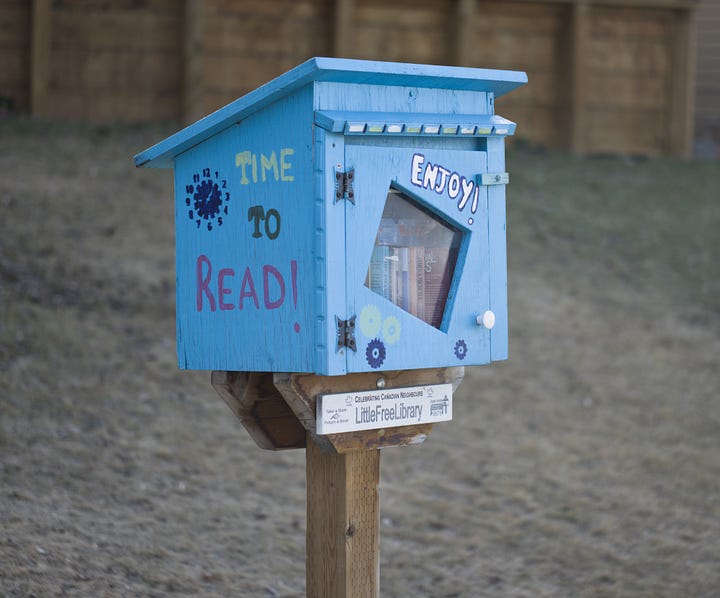
Around Canadian neighbourhoods you can find these small wooden houses filled with books. They are part of a project called Little Free Libraries, which seeks to expand access to books to more people. So you can find and borrow books without going too far from home.
Although these little libraries are usually placed on someone’s front lawn, the catalogue is a community effort, and you can contribute by putting books in it.
I recently donated a book to a Little Library close to my house, and I hope someone else will enjoy reading it as much as I did.
In Brazil, or more specifically in the São Paulo area I lived in, I saw two attempts at something like this: one of them by a local children’s school, the other by a coffee shop I frequented.
Sadly, the idea never blossomed into a full trend like it seems to be the case here in North America. Maybe the problem is that they were individual efforts, far and apart. The idea never got taken up by a dedicated organization. Which is really a pity.
Access to books can be difficult in Brazil. Growing up low class, I can say from personal experience that books are a commodity not everyone can afford. Let’s be honest, If you have to decide between paying bills, buying food or buying a book, which one would you choose?
Yes, regular libraries can help, but depending on the neighbourhood or city you live in you might not have easy access to one.
I know that the little free libraries are not perfect (maybe I’ll talk more about it in the future), but I think a lot of people would enjoy it if more of them existed in Brazil.
Well, these are some of the differences I noticed between Canadian and Brazilian reading habits. Like a patchwork, culture is made up of many distinct, colourful pieces. The details might not catch your eye right away, but they are what make the experience of living in another country a big adventure.
Thank you for reading,
–Lis