Qallupilluk
Feb 27, 2026 · 6 min read
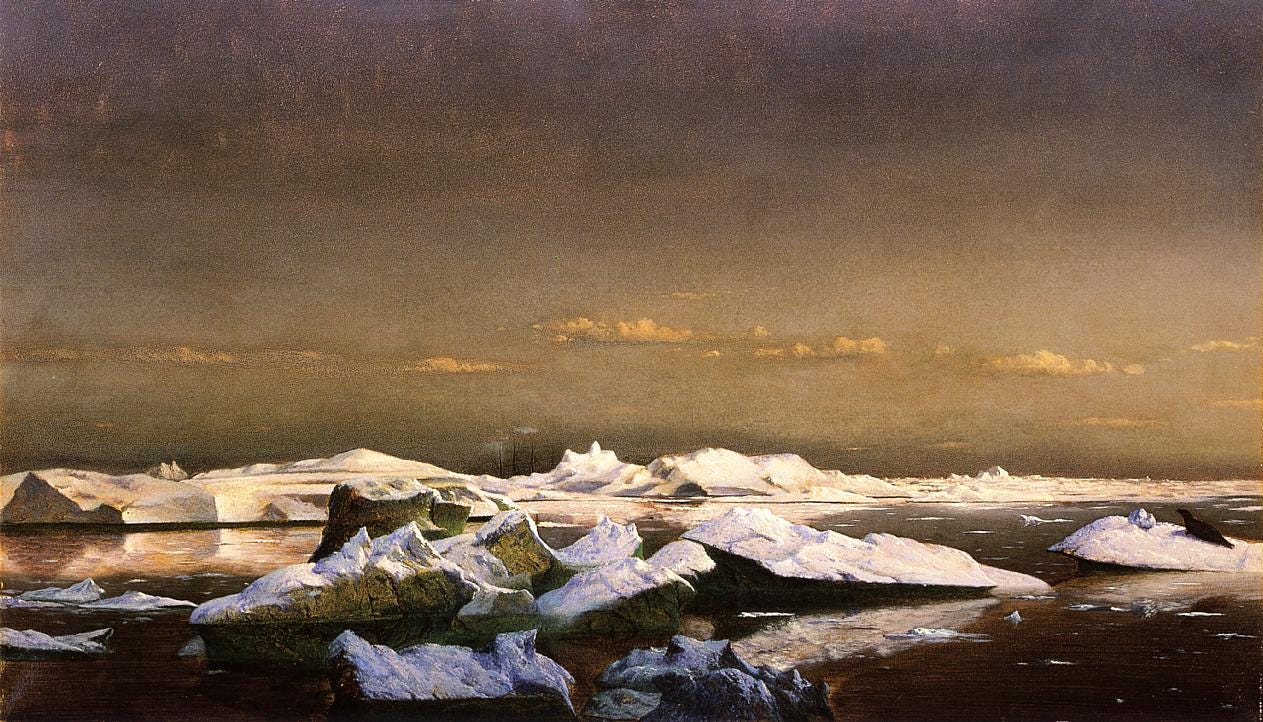
In midwinter the ocean plays at being rock. It lies flat and pale and obedient, as if the world has finally learned to hold still. Wind scours it clean. Snow drifts across it in soft dunes. Under moonlight it looks like a road—a wide white doorstep leading you out into bright nowhere.
It isn’t stone—just water holding its breath.
Beneath the ice, the sea keeps moving. It worries at its own seams. It breathes through cracks no wider than a finger, through places the tide has thinned and hollowed under the snow. It remembers the weight of bodies. It remembers the taste of warmth. And sometimes it sends warning, if you know how to listen: a knock from below, dull and patient; a shadow that glides under your boots when nothing should be moving; a low humming that seems to rise out of the ice itself, as if the ocean has found a throat.
Sometimes there is a smell, too—sour and sulfurous, the stink of rotten eggs pushed up through a hairline opening, as if something old has turned over in the dark and sighed.
That is when the elders pull children back by the hood and speak in the voice that does not allow questions.
That is when they say her name.
Qallupilluk.
Or they say the names that mean the same thing in different mouths, in different bays, on different winters. The stories shift as stories must. Some insist there is one. Others know better: hunger is never only one thing. Still the core holds, because the core is a warning built to survive midwinter. If you are small, if you are alone, if you drift close to the edge—closer, closer—then you are easy.
The Qallupilluit wait where water meets ice and ice meets air. They wait under the lip of a lead, in the dark mouth of a crack, in the place the tide has hollowed thin beneath the drifted snow. They do not need to climb onto the surface to hunt. The surface is theirs already, because children believe it is safe.
Adults know better. Adults have watched ice take a dog and close over it like nothing happened. Adults have heard the long settling groan of sea-ice shifting in the night and felt their bones answer it, as if something in the body remembers drowning.
Children do not have that memory yet. They have curiosity instead, and winter is full of invitations.
In the oldest warnings, Qallupilluk is described as almost human, the way something might be if it had learned people from below. A head that could pass in the dim. Eyes that catch light and throw it back. Hair streaming in the water like weed. But the skin is wrong—green or grey-green, slick, scaled, the color of kelp pressed to glass. The hands are too sure of themselves, and the fingernails are too long. Claws, really, made for hooking cloth and flesh and the soft part of a wrist where a mitten ends.
And she wears an amauti, the women’s parka with the great pouch at the back—except hers is not cloth and seal-skin sewn with care for a family. Hers is duck skin, or birds’ skins, stitched into something that shines wetly. The pouch is deep. It is made for carrying.
Adults can name the scales and claws without blinking. It’s the pouch that tightens their throats.
Because Qallupilluk is not a creature that kills and leaves you to be found in spring, bloated and blue under rotten ice. She is a taker. She takes you away.
The stories agree on the method, even when they argue about the reason.
She waits until you come close enough to the water’s edge to see your own face in the black. Close enough to throw a stone. Close enough to hear the small crackle of new ice forming like sugar hardening. Close enough to think, just for a moment, that you are alone in the world.
Closer.
Closer.
Closer.
Then the surface answers with a knock from below, and before you can decide whether you heard it, something hooks you fast—an arm around your waist, fingers like cold metal through your coat—and there is a sudden, impossible strength. It does not yank you out into open water. It drags you down through a place you did not know was open. A seam. A thin skin. A mouth.
Cold you can brace for. What breaks you is how fast the world vanishes. One moment the world is there—sky, snow, the familiar shore—and then it is gone. The ice closes over, and what was a gap is a smooth sheet again, a perfect lie.
Your scream hits the underside of the ice and comes back to you as a muffled thud. Your mitten scrapes, and the sound becomes a faint tapping that no one hears—or that someone hears and mistakes for the ice settling, the ordinary speech of winter.
Qallupilluk tucks you into her amauti like a mother tucking in a child.
That is where the stories split, and the split is its own cruelty.
Some say she eats the children she steals. That she keeps them under the ice until they grow quiet, then takes the warmth the way winter takes it: slowly, patiently, without anger. In those tellings she is hunger made personal, and her pouch is only a larder.
Others say she cannot have children of her own, and so she steals them to raise them. That she is lonely under the ice, and loneliness can be as dangerous as teeth. That she sings to the stolen children in the dark and teaches them how to breathe where there is no air. That they become something else—slick-skinned, long-nailed, bright-eyed—until even if the ice breaks in spring they do not come back, because the surface is not home anymore.
Either way, the end is the same for the ones left behind: the child does not return.
The Qallupilluit are said to be especially active when the ice breaks in spring, when the world is dangerous in the obvious way. The thaw makes holes you can see. The shore runs with meltwater. The sea-ice fractures into plates and the plates grind and moan. Adults watch more closely then, because the hazard is written plainly across the landscape.
But midwinter is when Qallupilluk’s work is easiest.
Midwinter is when the ocean seals itself under a lid of ice and becomes quiet enough to hear footsteps from above. Sound travels strangely through frozen water and frozen air; a child’s boots on hard ice are a drum. Laughter carries. The scrape of a sled runner becomes a bright line she can follow. A voice calls a name—just a name, harmless, everyday—and the ice keeps it and repeats it until it is no longer clear whose voice it was.
This is why the warnings are never only about the edge of the water. They are about being alone.
Alone is not only a distance. It is a condition you can feel from below. Alone means no chorus of other footsteps to confuse the hunter. Alone means no adult’s hand ready to catch the hood. Alone means if you vanish, there is no witness to say where the ice opened—because the ice will swear it never opened at all.
So the rules are spoken plainly, the way you speak to children when you want the words to stay lodged in them.
If you hear a knock under the ice, do not answer it.
If you hear humming from the ocean, do not lean closer to listen.
If the air stinks of sulfur where there is no fire and no open lead you can see, turn around.
And if you see a shadow under your feet moving the wrong way—against the pull of tide and light both—do not stop to name it. Do not try to prove you are brave. Bravery is a story for later. Winter only cares whether you live long enough to tell it.
Because Qallupilluk is not impressed by bravery. She is impressed by opportunity.
Water like a stone invites the wrong kind of trust. It makes a child believe the sea has been tamed, made flat and simple. But the sea has never been simple. It has always been a mouth. In winter it only learns to hide its teeth behind ice.
The elders do not tell these stories to make children afraid of the world. They tell them because the world does not care whether you are afraid or not. The ice does not soften for innocence. The tide does not slow because you are small. And what lives beneath does not need you to believe in it in order to reach for you.
It only needs you to take one step more.
Just one.
Closer.
Comments (2)