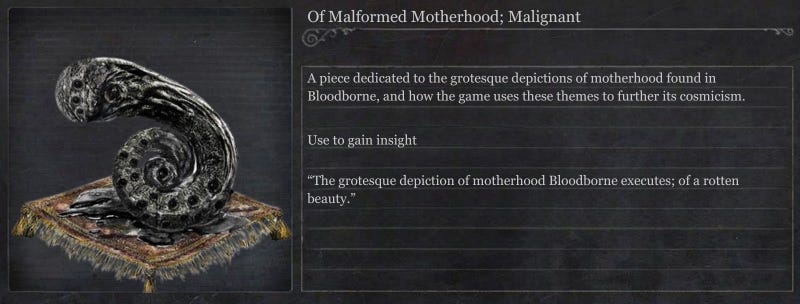
Of Malformed Motherhood; Malignant
The grotesque depiction of motherhood Bloodborne executes; of a rotten beauty
Feb 27, 2026 · 19 min read
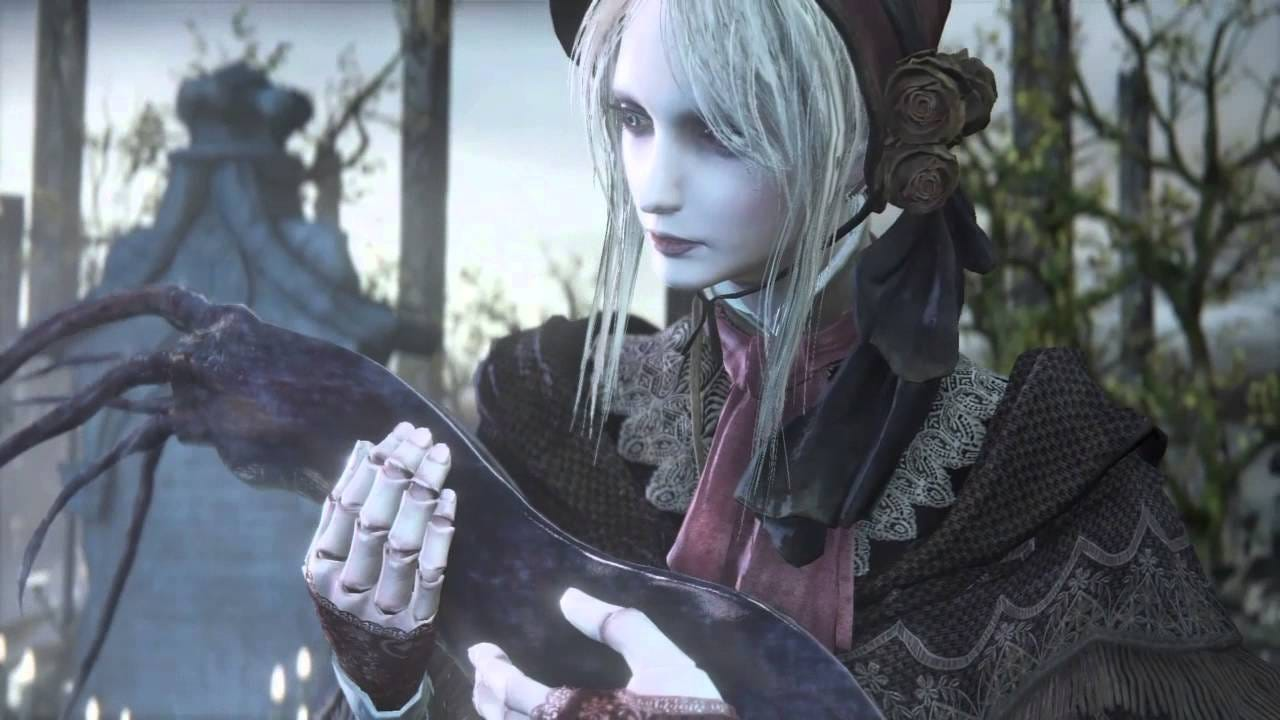
A piece born of a passion; that of my desire to forever explain just how embedded in feminist philosophy the 2015 video game Bloodborne really is. So long has this genre of games been equated to only the most die-hard of gamers (and thus, men). As I explained in my Dark Souls Is For The Girls essay, I believe the themes explored and general aesthetics of the soulsborne series is under-loved by women who are sadly yet rightly intimidated by the difficulty.
I do not want to gender games as “boy” or “girl” games, society has done that enough for my liking, but I will say that the themes explored in Bloodborne absolutely align with all things motherhood; and that which we, as women, experience, but in the most beautifully grotesque and rotten way. As HoneyBat explained in her introduction to Visceral Femininity: A Bloodborne Video Essay (which inspired a lot of this piece, and of which some of these ideas can be credited to), the topic of menstruation and pregnancy is something a lot of male gamers tend to be less than comfortable in conversing about. That is why I think it is so important to do so in this manner, relating to video games.
Menstruation and pregnancy is an experience of half of the population, and though there is a time and a place to talk about it, Bloodborne takes the “ickiness” of these concepts and turns it up ten fold. I wish it wasn’t so taboo to talk about, thus I will say I will hold nothing back in this essay in regards to it. We’re all human, and this is a very human experience!
No other game has used these themes in such a violent way, and I adore that. Too long has motherhood been seen as beautiful and innocent — no, I want it to be investigated in a horrifyingly putrescent manner. I want to cringe and grimace at the unapologetic gore and gruesomeness these ideas may illicit. Motherhood is beautiful, but it is also the only thing people believe women are capable of. Bloodborne takes this idea, of childbearing, and attacks it from so many different angles.
“Nobody is designed to have children. If you have a functioning uterus, you’re capable of having children; but that’s not your purpose.”1
Allow me to paint you the full picture…
“Are you cold?”
The Doll, Surrogacy, and Severance
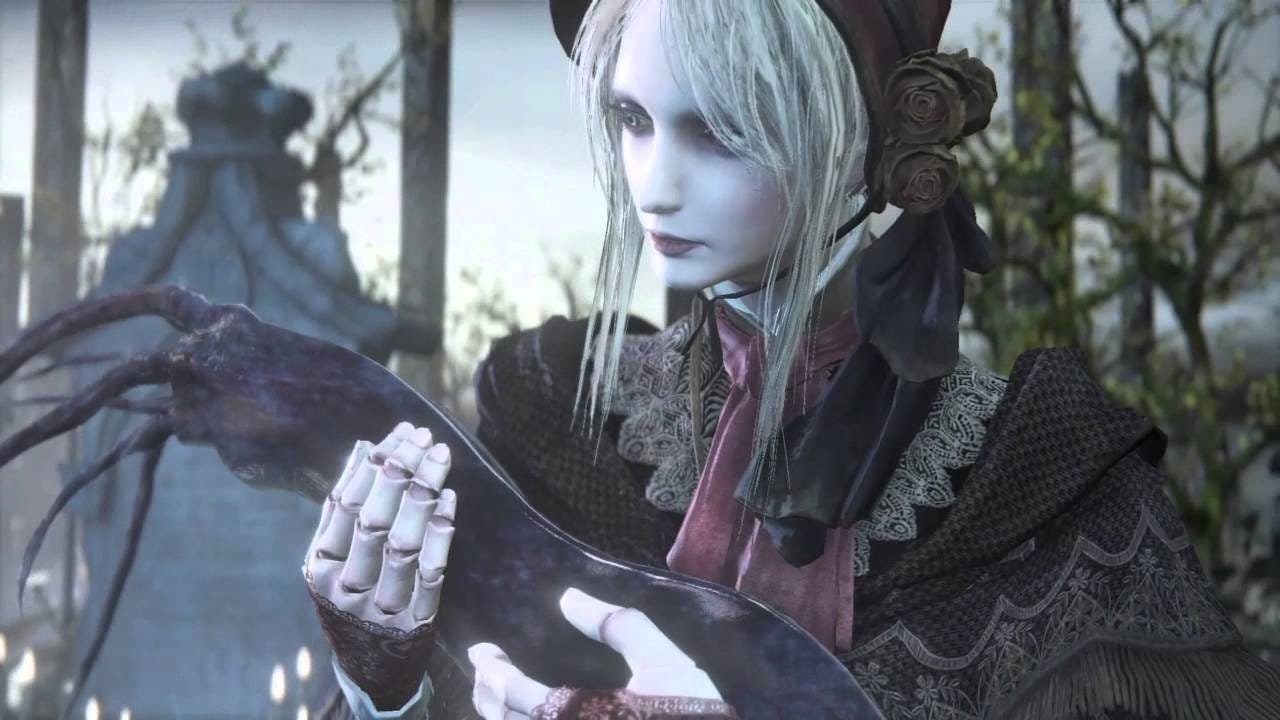
She coddles the godly thing within her arms, inhuman. It writhes and squirms, yet nestles. For the entirety of Bloodborne, you have been looked after by the Doll; the facsimile of Lady Maria. Now, you will be mothered by her again. Her purpose does not change, and never changes no matter the ending the player achieves. She is your mother, your guide through the night, and your guide through godhood. If you choose to replace Gehrman, she will mother you as she did he; mother, or perhaps a lover. If you choose to awaken, you will leave her with Gehrman to greet the other accursed hunters who will awaken in that dream; just as you did, and your forefathers.
Mother, the concept and role rather than the blood-relation, and lover, can become closely related in a heteronormative relationship. Women, in the “traditional” way society sees us, will replace their husbands’ mothers. The cycle, alike to the hunt, is endless. The Doll is the hunter’s mother, and her inclination toward you when you transform into a child Great One mimics that of a surrogate mother.
To access the Childhood’s Beginning ending, one must consume three of four existing umbilical cords. One, attained by killing Iosefka’s Imposter in the clinic; the second, by killing Mergo’s Wet Nurse; the third, by killing Arianna and her newborn Great One; and the fourth can be found in the Old Abandoned Workshop. There is an ardent connection between Bloodborne and severance (not the fantastic show lol).
The severance between dream and the waking world; the nightmare and Kos’ curse; man and beast; and, importantly, child and mother. As I will go into later, the death of the mother is the death of the child and vice versa. There is a heavy emphasis on this concept, and we cannot see it more than in the “true” ending, where we severe the umbilical cords of the Great Ones to become one ourselves.
I wonder if this could also be a manifestation of our hunter’s primal desire for comfort alike; to curl themselves into a ball and return into the warmth of the womb. The Doll becomes our surrogate mother, the same as Mergo’s Wet Nurse to he. It fulfils the prophecy, and by killing Arianna and “Iosefka”, we replace them as the ascended. We are the Moon Presence’s child, and she dutifully hands us over to The Doll.
Perhaps that is the reason we succeed in ascending. Our strength is unmatched and our feats unchallenged, but our mother is not human. With this logic, human women are not born to be mothers in this world (alike to our own), and only a being created purely to succeed in this position can protect a Great One. Human beings are fragile, The Doll may be breakable, but she is not vulnerable to the onslaught of knowledge that has killed countless scholars and turned men to beasts. No, we succeed because our mother is inhuman.
If you enjoy my writing, I can do wonders to yours! House of Hare is an independent editing company dedicated to editing your work while keeping your voice and writing style clear and respected throughout! Do consider if you’re a poet or writer; for submission pieces, short pieces, or full length novels!
Going a little deeper into this concept, we could also interpret it as a comment on women of our society. As HoneyBat also prefaces, I am not in judgement of any woman’s choices in her life. If she wishes to be a mother and does so, or cannot, if she does not wish to be a mother — it matters not to me as long as one is respectful of other women’s choices.
But I wonder if anyone else can see how Arianna, Iosefka, and Annalise represent different types of mothers. One is a woman forcibly impregnated and led to madness as a result. The unwanted babe is killed, and this kills her in turn. However much she did not love it, there is an unbreakable connection between child and mother (blood or not). Another wants a child, and is frenzied at the feeling — but does she deserve one? In the end, she is killed before she can give birth. And finally, Annalise is so desperate for a child that she has transcended to immortality in her feat. Alas, she does not bear a child.
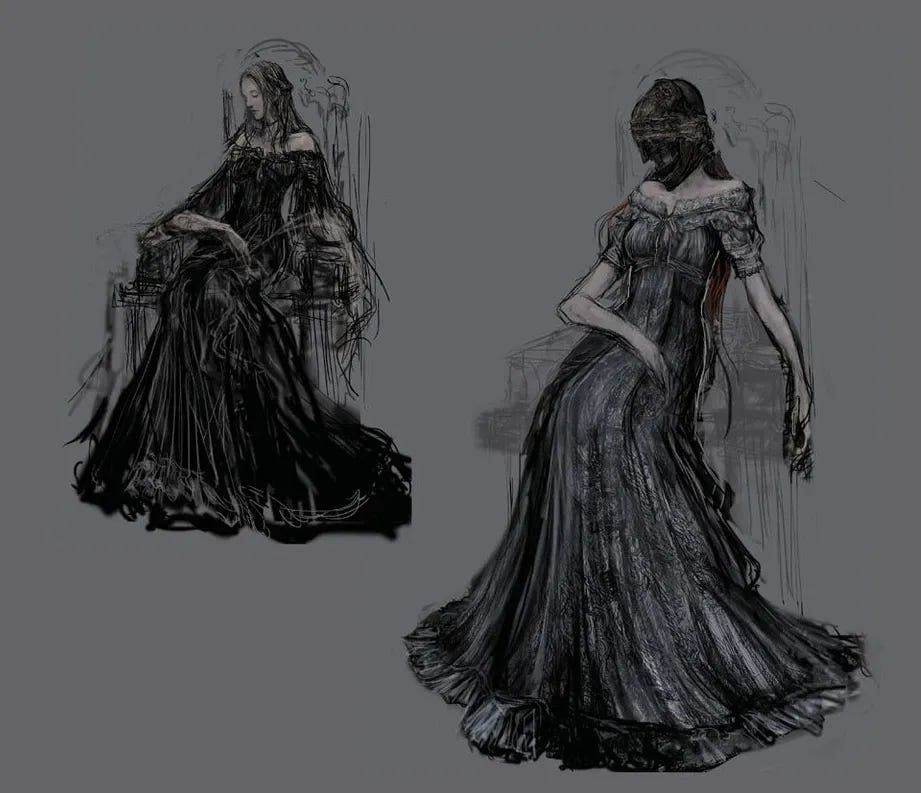
But The Doll, inhuman as she is, was created purely as a caretaker. She does not have our mortal weaknesses. She is void of complications as we, and she gets what she was made for.
“Do the gods love their creations? I am a doll created by you humans. Would you ever think to love me? Of course, I do love you. Isn’t that how you made me?”2
There’s something unkind about that; but thus is nature.
“Mercy, for the poor, wizened child... Let the pungence of Kos cling, like a mother's devotion...”
The Nightmare, A Curse, and A Weaponised Placenta
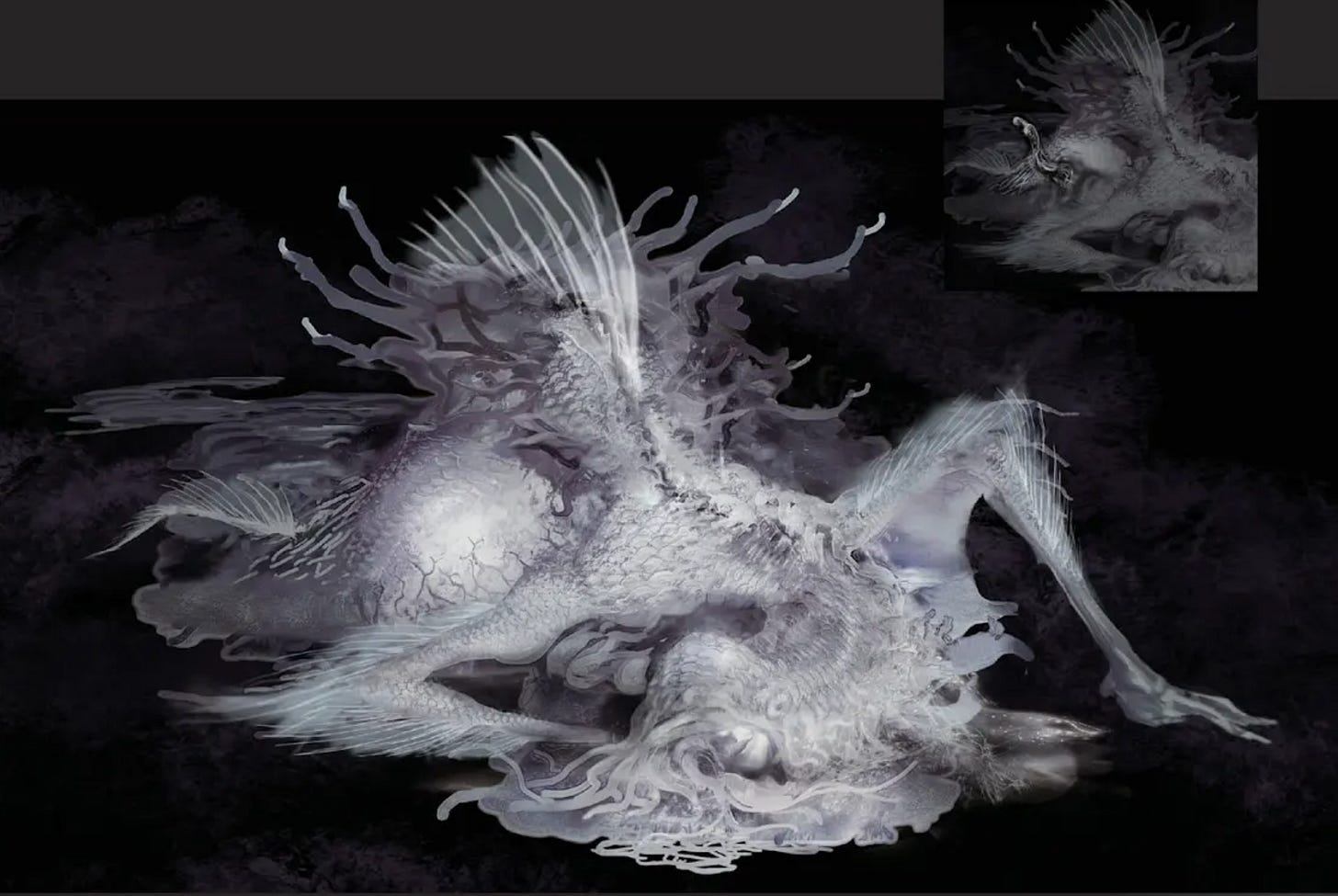
Laying motionless, abandoned yet revered, is the Great One Kos: Mother to a newborn child, now orphaned by her death. The entire Fishing Hamlet is shrouded in a thick gloam, and a potent malodour of the rotting marina. Wood doused in the endless rain decayed; sodden, rapt in barnacles. The entire place is plagued in the Innsmouth curse — a Great One’s influence over the minds and vessels of mortalkind. As a comment on Reddit elucidates:
“It certainly seems that along with the sky, the cosmos is one with the sea. Had the Byrgenwerth scholars not delved too deep and too greedily in the Fishing Hamlet and below Yharnam, perhaps they would have noticed - blood may be thicker than water, but water is a fundamental component of blood.”3
When the Healing Church were enlightened that a Great One had washed up on the beach of an inconsequential hamlet, turning the residents to piscine beasts, they leapt at the opportunity to harvest and study her corpse. They defiled her in their greed for knowledge and she cursed them, and their descendants, to be dragged to the Hunter’s Nightmare.
A mother, in vengeance for her and her child’s deaths, cursed those who committed it to eternal penance. This is the guilt and the duty of the mother. Historically, and within folklore, when a mother dies, only a surrogate can truly raise her child; another woman. Without a woman, the child will likely die, and this is due to the reliance on breast milk before the invention of alternatives in the mid-1860s. Thus, Kos’ child was doomed, and he fights in a rage for his mother. He was forced into the world without knowing love, without the warmth of maternity, and so he churned only the violence he bore witness to.
Even more gruesome is the weapon he wields. He is not some creature trained in swordplay, nor a beast with memories of using a sickle. He is a creature acting entirely on instinct. His weapon is part of his mother, a weaponised placenta — his home, his life-source for however long Great One pregnancy lasts. It’s no surprise he uses this vital organ to beat you to a pulp; screaming like a newborn.
Furthermore, it makes your author wonder if he first crawled out of his mother’s body upon our approach, or if he merely retreats there to avoid the cold. Would he, if he did not die to us, escape to the ocean? When he leaves his mother’s steaming corpse, he weeps; he weeps for her.
The Orphan of Kos was born into a cruel world — but that of his mother’s punishment. True enough that it was the misdeeds of the Church that ultimately caused her to strike them to the nightmare, but in the end it only caused her child suffering still. This is the epitome of From’s ability to write morality; there are no heroes, nor villains. Only avarice innate; and vengeance overrun.
The Old Hunters DLC does not only depict mothers as the vengeful, portentous Kos. Approaching the Research Hall, one will begin to hear rumours of a Lady Maria residing in the Astral Clocktower.
“Oh, hello. Not a pretty sight, is it?
The true face of the blood-worshipping, beast-purging Healing Church.
But that’s not all.
You seek the secrets field by the Nightmare, do you not?
Then here’s what you must do.
Climb the Astral Clocktower, and kill Maria.
She hides the real secret…”4
As we climb, young patients will mention her in adoration — they will beg for her to help them, to talk to them, to grant them succour. Just like the vacuous Rom, Lady Maria is an empty mother. Her children are but droplets, in need of a freeing death that we attempt, but fail, to grant them. Lady Maria was an Old Hunter gripped by the guilt of what she and the Church did. Out of empathy, and unforgiving guilt, Maria cast her weapon into a well and killed herself; but her soul was dragged to the Nightmare.
As penance, she protects the secret of the Fishing Hamlet and keeps all curious hunters from discovering Kos’ corpse. In relation to the previous chapter also, Lady Maria is whom Gehrman based The Doll on. She was once a warrior, but her guilt forced her to abandon her duty; to replace it. Perhaps a stretch, but I see this in the way many women battle with the decision to become a stay-at-home wife/mother, or a working woman.
Still in the throes of tradition, it’s common to see conservative philosophies finding the idea of a woman making her own fate to be against societal expectation. Many force their ideas unto women who perhaps do not want children, instead of allowing we as human beings to decide our own lives. Lady Maria is forced to abandon her duties and replace them with another. But perhaps we can also read this in a more positive light. Using her motherly instincts to look after these poor souls.
Whatever the case, Maria is a wonderful example of womanhood and motherhood coalesce.
“When the Great Ones descend, a womb will be blessed with child.”
The Queen, Gothicism, and Purity
Those of you who have braved the Chalice Dungeons in search of a platinum will be all too familiar with Queen Yharnam herself, a Pthumerian queen and the mother of Mergo; a Great One child. Though not masses of information is known about her, what we do know is steeped in feminine and maternal tragedy.
The hunter’s first encounter with Queen Yharnam is when we slay the Vacuous Spider; dear Rom. She will appear to us, a phantom, upon the edge of the lake before the rise of the Blood Moon and the echo of a baby’s cry will reverberate off the mirror lake. She gazes longingly at the rising celestial body, but we will soon lose consciousness before much else happens.
Awaking, we will be at the threshold of Yarha’gul, The Unseen Village, and a message will greet us:
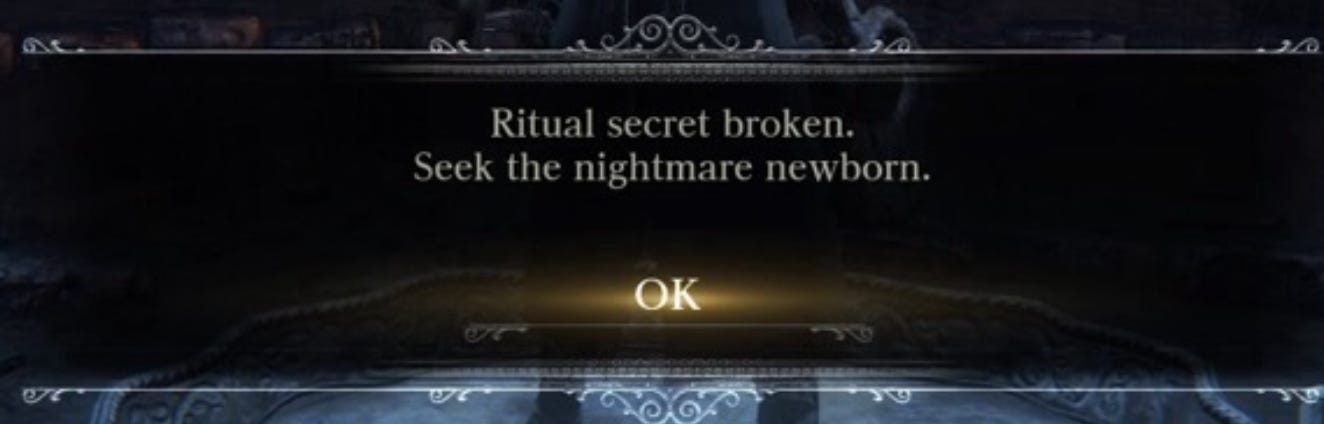
Bloodborne In Game
The use of the word “newborn” here is not coincidental. Perhaps it means the nightmare, newly born; or perhaps it means the Nightmare Newborn, i.e: Mergo. Either way, it is inconsequential and an example of From’s constant use of vague syntax to keep their players guessing.
The second time most hunters then encounter Queen Yharnam is as she stands, longingly gazing once more, at where Mergo resides — under the care of his Wet Nurse. If you approach, she will bow to you in thanks. You are setting her child free, and severing his connection to the Nightmare realms; at peace, finally. It is she who has been guiding us. But her wrists are bound — she remains coveted.
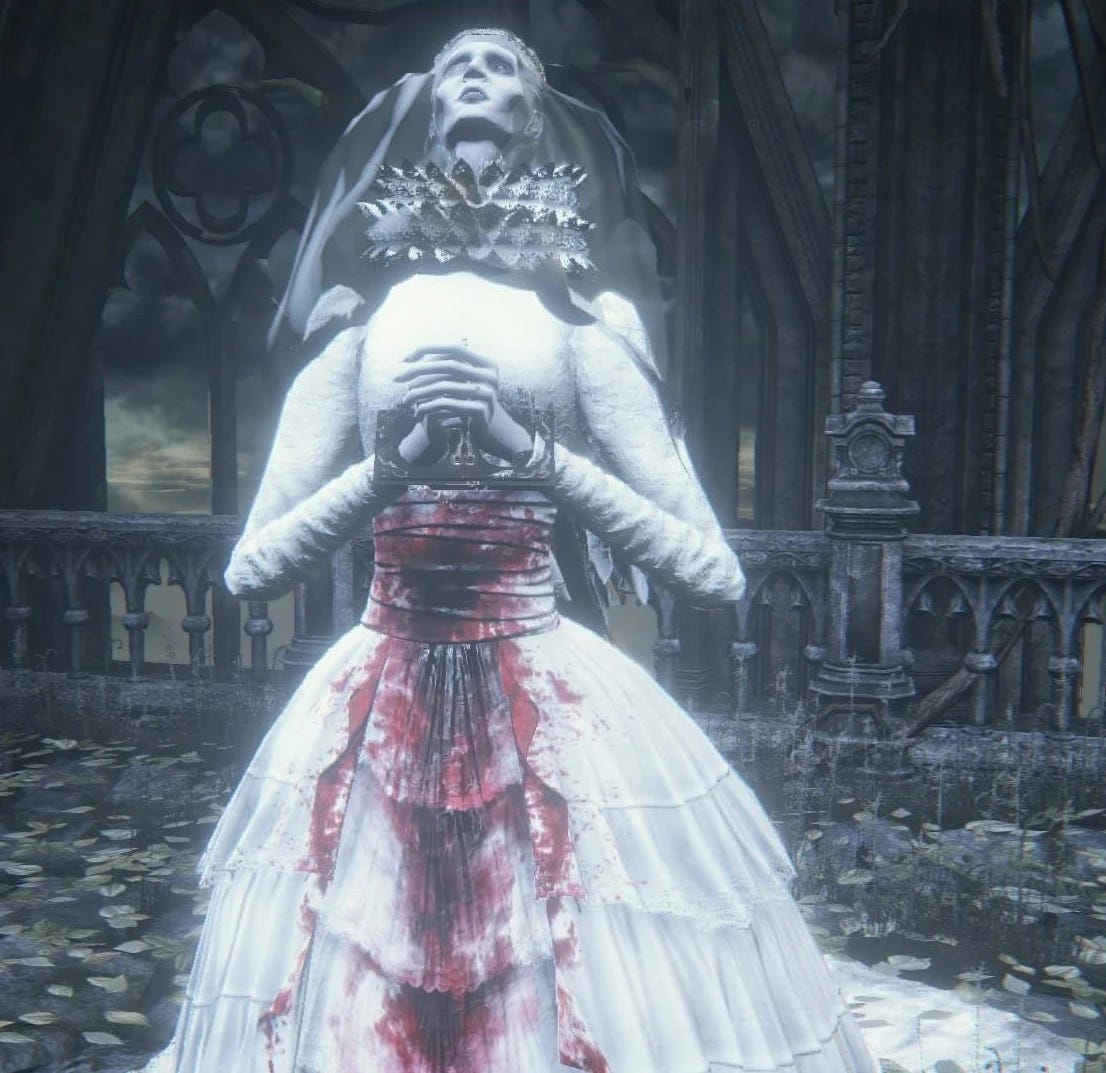
Bloodborne, In Game
Queen Yharnam in her malformed, emaciated state, represents motherhood. She encompasses every mother depicted in this game. Her pure, white dress (almost symbolic of a wedding dress) is tarnished in blood. White is often, in media, symbolic of purity and innocence. In this case, the innocence of a child? Or the innocence of a mother? She is not our enemy, and she did not mean for these events to happen. The blood that stains her is that which shows how Mergo was stolen from her belly — perhaps before he had time to grow to survive outside of her womb.
This sight, of a woman gazing up in prayer at her lost child, is a beautifully emphatic display of womanhood and motherhood. The white stained by blood represents as I mentioned above, or perhaps even the experience of all those with a functioning uterus — menstrual blood staining society’s expectations of a woman. We are expected, traditionally, to be innocent and pure; puerile, almost. In history, we were sheltered from the brutality of life and made to feel ashamed of our natural cycles. Periods are still taboo even nowadays, and men often find themselves shying from the topic as if it is too disgusting and shameful to mention.
Periods and pregnancy are uncomfortable and disgusting. The feeling of blood leaking from your vagina, especially when you know you’ve got no pad nor tampon prepared, is a truly disquieting sensation. But it is HUMAN for crying out loud. We are human, and this is a human experience. Pregnancy is pain and agony and uncertainty. Only in the past 70 years has pregnancy gone from a truly dangerous endeavour, to one of slightly more security. But Bloodborne takes this concept and runs with it. Pregnancy is probably the most cosmic thing a human can do. You’re quite literally growing another creature within you, only to have that creature leave your body and become the same creature as you are.
Bloodborne’s core theme is MOTHERHOOD. Art is life-borne, and we take living experiences and put them into our creations. This game, on the very surface, is about motherhood.
Returning to Queen Yharnam briefly, when we eventually brave the complex Chalice Dungeons and fight her, she is different from the phantom we have seen throughout the game. Her dress is still sodden in blood, but her belly is swollen. In this depiction, she is still pregnant, and when she duplicates herself, HoneyBat enlightened me to the fact that you can tell who the real one is by looking at her belly. Her mimics are not pregnant, showing once more that concept of severance between mother and child.
Furthermore, and more so as a fun little fact for my readers, are you aware that if your insight is particularly high in the early game, you can hear Mergo’s cries throughout Yharnam? He cries for his mother, but she cannot reach him. Not anymore.
"It can't be... this is a nightmare..."
Hags, Shame, and Daughters
One of my favourite revelations that HoneyBat helped to reveal to me is that every Yharnamite, accursed in beasthood, are men. Their models are all male-esque, and their voice lines, though corrupt, are masculine. The only exception to this are the Hemwick hags. They dance and cavort, laughing maniacally, drunk on blood. But they are not bestial, not in the way most Yharnamites present.
Old women have historically been the focal point of ridicule within folklore and literature. Witches and hags are the subject of old wives tales and tales to frighten children. Such prominence was their presence in our folklore that they even became a real-life fear; sparking the infamous 17th century witch hunts. Depicted as old women, one can only wonder why old men did not receive the same treatment (though men were also tried as witches, this legacy is not so well known). Old women as is are often seen as societally useless. Once they no longer can have children, they no longer serve the human race. This is a vile disregard of existence beyond “duty”, but I do not think I need to tell you that.
This, I think, relates to these Hemwick hags. Unlike their male counterparts, they are entirely unique. They do not seem to succumb to the beasthood of the healing blood, and HoneyBat made a fantastic point here. Perhaps it is our periods that keep us cleansed of the scourge. All who experience periods understand the utter hell that is PMS, and the relief of the bleeding that seems to relieve the mood swings, but HoneyBat explains that this was historically seen as the body cleansing itself of bad energy. This relates to the Four Humours, a theory in medicine that dates back to Hippocrates.
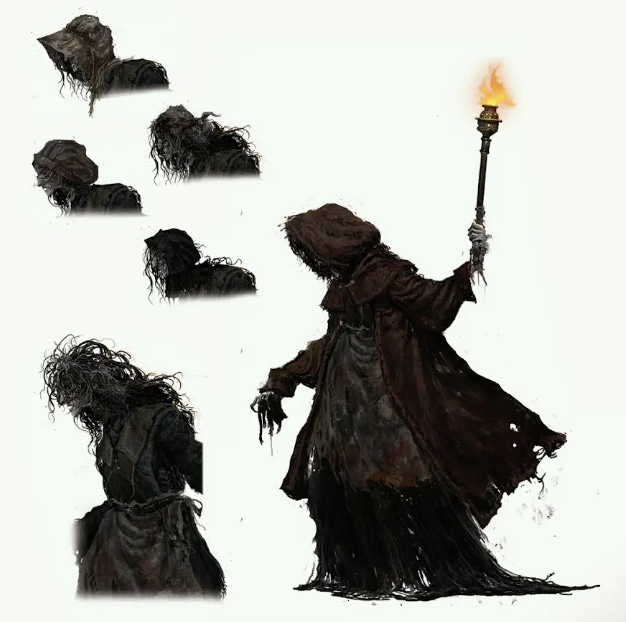
Hemwick Grave Woman; concept art
To heal oneself, one must balance their unbalanced humours (black bile, yellow bile, blood, and phlegm). This is why blood letting was such a prominent part of medicine until worryingly recently (the late 19th century when Germ Theory became widely recognised). Perhaps this could also relate to Bloodborne’s women. Every month, a woman would bleed out the scourge during her period, and would save her from beasthood.
The hags of Hemwick are drunk on blood, but not lycan-esque. Perhaps they had, throughout their lives, been countering the effects of the Old Blood with their monthly periods. It certainly makes sense thematically, what with the endless symbolism toward moon cycles and pregnancy.
Arianna is an NPC many hunters are very aware of. She is a prostitute with Vileblood ancestry that connects her, for better or for worse, with the Pthumerians (an ancient race of people who first made contact with the Great Ones). Should you keep her alive until the blood moon, you will greet her as she writhes in pain.
“Oh...there's something wrong with me...”5
In time, Arianna will move to the sewers below the Chapel and will be discovered after giving birth to a baby Great One. She sits in a chair, the worm-like larvae squirming beneath her; looking up in a kind of yearning for its mother. She weeps, and wonders just what this means for her.
“It can't be... this is a nightmare...”6
Arianna was forced to give birth to this child. She had no means of disrupting the process (in a similar vein to Ridley Scott’s Alien), and fled to the sewers to hide her shame. Does this not sound so familiar to our modern day? Women, raped, forced to give birth to unwanted, doomed children? I will say no more other than abortion should NOT be illegal, and any who disagree should not interact with my publication.
Arianna is a mother, but not by choice. Unlike the aforementioned “Iosefka” and Queen Annalise, she was chosen but entirely unwilling. Her story is a tragedy, and alike to most Fromsoft NPCs, will end in death no matter what. Killed by beasts in her own home, by the jealous Adella, or by us; a mercy? Of course, we could call it that. Her death is that of rejecting the natural order. Every child needs its mother, or it will die.
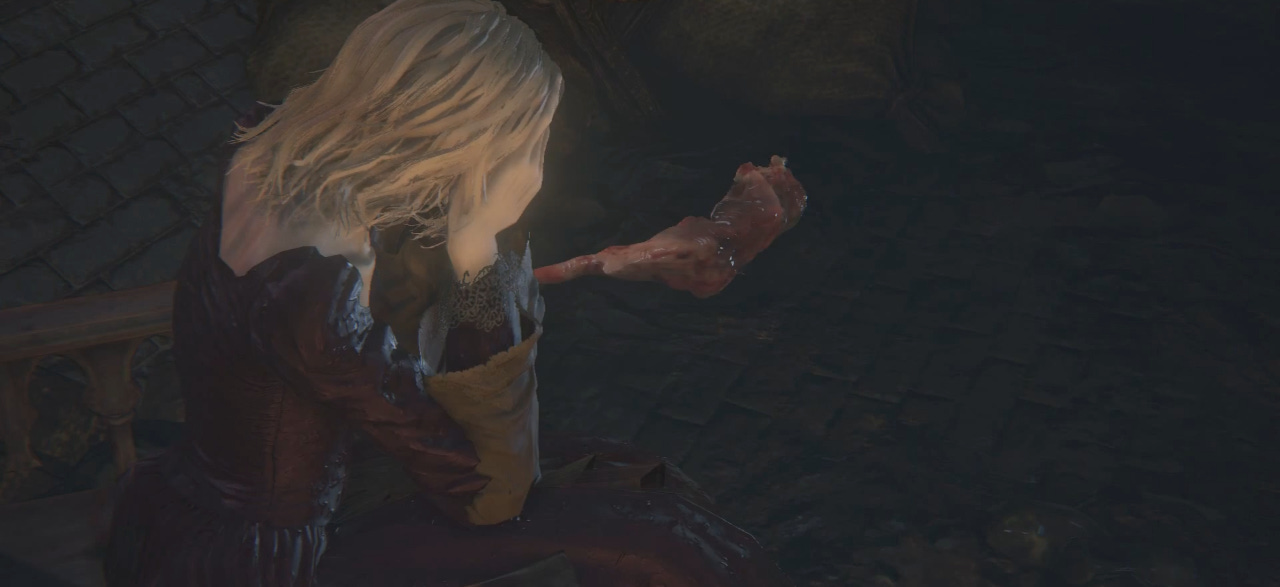
Arianna, Bloodborne
As I mentioned in Chapter I, a mother is born linked to their child. Once the player kills the newborn Great One, Arianna seizes in a disturbing frenzy before, too, falling dead. Alongside the Umbilical Cord, she will drop her shoes which read;
“Shoes worn by Arianna. woman of the night in the Cathedral Ward.
Innocent and cute. in contrast with its owner.”7
There is a kind of accusatory tone to this. It feels as though she is being presented as a wolf in sheep’s clothing, that she is not innocent due to her profession. Even in Yharnam do prostitutes get ridiculed for their strife, and Arianna is no different. She suffers, yet there does not seem to be any morsel of sympathy pronounced by either the game itself, nor NPCs around her. The only one who does not disregard her is the blind and pure Chapel Dweller.
I find this sad, and unkind, yet the perfect vision of how women are treated in our world. She was forcibly impregnated by a god (do we see a Christian link here?), shunned due to her profession, and killed by none but we, the hunter to remember her.
I do not think this is fair… but such is the Fromsoft way.
Here are some other little bits of lore that pertain to this essay, very roughly spelled out as I do not think I can analyse them in too much depth, nor need to:
Rom is a mother. It’s no secret that she is female, humanity’s attempt to create a Great One, but did it ever occur to you that she is also a mother? To some… incredibly… beautiful children… and lots of them. Children that protect her steadfastly.
The meaning of the word “mensis” is “month”. The latin origins of the word Menses is menstruation. If that isn’t confirmation, I don’t know what is!
The ghosts of the Vilebloods in Cainhurst are all women, and they are tortured. Their hands are bound and their eyes are blinded; throats slit. Some hold their heads, and their screams are paralysing. It is the very epitome of the gothic aesthetic, and wouldn’t be so out of place in an Ann Radcliffe novel. Furthermore, the fact they’re beheaded reminds your author of Anne Boleyn, Lady Jane Grey, Mary, Queen of Scots, etc; nobles wearing aristocratic attire yet resulted in execution nonetheless.
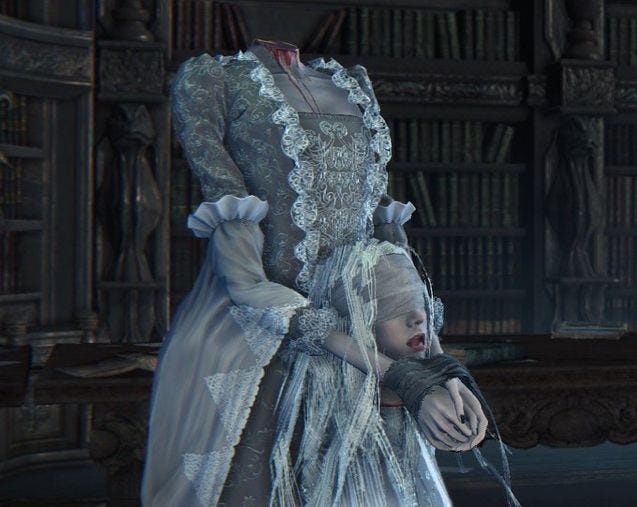
Cainhurst noble; in-game
Mergo’s Wet Nurse is a surrogate mother. For those unaware, a wet nurse was commonly employed by the wealthy and nobility; I’m actually unsure if they still exist today! They would feed their employers children from their own boobs. It is an intimate act. They were typically young women in the “prime” of their fertility, a mother themselves. With that logic, is it too much of a stretch to wonder if Mergo’s Wet Nurse has a child herself? Was she created purely to nurse the poor child? I don’t really know much about her lore to be honest, so this is a bit of a blindspot for me!
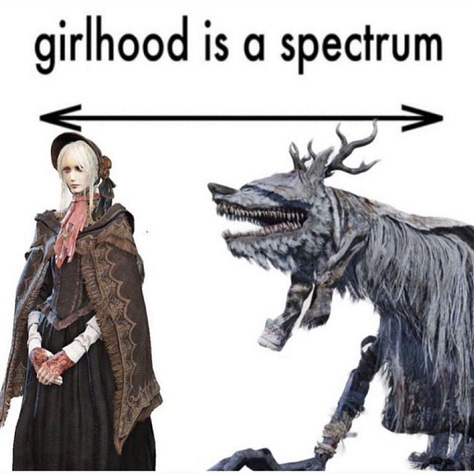
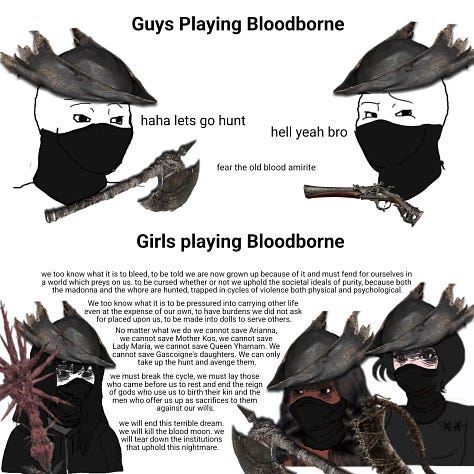
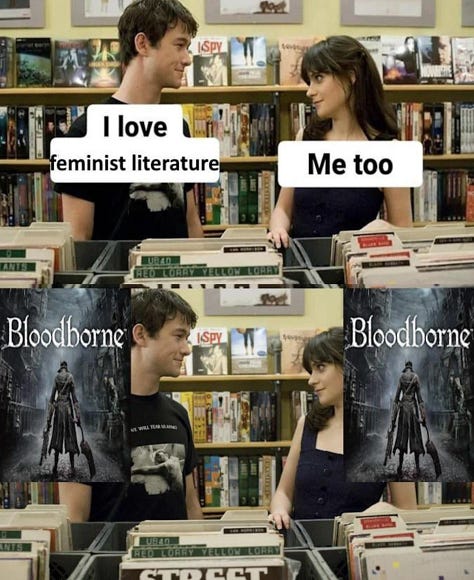
Do forgive my lacklustre citations here that aren’t in any particular style, and also the passive voice that PLAGUES my essay writing. If I was submitting this professionally, I’d clean that up… but alas… (psst, Tune and Fairweather…)
(also this was the image I wanted to use in chapter III BUT I DIDN’T BECAUSE I WANTED IT TO BE SERIOUS BUT IT MADE ME LAUGH SO MUCH (this Willem Defoe meme gets my every time).
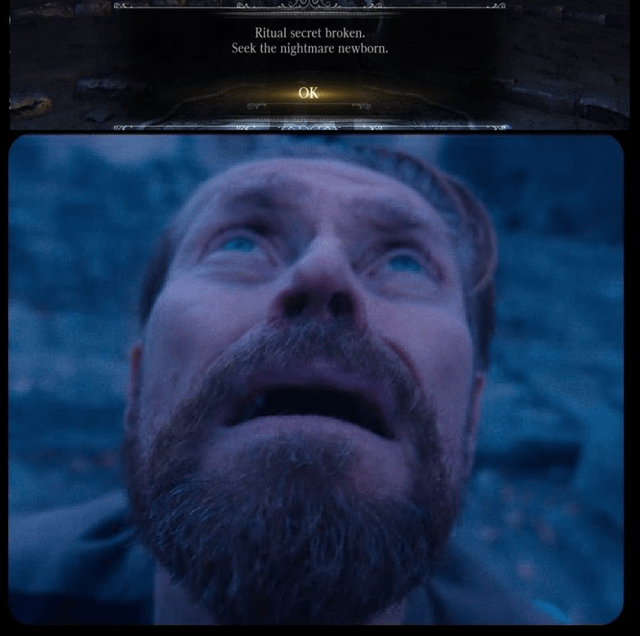
Thank you for traversing this sinister chalice with me <3
If you wish to donate some echoes, do consider doing so here!
Comments (1)
