Observing Free Will from the Window

Apr 9, 2026
You have about two hundred milliseconds. Maybe less. Free will is not evenly distributed.
“Between stimulus and response there is a space. In that space is our power to choose our response. In our response lies our growth and our freedom” - Attributed to Viktor E. Frankl
But maybe it’s more than just pretty words; maybe it’s three mechanisms in a trenchcoat.
Free Won’t
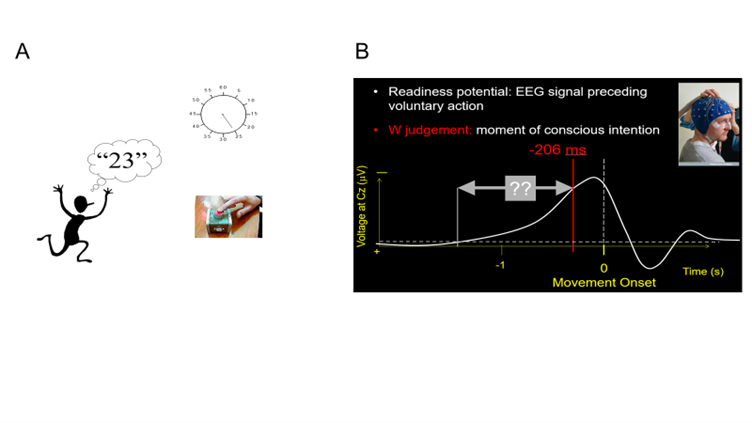
In 1983, Benjamin Libet was studying the timing of events in the process of conscious decision making. The subject would flex their wrists when they felt like it, and they would measure it via EEG machines and subject indicated stopping points on a clock. (A quick note: this was not a normal clock; it was an oscilloscope with a dot of light moving around every 2.56 seconds, especially designed to facilitate the measurement of the exact moment of conscious awareness, a notoriously tricky metric to pin down. You can think of it as a visual stopwatch with high precision, measured down to +-50 ms reporting error). So we measure the time when they flexed their wrist, the position of the dot when they felt the urge to move, and the EEG signal from the scalp when the motor cortex starts ramping up.
This ramp up period is measured as “readiness potential” (RP), or the electrical potential that precedes voluntary movement. On average, RP onset occurred between 750 and 350 ms before the action, and the moment where the person believed to have made the judgment to move was around 200 ms before.
Two big takeaways:
The readiness potential ramped before the conscious thought to take action ever took place. While there have been arguments about measurement precision in this experiment, the same idea has been retested multiple times. In a meta-analysis by Braun et al. in 2021 that reviewed nearly 40 studies, he argues that only six of those studies measured the most crucial time difference, but the temporal ordering holds.
Since the subconscious decision precedes the awareness, can you really describe our choices as free will? Libet termed this 200 ms window of awareness as “free won’t”, or an opportunity to veto the subconscious will.
If 200 ms is the quantity of free will, how would we describe its quality?
Not All Free Will is Created Equal

Depending on historical and current conditions, there are many reasons to have a smaller quantity. This could be because of anything from ADHD to trauma, addiction to chronic stress. This quantity can also shift due to temporary conditions, like an upcoming test, or a bad night putting the baby to sleep. Without a minimum quantity, quality can only take you so far: it is critical to take steps to protect the quantity via sleep hygiene, stress management, knowing your limits on a given day (“how many spoons do you have”). Regardless of the quantity of this window, which can shift from day to day, we can still control the quality of this window. Quantity is something you protect, while quality is something you grow.
Harry Frankfurt’s philosophical perspective is that true freedom lies at the Venn diagram where you align both first and second order desires (first order desire being the addict who wants the drug/second order desire being the addict who wants to not want the drug). The goal is to want what you want to want, beyond what you simply want. The quality of your window is highest at the intersection of your first and second order desires. So what are the vectors by which freedom can be grown?
It’s Time to Hit the Gym
It’s no longer just for the body builders; the reps aren’t always with physical weights! The three primary training avenues would be mindfulness training, behavioral training, and physical training. And as you use that path more, it becomes easier to access. A study by Lazar et al. showed that meditation experience is associated with increased thickness in both the prefrontal cortex and right anterior insula, both regions associated with attention, interoception, and sensory processing.
We can see similar results in behavioral training. A study by Shou et al. in 2017 showed that Cognitive Behavioral Therapy (CBT) increased amygdala connectivity with the cognitive control network, thus allowing more effective top-down emotional regulation. But this extends to physical domains as well. Like how does an athlete execute highly technical tasks in fractions of a second? Per Sanchez-Lopez et al., the difference comes in the form of more automatic mechanisms. Instead of having to think through the right choice, expert athletes can perform the same tasks with less attentional resources; novice athletes showed increased cognitive control brain activity during the task.
But this isn’t new: Theravada Buddhism had a system for training this quality of free will before neuroscience ever even attempted to measure it. The figure below shows the chain of events they established (note: this is a simplified subset of the 12-link chain of dependent origination).

When we pay attention to vedana, we’re less likely to fall into tanha. This is what the training system, satipatthana, works towards. It translates roughly to “the foundations of mindfulness”, and its weighty introductory claim lives up to the title: “the direct path for the purification of beings, for the overcoming of sorrow and lamentation, for the destruction of suffering and grief”. It’s structured as four foundations, often taught as a progression: you start with the body (kaya), progress to feeling tones (vedana), observe the mind states (citta), and then practice the awareness of mental categories (dhamma).
The body stage is normally begun with breath awareness, but eventually extends to awareness of posture, bodily activities, and so on; over time, you can leverage this mindfulness as a pillar to tie the six “wild animals” to (the six senses). The vedana stage only emerges after the practitioner can sustain bodily attention. It’s not to assess the emotion, narrative or judgment: rather, it is the very first flicker of valence. Before you even engage with it, what is the “feeling-tone” of that content? You are to notice it, stay with it, and do nothing - don’t chase it, don’t zone out, don’t push it away. The third stage involves observing this awareness and initial feeling tone as a cohesive state instead of individual sensations. Similarly to how a trained climatologist would describe a weather state, rather than simply recount all of the individual measurements. Finally, this gives rise to the fourth stage, where we observe the arising and passing of specific patterns identified (the five hindrances, the seven factors of awakening, and the four noble truths themselves).
Beyond general mindfulness, modern behavioral training, and physical training exercises, this system from Theravada Buddhism is a comprehensive way to understand how we can strengthen the quality of our window of free will. But how do we move through the world, when conscious choice adds up to about two blinks of an eye?
You've Blinked. It's Over. Now What?
Clearly, we aren’t headless chickens - we go beyond simply executing on our previous impulse until we die (regardless of what determinists might argue). Then how do we manage continuous action that outlives the window? I think the most appropriate way to understand this would be stigmergy.

Image from: https://www.mdpi.com/2227-7390/10/7/1041
Stigmergy is the process by which an agent acts on its environment based on the previous stigma (think like imprint) on the environment. Consider how termites build bridges, or ant colonies develop advanced road networks (optimized pheromone trails) over time. There’s nowhere near enough neuronal connections for this to be possible via a top-down architecture, with some particularly clever ant leading the charge. Instead, it’s a complex sequence of stigmergic actions, with each signal left in the environment signaling what the next best signal is for the next ant.
So “what is this, a center for ants?” Not quite, but similarly to how it enables advanced behaviors in colonies of ants, it can be applied to how we live complex lives beyond the window of 200 ms. With each additional rep, you’re not only improving your current condition, but tilling the mental ground to make future efforts more fruitful.
Think of Box Breathing for example. Do you ever feel better on the first cycle? If you do, well, power to you; I’m normally still cursing under my breath for at least the first two. But as you progress through the steps, you are gradually down regulating by activating the vagus nerve, shifting the sympathetic/parasympathetic balance, lowering cortisol, and reducing heart rate. Then the resulting stigma is a progressively more balanced nervous system, from which more beneficial thoughts may emerge.
Box Breathing is stigmergy applied in the scale of seconds, but we can also practice on a longer time scale. Journaling for example externalizes the internal state observations onto a page, and by the simple act of stating the observations and preferred actions, you are establishing an increased quality for the next time the window opens. In this way, you gain a bird’s eye view of your own pheromone trail. This is where human free will stigmergy differs from the ant: with training, the quality of your free will allows you to study your trail and choose your destination. It also comes into play in the stories we tell ourselves: over time, those repeated thoughts about yourself and your place in the world become the soil from which your next thoughts grow.
In these ways, free will compounds. Your past thoughts constrain or expand the action space of future thoughts. Then the actions that result from them establish the certainty of your internal model of that action space. The window at any given moment is the product of what you did in the last one shaped by the direction your current thought space points. Thus a single breath does not fix anything: it can, however, trigger the state, that allows for a better thought, which allows for a better state, and so on. Every choice carries compound interest; you’d rather be on the earning side.
So… Am I Free? Can I Be Free?
I think so.
First off, I’ll borrow a little from The Will to Believe (William James). He argues that when a decision is forced (you can’t avoid it), living (both are really possible) and momentous (the stakes matter), and you cannot choose on intellectual grounds, then the best course of action is to choose the belief that opens up a better life. He originally used this to argue regarding religion, but Free Will certainly ticks all three boxes. So why not choose the better version, where you are actually in control?
However, I also believe we are free fundamentally: 200 ms is plenty of time. Just don’t try to build a whole life five times a second. Instead, you’re preparing the plans and scaffolding, and the building naturally results. While agency is experienced in milliseconds, a life is experienced in years. Over time, we gather the accumulated agency as proof of our free will. But in every moment, we have the chance to decide again, fresh for ourselves. Are you free? How you use your 200 milliseconds every day is how you end up spending your life.
Don’t spend it all in one place.
~~~~~~~~~~~~~~~~~~~~~~~~~~~~~~~~~~~
Thanks for choosing to spend ~2000 windows with me! I’ve had the idea around free will as a reaction window for a while, but decided to take the opportunity to write it all out for this submission. I hope you enjoyed!
Cover Photo by Mehmet Akif Karakuş: https://www.pexels.com/photo/moody-silhouette-by-colored-window-in-istanbul-29837318/