Hanukah, Explained
How a little extra flame got Jews so lit

Mar 13, 2026 · 6 min read
(Author's note: Somebody seems to have tried to blow up another synagogue, and so, despite my longstanding status as a self-loathing Jew, it seems time once more to highlight our best quality: we keep our sense of humor even when things get shitty. Things are shitty all over these days, and no religion's hands are unsoiled. But they are funny too, as you'll discover if you keep reading. And yes, I realize Hanukah was three months ago.)
It’s Hanukah time, boys and girls, that time each year when Jews all over the world gather with their loved ones to try and remember what the hell a Maccabee is. Hanukah, for those unfamiliar, is a holiday that grew organically from the tenderly cultivated guilt of Jewish parents, guilt that sprang from their children’s complaints about all the great presents their Christian friends were getting. The whole oil lasting for eight days/Festival of Lights thing is a decent but to my mind uninspired cover. Then again, there probably wasn’t much time to work on the story. Jewish parents, in their continuing effort to ensure their children’s superiority in all things because apparently we had to be better in order to do as well as the goyim, raised the stakes in the December war of gifts sometime in the 1950s. Problem was, even for most Jewish families, passing out eight nights of train sets, electric guitars, and Barbie Dream Houses was a financial non-starter. So instead of train sets, electric guitars, and houses with residents lacking defined genitalia, we got gloves, galoshes, and scarves, all items true to the Jewish belief that gifts should be of immediate use because who knows when the next knock at the door will come and we’ll have to make a quick exit (see matzoh, Passover).
I am something of a self-loathing Jew, and for this I blame my conservative Jewish upbringing and schooling, both because it’s convenient and accurate. I will concede that of the religions I’m familiar with, Judaism is clearly one of the best. It’s not so obsessed with god or other folks who make the faithful kneel down a lot or otherwise avert their eyes to some non-specific but blinding glory. There’s a lot of stuff in there about doing good, giving back, paying it forward and other positive human values. And in many ways, modern Judaism seems to me among the hippest, most choose-your-own-adventure faith. It’s really the Chipotle of religions. You flip through the manual, choose those ingredients that resonate most for you, ignore the ones that creep you out, then find a place to do it where it isn’t too hard to park. Still, and this is important: it’s a religion, and as such is at bottom just a crazy story that asks you to believe in time travel, talking snakes, and other things rational people should not waste their time on. Judaism is like Jack Nicholson’s character in One Flew Over the Cuckoo’s Nest—it’s more firmly tethered to reality than the rest of the crowd, but that’s not really saying much.
Hanukah’s Core Elements
Dreidels: The bottom line on dreidels is that nobody really knows what they are, where they came from, or how to play the game they’re named for. As a general rule, American Jews can neither read nor understand Hebrew, so the letters on the sides of dreidels may as well be Urdu for all we know. Thanks to six months of daily study for my Bar Mitzvah, which is a whole other essay, I learned to read Hebrew without learning the meaning of all but a few of its words, which makes approximately as much sense as anything else associated with my religious training. I do know that dreidel’s payoff comes in the form of gelt—coins of historically bad chocolate, hermetically sealed in gold foil. I’m sure these days you can get truly delicious, 80% cacao, free trade dark chocolate gelt with sea salt, but we always got the stale, gritty kind that came in a weird red mesh bag. And while it seems that gelt became a Hanukah staple because it represents the spoils of war gained by the Maccabees in their successful revolt against the evil Greek king Antiochus, is it really the best look, given certain persistent stereotypes, for Jewish children to spend a week and a day scrambling for gold coins?
My wife’s Aunt Jean, who was the spiritual guardian of her extended family, hosted an annual Hanukah party, and among her many generosities was a near pathological effort to fill the houses of her family members from floor to ceiling with dreidels. We have dreidels that look like golf balls on tees, dreidels designed to induce hypnotic trances, dreidels with wide, creepy smiles, dreidels with arms but no legs, dreidels with hair but no arms, and dozens and dozens of dreidels that when you spin them correctly, light up and play the I Am A Little Dreidel song in that tinny, digitized music that makes your kidneys throb. We used to gather to see how many of those dreidels we could get spinning and playing the song at the same time, all at different intervals in the most unharmonious symphony ever accidentally produced by humans, but the local birds started committing suicide at an alarming rate, so we stopped out of simple humanity.
Because we are a family that values cross-cultural understanding, our slew of dreidels resides in a small wooden sleigh friends gave us one December which quickly and inevitably became known as the “sleighdel.”
Latkes: In order to remind us—like even the most addle-minded among us could forget—of the Miracle of the Unusually Long-Lasting Oil, Hanukah foods are traditionally greasy. Apparently some Hanukah menus include jelly donuts, a tradition that dates back to 1485 and one of the world’s first published cookbooks, which emanated from Johannes Gutenberg’s original printing press, a menschy thing for a German Catholic to do. But we already have bagels and knishes, and no religion needs three iconic circular baked items.
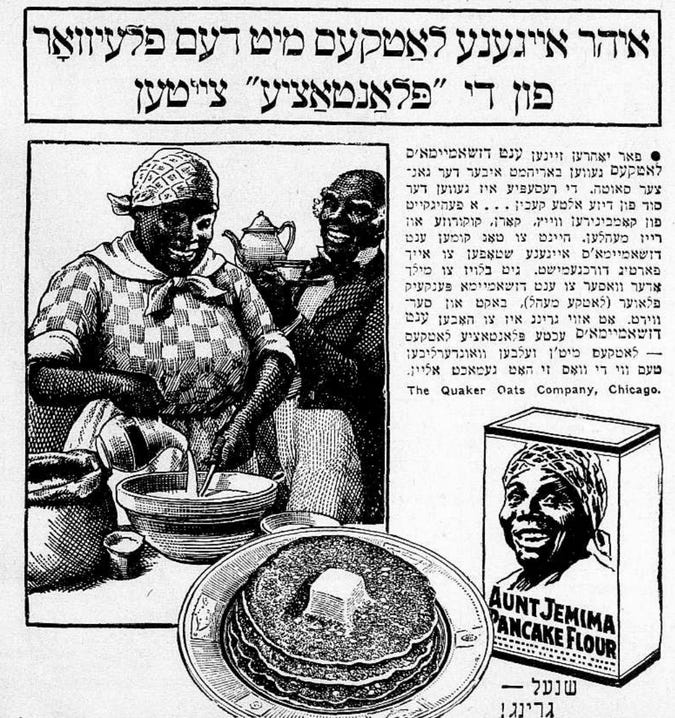
A well-made latke is a delicious thing indeed, but they are among the messiest foods ever devised and the only one that got me within spitting distance of buying a splatter screen. The key to great latkes is bone-dry shredded potatoes, and were it not for the oil connection, they might have found a better holiday home in Passover, as while crossing the desert I’m guessing Moses and the gang could’ve seriously dried some spuds. And in a truly bizarre bit of 1930s cross-cultural marketing, some impressively racial-stereotype-reinforcing ads for Aunt Jemima Pancake Mix—touted as a latke-making labor-saving device—appeared in the Forward, a national Jewish newspaper whose circulation rivaled that of the New York Times. This one features the following disturbing sales pitch: “Her own latkes have the flavor of the ‘plantation’ times.”
Spelling: The Oxford English Dictionary lists, and I am not making this up, 24 acceptable spellings of this holiday’s name, including, inexplicably, Khanukkah and Chanucha, the latter sounding more like a Latin line dance than a Jewish holiday. Transliteration of Hebrew words is at best a tricky endeavor, but two dozen spellings seems excessive, even for a competitive lot such as we.
Menorahs: Had Liberace been Jewish, he’d have had one of these on his piano 24/7. These Hebraic candelabras are responsible for a 10-15% uptick in Israeli home fires during the Festival of Lights, as they are often a bit wonky at their job. Most people know to pre-melt some wax into each candle’s vestibule, but if you don’t do it one at a time the wax in the first few will harden before you attempt candle insertion, and of course you’re performing this dangerous dance while remembering the words and tune of the appropriate blessing while keeping your kids from opening their presents prematurely, and so, fires.
The mildly uncomfortable but fully inescapable truth is that Hanukah is a pretty minor holiday, theologically speaking. It’s the only post-biblical Jewish holiday, in that no mention of it appears in the Old Testament, and its only mention in the New Testament is its celebration by none other than JC himself. But it is nice that Jews have something to look forward to in December while much of the rest of the world goes Christmas crazy. In fact, it’s my favorite time of year to be Jewish, as you get many of the presents with none of the pressure, and an added bonus: extra fried food.