floriography, part one
part of my 12th grade research paper

Mar 11, 2026 · 4 min read
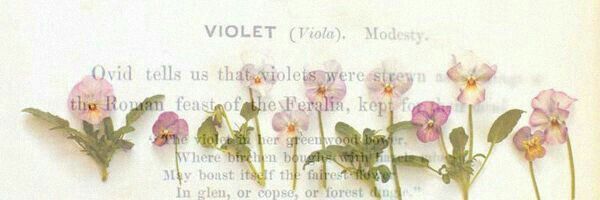
I first learned about floriography from a book series I began reading in about sixth grade. The Enola Holmes books focused on Sherlock Holmes’ little sister, and floriography played a decently large part in the plot. The series will be discussed a little more in depth later, but it’s important enough to mention now, because reading those books is what first piqued my interest in floriography. Floriography, or the language of flowers, has an interesting chronicle, one that began gaining popularity in the Victorian Era.
Floriography is, simply put, the language of flowers. People use flowers to communicate various messages that they otherwise may not say. Variations of this practice have been used for centuries, with many different objects and motivations.
One of the sources that I’ve seen says that floriography originated in Turkey, with Lady Mary Wortley Montagu, an English aristocrat, visiting Constantinople with her husband (Weiner, n.d.). She began writing home about “sélam.” Sélam was a practice where women in the harem passed objects that rhymed with other words to each other.
Lady Montagu misinterpreted this game as a way to communicate with one’s lovers through flowers. Her letters eventually became published, and the idea of a clandestine way to communicate with flowers became quite popular.
However, Cornell University Library states that floriography has connections to symbolism in ancient China, Assyria, and Egypt.The 18th and 19th centuries’ floriography is often credited to Turkey, as the previous source I mentioned has done, but Cornell University Library suggests that the traditions in European floriography actually began in France. The first known floriography dictionary was actually written in French, and was called Les Langage des fleurs (or The Language of Flowers).
As part of God’s creation, flowers are included in the Bible quite a few times.
Lilies are mentioned several times in the Bible. Song of Solomon mentions them multiple times, in verses like “My beloved is mine, and I am his. He feeds his flock among the lilies” (Song of Solomon 2:16, NKJV). Lilies are used frequently as symbols of purity, and in Kate Greenaway’s dictionary, white lilies mean “purity” or “sweetness.” Lilies are used today to demonstrate condolences for funerals and deaths.
The Bible uses olives a few times, too. Olives portray peace, which makes sense when one thinks about the metaphor of extending an olive branch to another person as a symbol of peace.
Olives don’t always symbolize peace in the Bible; from my brief study, they’re mentioned in a couple different contexts, mostly either regarding building or analogies. Romans 11:24 (NKJV) says, “For if you were cut out of the olive tree which is wild by nature, and were grafted contrary to nature into a cultivated olive tree, how much more will these, who are natural branches, be grafted into their own olive tree?” This is obviously on the allegorical side of things, but there are multiple instances of olive wood being used in building. I Kings 6:23 is an example of this: “Inside the inner sanctuary he made two cherubim of olive wood, each ten cubits high.”
Early on, floriography became a method of symbolism in literature, not just society. One well-known example would be the play Hamlet by William Shakespeare.
Lapham’s Quarterly gives examples of the flowers included in a bouquet in said play: “rosemary, pansies, fennel, rue, columbines, and a daisy”. According to The Language of Flowers: An Alphabet of Floral Emblems (from 1857), each of these flowers has a specific meaning.
Rosemary means remembrance or “your presence revives me”. Pansies mean “you occupy my thoughts,” while fennel wasn’t even in that specific dictionary. A search in a different dictionary–The Illustrated Language of Flowers from 1858, compiled and edited by Mrs. L. Burke–says that fennel means “worthy all praise” or “strength.” Rue signifies disdain, according to the Alphabet of Floral Emblems, and daisies, again, are not included in the same dictionary, or at least they are not present in the copy I have obtained. The Illustrated Language of Flowers states that daisies symbolize innocence, while columbines represent folly.
All in all, Ophelia held quite a dramatic bouquet, but drama is good when trying to get a point across. Hamlet was written between the very late 16th century and the very early 17th century, which means that floriography was in use at some point before its boom in popularity in the Victorian Era, even if it was only in literature.
Comments (1)