FIELD NOTES FROM THE DOPAMINE DAYCARE
The Youth Mental Health Epidemic Nobody Will Actually Fix

May 17, 2026
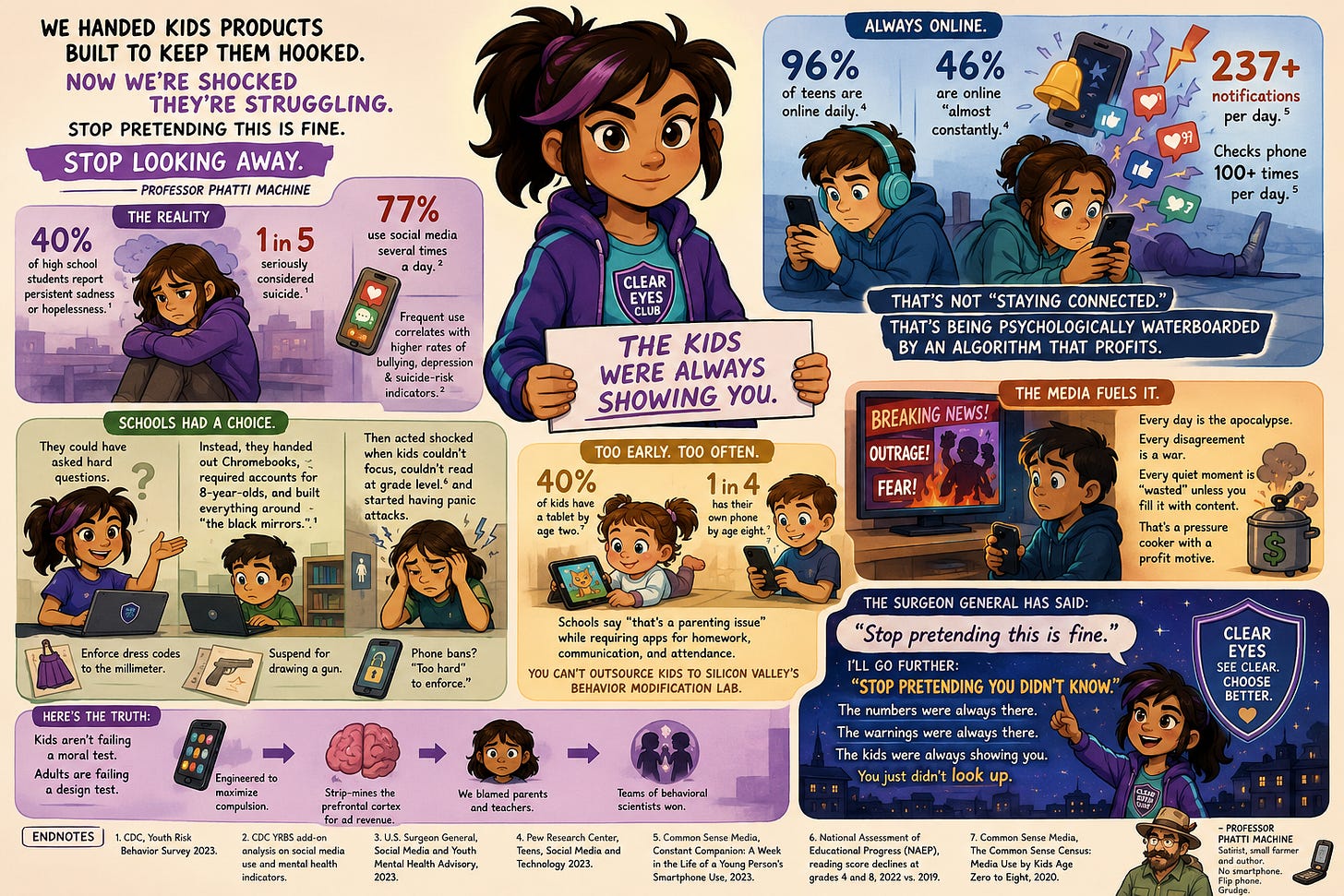
Let me read you some numbers that should make every school board member choke on their lanyard.
Forty percent of American high school students report persistent sadness or hopelessness. One in five seriously considered suicide. Nearly one in ten actually attempted it.¹
That’s a mass casualty event happening in slow motion while adults argue about whether phones should be in pockets or cubbies.
Here’s the part that makes my eye twitch. 77% of students use social media several times a day and frequent use correlates with higher rates of bullying, depression markers and suicide-risk indicators.² The Surgeon General issued an advisory that basically says, in polite bureaucratese, “We don’t have enough evidence this is safe, and we’re seeing enough red flags to be concerned.”³
Translation for the policy-illiterate: The nation’s top doctor is waving a caution flag and nobody’s slowing down.
Ninety-six percent of teens are online daily. Forty-six percent are online “almost constantly.”⁴ The average kid gets 237-plus notifications per day and checks their phone over 100 times.⁵
That’s not “staying connected”, that’s being psychologically waterboarded by an algorithm that makes money when keeping you engaged.
NOW LET’S TALK ABOUT SCHOOLS
Public education had a choice. When the shiny devices showed up promising “engagement” and “21st-century learning,” they could have asked hard questions. Instead, they handed out Chromebooks like Halloween candy, required Google Classroom accounts for eight-year-olds, and built their entire curriculum around “the black mirrors”.
Then they acted shocked, SHOCKED I say, when kids couldn’t focus, couldn’t read at grade level⁶ and started having panic attacks in the bathroom during class-breaks.
Shouldn’t surprise anyone who wasn’t indoctrinated into the system. Unfortunately the majority did go through that system and readily accept any lie told them.
Schools enforce dress codes down to the millimeter of a skirt hem. They’ll suspend a kid for drawing a gun. Phone bans? “Too hard to enforce.” Screen time limits? “We need the devices for learning.” Meanwhile, the “learning” is a kid toggling between a Google Doc and a Discord server while their prefrontal cortex gets strip-mined for ad revenue. If it were a problem they didn’t want it would be dealt with like the others. The system wants you and your children dumber than dirt. It is to its advantage.
Forty percent of kids have a tablet by age two.⁷ One in four has their own phone by age eight. And schools shrug and say “that’s a parenting issue” while requiring apps for homework, communication, and attendance.
You can’t outsource kids to Silicon Valley’s behavior modification lab for twelve years and then blame mom and dad when the product comes out broken.
THE MEDIA ISN’T HELPING.
I know what you’re thinking when you hear “the media”—the doom-scroll, the outrage cycle, the “BREAKING NEWS” banner that’s been broken since 2016 and nobody’s called a repairman.
Modern media has one product. Your attention and the most efficient fuel for attention is fear, anger, and tribal combat. So kids grow up marinating in a world where every day is the apocalypse, every disagreement is a war crime, and every quiet moment is “wasted” unless you fill it with content.
HERE’S THE PART NOBODY WANTS TO SAY OUT LOUD
Kids aren’t failing a moral test, adults are failing a design test.
We handed children products explicitly engineered to maximize compulsion, then told parents to out-discipline teams of behavioral scientists backed by machine learning. We told teachers to “integrate technology” and then blamed them when technology integrated the children instead.
The phone was supposed to be a Swiss Army knife. Maps, camera, encyclopedia, emergency line. Instead, it became a slot machine that buzzes. A portable nervous system hijacker. A dopamine drip we stuck in their hands and called “normal.”
The Surgeon General has plainly said ”Stop pretending this is fine.”
I’ll go further, “Stop pretending you didn’t know.”
The numbers were always there, the warnings were always there.
The kids were always showing you.
You just didn’t want to look up from your own screen long enough to notice.
-Professor Phatti MacHine is a satirist, small farmer and author. He does not have a smartphone. He has a flip phone and a grudge.
ENDNOTES
1. Centers for Disease Control and Prevention, Youth Risk Behavior Survey 2023.
2. CDC YRBS add-on analysis on social media use and mental health indicators.
3. U.S. Surgeon General, Social Media and Youth Mental Health Advisory, 2023.
4. Pew Research Center, Teens, Social Media and Technology 2023.
5. Common Sense Media, Constant Companion: A Week in the Life of a Young Person’s Smartphone Use, 2023.
6. National Assessment of Educational Progress (NAEP), reading score declines at grades 4 and 8, 2022 vs. 2019.
7. Common Sense Media, The Common Sense Census: Media Use by Kids Age Zero to Eight*, 2020