Dumpster Devil
A Robot Combat League Story
Mar 9, 2026 · 5 min read
In the early days of the Robot Combat League, before the arenas were
packed and the sponsorship banners stretched across the octagons like
neon war flags, the sport still smelled like solder, machine oil, and
optimism.
Most fighters entered the league with money. Or corporate backing. Or
both.
Mira Calder entered with a toolbox and a junkyard.
She was twenty years old, five feet seven, brilliant in the irritating
way that made professors either adore her or wish she’d stop correcting
them mid-lecture. Her hair was usually tied up with a cable tie stolen
from a parts bin, and she lived in a cramped workshop apartment above a
defunct auto garage.
On fight nights, though, she looked like something else entirely.
The VR pilot rig used by most RCL fighters consisted of a
neural-feedback system built into lightweight sensor clothing. Mira’s
version was a simple two-piece biosensor suit that read muscle impulses
and balance signals, translating them into motion commands for her
robot. It looked almost like athletic swimwear threaded with fiber optic
filaments.
When she stepped into the pilot booth wearing it, the commentators never
quite knew where to look.
Not that Mira noticed.
Her brain was already inside the machine.
The League
The Robot Combat League had appeared almost overnight.
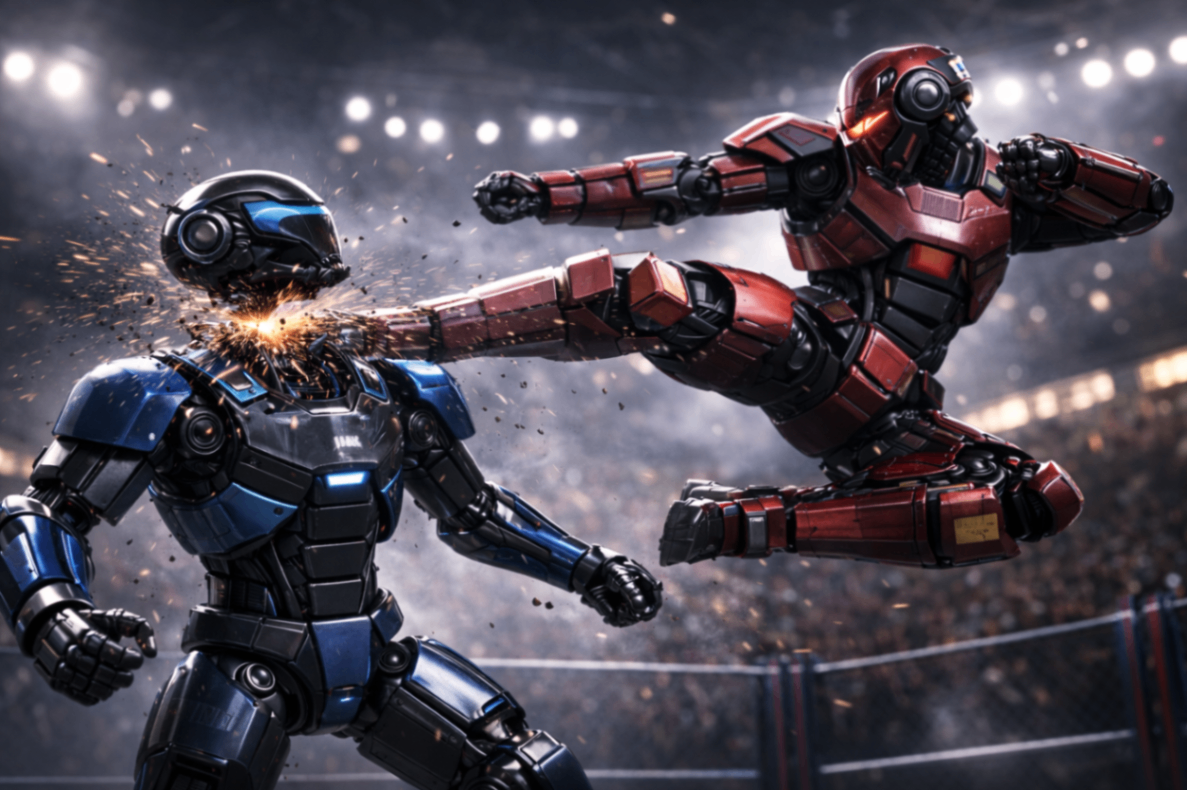
At its core, the sport was simple: human pilots controlled bipedal
humanoid robots inside enclosed arenas, fighting across structured
weight classes much like traditional combat sports.
Featherweight robots under forty kilograms danced across the floor like
mechanical gymnasts.
Lightweights were larger, faster and capable of grappling or weapon
strikes.
Middleweights, the giants of the sport, fought like steel gladiators
capable of devastating knockouts.
Matches were fought in timed rounds, scored by judges if neither machine
was destroyed or immobilized.
The spectacle was undeniable.
Two human minds. Two humanoid machines. A crowd screaming for knockouts.
What made RCL different, though, was its philosophy.
Fighters owned their robots. They built them, repaired them and upgraded
them themselves.
The league thrived on garage engineers and wild inventors.
Which meant Mira actually fit right in.
Sort of.
Scrapmetal
Mira’s robot wasn’t supposed to exist.
Most Featherweight fighters bought a commercial platform like the
Unitree G1 or R1, clean factory hardware designed for robotics labs and
universities.
Mira couldn’t afford that.
Instead she had scavenged components from warehouse auctions, failed
robotics startups and a particularly productive dumpster behind a
medical automation company.
The result was a strange machine she called Scrapmetal.
It stood just over four feet tall, barely within Featherweight
regulations.
Its frame was asymmetrical.
One leg used a precision actuator from a surgical robot. The other ran
on an industrial servo designed for automated pallet loaders.
Its torso plating came from repurposed drone housings.
Its hands were 3D‑printed carbon composite with embedded shock foam to
meet league strike rules.
The entire robot cost less than most fighters spent on a single sensor
package.
But the thing moved like it had personality.
That was Mira’s doing.
VR Fighting
When a fight began, Mira stepped into the pilot booth and pulled on the
visor.
The biosensor suit lit up with quiet pulses.
Inside the headset, the arena appeared in perfect stereoscopic detail.
Every motion she made translated into robotic movement through the VR
control system used by RCL fighters.
Lean forward. Scrapmetal stepped.
Twist her shoulder. The robot threw a hook.
Balance signals, muscle impulses and predictive motion software turned
her body into the robot’s nervous system.
For most fighters it took years to develop fluid control.
Mira adapted in weeks.
Her brain simply understood machines.
Amateur Nights
RCL’s early structure mirrored traditional combat sports.
Amateurs fought in small local events. Semi‑pros competed regionally.
The best climbed toward national titles.
Mira’s first fight happened in a warehouse arena outside Atlanta.
Attendance: maybe 120 people.
Prize purse: $750.
Her opponent rolled in with a pristine commercial robot that looked like
it had come straight from a robotics expo.
Mira arrived with Scrapmetal strapped into the back of a pickup truck
next to a crate of spare motors.
The commentators were polite.
“Interesting custom build,” one said.
That lasted about twenty seconds into Round One.
Scrapmetal moved unpredictably.
Instead of the rigid cautious movement typical of new pilots, the robot
flowed.
Her opponent tried a standard straight punch combination.
Scrapmetal sidestepped.
Hooked the robot’s shoulder actuator.
Then dumped the whole machine on the arena floor.
The crowd went silent for half a second.
Then erupted.
Underdog
Within months Mira had a small reputation.
Not for winning.
For doing things that shouldn’t work.
Her robot had a habit of breaking mid‑fight.
One knee actuator failed during a semifinal match.
Mira compensated by shifting the robot’s stance and fighting almost
entirely off one leg.
Another time a shoulder servo burned out.
She finished the round using kicks and grappling.
Commentators started calling her the Dumpster Devil.
She fought like someone who genuinely
enjoyed the chaos.
The Real Economy of Robot Fighting
Behind the spectacle, RCL had created something unusual.
A whole ecosystem.
Robots were bought and sold on a marketplace run by the league.
Destroyed machines were salvaged and resold as parts. Repair shops and
training facilities grew around the sport.
Damage from fights created demand for upgrades.
More fighters meant more parts.
More parts meant more innovation.
For someone like Mira, it was paradise.
After every event she wandered the salvage tables, digging through
broken actuators and cracked sensor arrays like a treasure hunter.
Half of Scrapmetal’s upgrades came from defeated opponents.
She found beauty in that.
The Fight That Changed Things
The turning point came during a regional Featherweight championship
event.
The venue held nearly 500 people.
Sponsors had started appearing.
Streaming numbers were climbing.
Her opponent was the current top seed, piloting a sleek factory‑spec
robot with advanced stabilization systems and perfectly balanced
actuators.
Scrapmetal looked like it had been assembled during a power outage.
Round One was brutal.
The factory robot landed heavy strikes that nearly toppled Mira’s
machine.
A knee actuator cracked.
Balance algorithms screamed warnings in her visor.
She laughed.
Then did something stupid.
Instead of backing off, she charged.
Scrapmetal ducked under a punch and grappled the opponent’s torso.
The two robots slammed into the arena barrier.
Actuators shrieked.
Servo motors strained.
Then Mira shifted her hips and twisted.
Scrapmetal executed a crude judo throw.
The other robot hit the floor with a metallic crash.
The referee began the ten‑second knockout count, the standard RCL rule
for an immobilized opponent.
The crowd counted with him.
Ten. Nine. Eight.
The fallen robot struggled but couldn’t stand.
Three. Two. One.
Knockout.
The Future
That clip went everywhere.
A salvage‑built robot defeating a premium machine with a throw that
looked like something from a martial arts tournament.
Sponsors noticed. Engineers noticed. Investors noticed.
Robot Combat League itself was growing fast, aiming to become the first
global sport built around humanoid robotics.
Somehow, right in the middle of it, was a cheerful slightly chaotic
genius with a junkyard robot.
Mira didn’t think about the future much.
After the fight she was already crouched beside Scrapmetal, removing a
damaged actuator.
She glanced up at the cameras and grinned.
“Anybody got a spare torque sensor?”
The crowd laughed.
Somewhere in the stands three different engineers immediately opened
their tool-kits.
Because the truth about Robot Combat League was simple.
The robots were spectacular.
The fights were wild.
The real reason people loved it was watching human ingenuity collide
in steel bodies.
Nobody embodied that better than the Dumpster Devil and her ridiculous
beautiful pile of scrap.
Comments (1)
Anyone interested in a semi serious attempt at creating a new sport? I worked on this RCL a couple years ago. Elaborate plan, even had a partial website built for potential investors. I have since integrated the whole Robot Combat League idea into my Forever:NEON series as part of the Bread & Circus atmosphere. I can dig some Rulebook drafts, Arena design and deployment and Investor Pitch Materials.