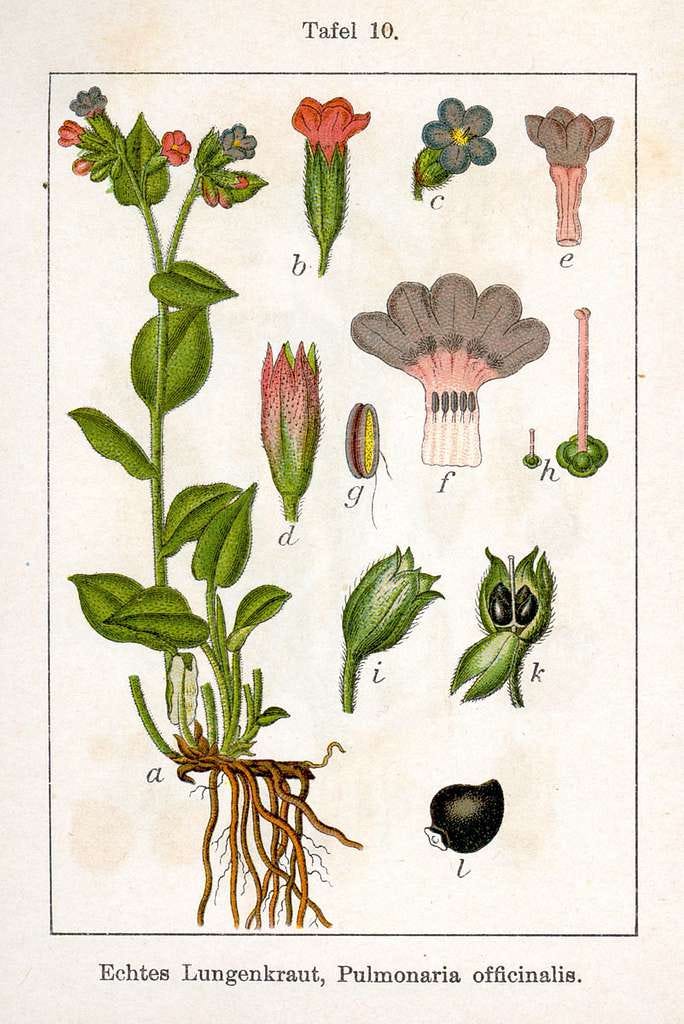
CChapter 2.1: Pulmonaria Officinalis – Transformation
Herbarium 3/30. Celia starts piecing together her past through her old journals.
Apr 19, 2026 · 8 min read

Previous chapter (1.2) | Contents | Next chapter (2.2)
Aged 10
“𝕳ello, princess.”
Father had entered the room – he must have since he talked to me, but I didn’t hear the door open or close, or his steps approaching. I tried to appear focused on my notebook, yet my senses were on high alert.
“Aren’t you going to answer me?” he asked, his voice muffled.
I shook my head and kept on scribbling.
“What are you drawing?”
God, why won’t he leave me alone? I just want to stay here by myself and suffer in peace.
The air shifted from the left, and this is how I knew he had walked up to me. I dragged the notebook closer to myself, so he couldn’t see the disgusting rendition I had made of Dr. Emily, the therapist my father had forced me to see. He had nearly noticed the other one, from a few days ago, where I drew Jason. He knew my feelings towards both of them, but I still preferred it if he didn’t see the drawings. They were just for me.
“I wanted to ask how you are. Are you feeling better? Do you hear better?” Father’s voice was calm, muted.
“Not good enough. Your machine sucks.”
I glanced over at him. His shoulders slouched briefly, then returned to the perfect position he always kept them in. I had a feeling he sighed, but I couldn’t be sure. My jaw clenched. I didn’t like having to guess.
“Ok, sweetie. Can you answer a few questions for me? I can tune the machine so it’s better for you.”
“Why? Why do you even bother? I’m never going to play again. I won’t ever be able to enjoy music again.” My voice trembled, despite my attempts to keep it steady.
I waited for him to scatter my fears, to say he would do such a great job with his machine that my hearing would be as good as new. Instead, he touched my shoulders – I could barely feel the weight of his hands – and kissed my head.
“I’m so sorry, princess. I try my best to make this work, but you have to help me out a little, too.”
“It doesn’t matter anymore. I’ll never be as good as new.”
My scribbles, pouring out of a short pencil, covered more and more of the page with black. Spirals digging into the thin paper, covering the shameful drawings, almost covering father’s answer:
“Celia, you’re not broken, so you will never be as good as new. You’re not an object.”
“Yes, I am. I can’t do what I love.”
“Then you can find something new you like.”
“I don’t want anything new. I want to play the piano again and the violin and hear music again.”
“You can still do that.”
I brought my fists down on the table, staining them with smudges of the black void in my diary. “But not properly!”
A short silence filled the air between the two of us.
“Why is this happening to me of all people?” My voice cracked, and tears escaped the confines of my eyelids. Words seeped through strands of hair spread akimbo on the table, intertwined with sobs. “I worked so hard and I’m so good at what I do. I could have become so famous.”
“It didn’t only happen to you. Other people went through the same thing.”
“God, Father! If you mention Beethoven again...”
“Then what do you want, Celia?” he pleaded, an exasperated edge to his voice. “I’m doing everything I can to make this easier for you.”
“Maybe your best is not good enough for me. I need to hear properly again.”
“And I need you to straighten up and get used to your new reality.” His voice was now cold and firm and snappy. A shiver ran down my spine. He never talked to me like that.
“I hate you”, I growled. “I shouldn’t have been born.”
He didn’t reply to my outburst. Almost all our conversations ended like this lately – when I got hateful he would leave. He probably didn’t want to do anything he would regret later, like strike me across the face, or say something he would never be able to take back, like inform me I wasn’t even wanted, or that I was the worst thing that happened to him. I never found out what he thought during those fights.
Alone, I abandoned the notebook but didn’t leave my chair. As of late, I kept my eyes low when I spent time in my room, avoiding the instruments crowding more than half the space. Father had offered to move them into another room, but I refused. My mind still clung desperately to the hope that he would finish fine-tuning the little apparatus he had been working on for weeks and I wouldn’t need to give up my passion.
Father was an engineer with nearly absolute trust in the potential of technology. When I lost my hearing, he tried to convince me to get a cochlear implant, but I refused. Music though an implant would be distorted, an electronic dither, an abomination lacking timbre and tone and emotion. Rather than be subjected to such a perversion, I had decided to concede my hearing altogether.
When I had informed him of my decision, he had promised me he would try to perfect a device similar to an implant, fine-tune it so it would suit my needs. Every day he would go down to the basement and work on it for hours on end, yet the results he had promised me failed to materialize. A small piece of plastic I could take off at will that would grant me the luxury of hearing.
During those long hours, I tried to keep busy. Previously I would have practiced one of my instruments and with that considerable amount of my schedule free, I was directionless.
Behind the rage screaming inside me at father and the world and God, I just wanted to be shown understanding and a way to start over. I had never admitted this to anybody – not to Dr Emily, the psychologist that father forced me to see, not to father. There wasn’t anybody else to talk to. I had no friends and we didn’t have any other relatives. I was alone in the dark, with only my fear and rage to keep me company.
With every tantrum I threw, with each time father left the room stone-faced and silent, my loneliness grew. I needed a friend and a protector, and he was the only one I had. So I would run to him, after less and less time apart, asking for his friendship back. Father would always accept my not-quite-an-apology. He would kiss my forehead and he would tell me to come and help him work. His touch always felt ethereal, almost like a dream. I knew I was supposed to feel his warmth and the rough skin on his cheeks as I lay my forehead on one of them, but it wasn’t quite as material as I hoped. Yet it was enough to push the loneliness a little further inside.
❀•······················•❀•······················•❀
My legs dangled from the top of the bar-stool on which I sat in the kitchen. He smiled at me and offered me a plate of peach slices. Cheeks still stained with dry tears, I smiled back.
“Can you hear me well?” he asked.
I touched the device as if to check if it was still behind my ear. A smooth, annoying bulge. “Sort of. It’s better than before. I can make out what you’re saying when you’re talking normally, but not if you whisper.”
He nodded, solemnly. “And how have you been feeling?”
I shoved a slice of peach into my mouth, to give me enough time to decide on an answer, and to give my hands something else to do other than rub the device behind my ear. After a few seconds, I found my resolve and swallowed. “Better.”
“I’m glad to hear that.” He took a deep breath as if he wanted to continue, but I interrupted him.
“I just...” My voice quivered and I stopped. I grabbed another slice, allowing my fingers to explore the sticky surface as if that would bring me courage.
“What is it?”
“I feel very tired, Father, and weak and lonely. I used to be angry and I am not anymore. I’m so much better now, but I want to feel normal again. I want to be good at things again.”
I waited until he swallowed a sip of coffee, praying he wouldn’t tell me that I could do whatever I wanted. I needed guidance. I needed help. More than anything I needed to prove to myself that I wasn’t useless just because I had lost what made me special. Surely, there must be other special talents within me. My eyes started at the mangled peach in my hands. I feared seeing pity on his face.
“Are you willing to put in the work, if you’re not good from the start?” he asked.
I looked up and choked a laugh out, the first in months.
“Father, I’m used to practicing piano for hours a day.”
“Because you saw were already amazing. You might not be as good at something else.”
I took a deep breath, my heart racing with anticipation. “I will put in the work.”
He got up from the table and put the cup in the sink, on top of the other three from that week.
“Good. Finish your breakfast and meet me in the basement.”
❀•······················•❀•······················•❀
My nose wrinkled in disgust at the sickeningly sweet smell in the basement, but I sat on the chair he pointed to me nonetheless. The desk, usually littered with half-finished projects and ablaze with code running on his computer screens, was empty. Dad wiped the surface one more time with his hand, as to remove any dust, and dropped a large book in front of me.
“What’s this?” I asked.
He pointed to the title. “An Introduction to Acoustics.”
My face scrunched into a frown. “Is this a joke to you?”
He shook his head then sat next to me. “I’ve been thinking: you were in so many concert halls, and operas, and you knew how to identify the best room to practice in based on acoustics.”
“I could do that when I could hear well. I can’t anymore.”
“Not by ear, no.” His voice remained distant, but a twinkle in his eyes betrayed his excitement. “But you can learn to puzzle it out through formulas.”
I reached for the book and browsed it quickly. Page after page covered in walls of text, interrupted by small diagrams, formulas, suggested exercises.
“You’re giving me homework?”
“You might become good at it, “ he said plainly.
“Not before I die of boredom. I want to do something fun.” His grand idea had been to suggest I do more homework. I turned my face from him, my eyes tingling with tears of disappointment. Yet no tears fell, because something caught my attention. The only splash of colour in my basement, my old doll house.
I pushed the book away, a thought forming at the edge of my consciousness. My words slipped out slowly: “Do you think I can design concert buildings?”
Thank you for reading! If you have any thoughts you'd like to share, please leave a comment!
Previous chapter (1.2) | Contents | Next chapter (2.2)