Black by Day, Red by Night

Mar 2, 2026 · 9 min read
Sarah paid the guide two hundred quid to let her take the boat through alone. He pocketed the notes but wouldn't look at her.
"Something ay right down there, wench," he said, Black Country accent thick as coal dust. "Canal Trust's had three boats turn back this week. Folk getting upset, like."
"I just need to see it."
He shook his head, walking away. "Doh say I never warned ya."
The narrowboat hummed into Dudley Tunnel, swallowing her into limestone darkness. Sarah kept her torch trained ahead, watching trilobites frozen in the walls: four hundred million years old, caught mid-crawl through ancient seas.
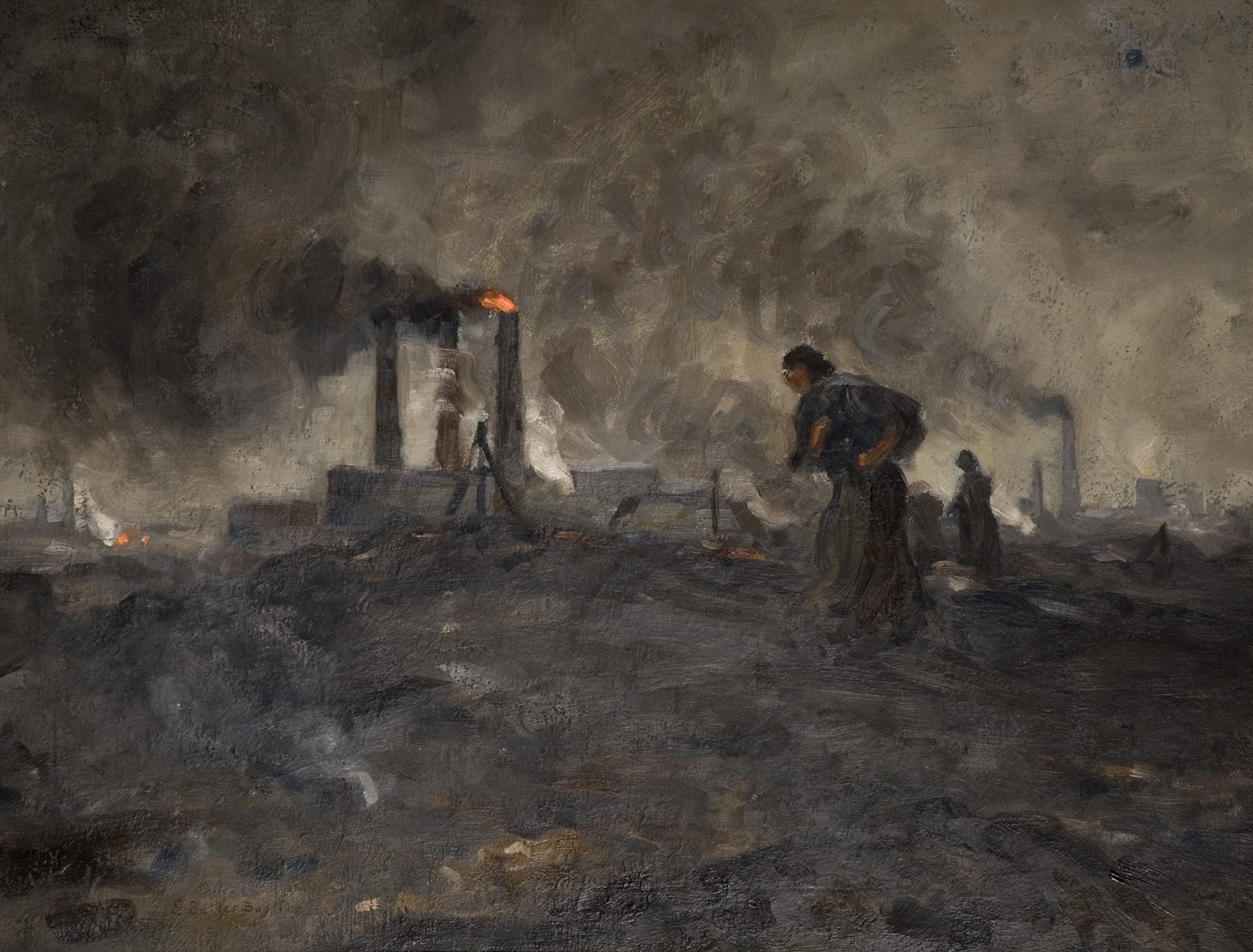
She'd come to Dudley for a story about regeneration. New luxury flats rising where the old iron works used to stand in Netherton, where they'd forged the anchors for the Titanic. Heritage conversion, the developers called it. Progress.
Then the sightings started.
A chain maker in a leather apron, walking the same route over and over. A boy falling from empty air into the ground, endlessly. Workers at the development site moving slower each day, speaking less, accepting dangerous conditions with a resignation that reminded Sarah of her sister three years before she died.
Emily had worked herself hollow. Customer service job, zero-hours contract, impossible targets. Ground down shift by shift until there was nothing left but the mechanical process of showing up, repeating. Until hanging herself seemed like the logical next step. The note she left was three words: "I'm so tired."
Sarah had processed that grief. Therapy, time, the slow work of letting go. She'd moved forward.
But Dudley kept pulling her back.
The old chain maker she'd interviewed had sat in the Netherton pub, gnarled hands wrapped around his pint, eyes distant.
"Thirty Foot seam," he'd said. "Thickest coal in Britain. Miles of tunnels under the whole Black Country, see. And we filled 'em. Two hundred years of us, dying down there. Children young as five, wench. Can you imagine? Five year old, in the dark, pulling carts bigger than they was."
He'd taken a long drink.
"Me dad helped pull that Titanic anchor through the streets. Twelve ton, it were. Twenty horses they needed, just for the one anchor. The whole of Netherton came out to watch. Through Netherton to Tipton goods yard. Proudest day of his life, he said."
His eyes had gone distant.
"Women chained to them carts like animals. Died in harness, some of 'em. Me great-grandfather, he worked the tunnels his whole life. Said they got hungry. Said we kept feeding 'em—every accident, every lung that gave out, every poor sod who couldn't take it no more and just... stopped."
His voice had dropped. "Said you could feel it sometimes, down there. Like the tunnels was watching. Like they was waiting."
He'd gone quiet then, staring at his pint.
"And now them lot gone and opened it back up."
The development had breached old mine workings. Sealed them off for "health and safety." But the sightings multiplied after that. And Sarah had learned: the mine tunnels connected to the canal tunnels. Connected to the limestone caverns under Dudley Castle, where Dorothy Beaumont had been haunting for three hundred and eighty years.
Dorothy. The Grey Lady. Civil War widow who'd lost her baby daughter, died in grief, been denied burial beside her child. A real ghost. Documented. Consistent.
Until recently.
Now she appeared frantic, desperate, in places she'd never been seen before. Like she was trying to warn people.
The boat moved deeper. Sarah was under Castle Hill now. Under the ruins where Dorothy walked. Under centuries of accumulated sorrow.
The water changed.
She couldn't explain it later, when she tried to write it down and the words came out broken. The water was still water, still reflected her torch, still lapped against limestone, but it was also something else. Something her brain kept trying to process and failing.
Like looking at an optical illusion that refused to resolve. The surface was there, definitely there, rippling with the boat's movement. But underneath—or behind, or through—was something that didn't obey the same rules. Space folded wrong. Depth that shouldn't exist in three feet of canal water.
She cut the motor.
In the silence: breathing. Vast and slow, like the tunnel itself had lungs.
Dorothy Beaumont stood in the water.
Not on it. In it. Submerged to her chest, grey dress both soaked and dry, face pale and desperate in the torchlight. She shouldn't be here. She haunted the castle above, always the castle, nowhere else.
"You have to leave," Dorothy said, refined English accent nothing like the Black Country voices Sarah had been recording all week. "They are not what they seem. They are not people. They were never—"
Her eyes widened, looking past Sarah.
"It's learned too much. It knows the shape of us now. You have to—"
She pointed behind the boat, urgent, terrified.
Sarah turned.
It rose from the water like tar, but tar didn't move like that. Her vision kept sliding off it, unable to focus. The surface was there, she could see it, but she could also see into it, miles into it, as if it existed in dimensions her eyes weren't built to process.
There were shapes in it.
Faces. Hands. Forms pressing against the surface, or emerging from it, or existing in some state between the two. A woman's mouth open in a scream that might have started two hundred years ago. A child's fingers reaching for something impossible to grasp.
The entity—she had to call it something—spoke.
Except it didn't speak.
Sarah was five years old. The tunnel was dark but not this dark, and her hands were so small, and they hurt from pulling the coal cart. The chain around her waist cut into her stomach. She was so hungry. When had she last eaten? Mama said to be brave, but Mama was dead now, wasn't she? Or was that tomorrow? Time was strange down here. Just pull the cart. Pull the cart. Don't stop pulling or—
Sarah gasped. She was thirty-two. She'd never pulled a coal cart. She'd never been five in a tunnel.
But she remembered it. Remembered the weight of the chain. The absolute darkness. The cold that went into your bones and never came out. The knowledge that if you stopped, the foreman would—
She was eighteen. The furnace heat hit her face like a wall. Too close to the edge. The walkway was slick with something. Sweat? Blood? Didn't matter. She was so tired. Three sixteen-hour shifts. Her eyes wouldn't focus. One step, another step, just get through this shift, just—
Her foot slipped.
The sensation of falling. The heat rising up to meet her. The smell of molten metal, copper and sulfur and the end of everything. The scream dying in her throat because—
Sarah was in the boat, hands white-knuckled on the sides, breath coming in gasps.
Those weren't her memories.
But they were in her now. She could remember being that five-year-old girl, remember her name was Mary, remember she had a rag doll her father had made her before he died. Could taste the coal dust. Could feel herself falling into the furnace—Thomas, his name was Thomas, he was saving up to marry his sweetheart—except she hadn't, she was here, she was alive, she'd never worked in a foundry.
More memories flooded in:
The cough. Black lung. Six months to live. Family would starve when you couldn't work. The taste of blood every morning, darker each day.
The explosion. Mine shaft collapsing. Darkness and rock pressing down, crushing your chest until you couldn't breathe, couldn't move, couldn't scream. The silence after the screaming stopped.
The resignation. The worst one. The slow, grinding acceptance that this was all there was. That you'd work until you died. That your children would work until they died. That you were a thing, not a person. Raw material fed into the machine of progress, chewed up, spit out, discarded.
Hundreds of lives. Thousands. Each one distinct—she knew their names, knew who they loved, knew what they'd eaten for breakfast the day they died—but also compressed together into a single vast experience of suffering.
This was how it communicated. Through being, not through language. Through forcing her to experience what it was made of.
The Thirty Foot seam. Miles of tunnels carved into the thickest coal deposit in Britain. Filled with two hundred years of death and despair and grinding hopelessness. Children who never saw daylight. Women who died harnessed like animals. Men whose lungs turned black and stopped working at thirty.
All that suffering, concentrated in enclosed spaces deep in the earth, had become something.
The way coal was pressed forests. The way diamonds were pressed carbon.
This was pressed misery made manifest.
And it had learned.
The entity showed her: Dorothy above, walking the castle grounds for centuries, genuine human spirit trapped by grief and denied wishes. It had encountered her through the connected caverns, the limestone hollows, the canal tunnel that ran beneath her feet.
And it had studied her.
This is what the dead look like. This is how they move. This is the shape of haunting.
So when the development breached the old mine workings, when it found new paths up, it made ghosts. The chain maker. The falling boy. Perfect copies of people who'd died making it, shaped from the substance of their own suffering.
Practicing. Learning. Getting better.
Sarah's hands found the motor control.
But as the boat pulled away, a new memory formed:
Her own. But wrong. She was walking through Dudley. Over and over. The same route. Never stopping. Never changing. Just walking, walking, walking.
This is what I do, the entity told her without words. This is what I make. This is what fills the spaces where people used to be.
The memories wouldn't leave. They were part of her now. She could still feel the chain around her waist. Could still feel the heat of the furnace. Could still taste the coal dust coating her tongue.
She'd looked at something humans weren't meant to perceive, and now she couldn't unsee it.
Dorothy appeared one last time, standing in the tunnel mouth ahead, backlit by daylight. Fading. Less substantial than before.
"Let go," she said, and Sarah understood: Dorothy had held onto grief too long, stayed too long, and the entity had used her as a template. Had learned from her mistake.
"Don't feed it."
Then she was gone.
Sarah brought the boat out into daylight. The sun felt wrong on her face. Too bright. Too simple.
That night, she tried to write it down. The words came out broken:
—not tar thick but also thin could see through it no INSIDE it, miles of faces pressed together time wrong all happening—
She gave up.
Some things couldn't be written. The entity existed in spaces between words, between moments, between what was real and what couldn't be real but was.
All she could manage:
It's still down there. Miles of it. Under the entire Black Country. Every tunnel, every shaft, every cavern. Two hundred years of suffering compressed into something that shouldn't exist. And every time they build, every time they dig, every time they breach old workings, it finds new ways up.
It's learning to be us.
She looked at her reflection in the window.
For just a second—less than a second, a fragment of time too small to name—she saw two of herself.
One solid.
One wrong.
She closed the laptop.
The entity had touched her. And she would never be free of it.
In the tunnels beneath Dudley—beneath Netherton, beneath Bilston, beneath all the Black Country—the tar-substance filled the spaces humans had carved from coal. Still hungry. Still seeping. Still learning.
Black by day, red by night.
And underneath: something that should never have been born.
#horror #cosmichorror