Aino's story
Kalevala in prose
Mar 14, 2026 · 13 min read
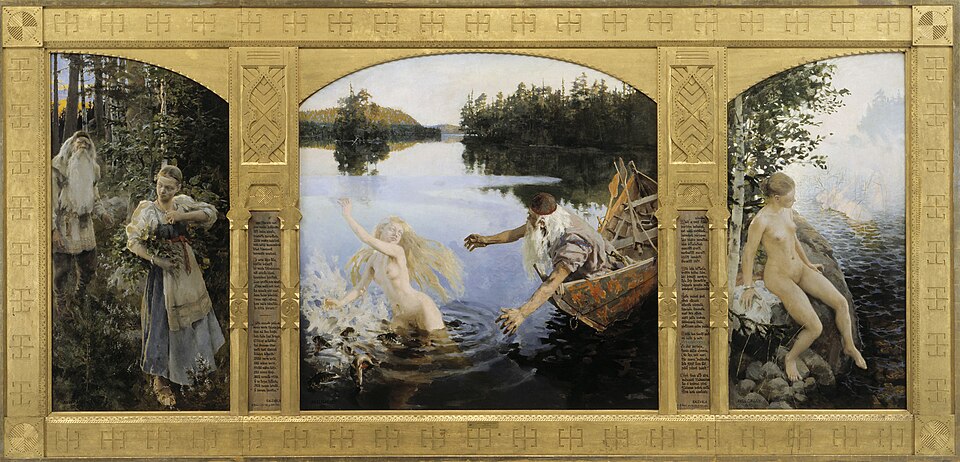
This is a quick prose rewrite from the Kalevala, telling Aino's story.
Väinämöinen, steadfast and old, lived on the open lands of Väinölä and the heaths of Kalevala, and there he sang. He sang through the days and shaped songs through the nights. What he sang were not light songs, not bench-laughter, not the sort of thing every child could repeat. He brought up ancient remembrances and the deep births of things, the hidden origins of the world, the first makings and the old powers that lie underneath names and tools and living creatures. The report of his singing went far. It traveled across the summer and rolled northward until it reached Pohjola.
There was there a young man named Joukahainen, lean and quick-tempered, a Lapland boy with too much pride in him. He heard that in Väinölä there was a singer better than any he knew, better even than the songs he had learned from his own father, and the praise of it stung him like a lash. He could not bear that another man should be called greater. He went at once to his parents and said he would ride to Väinölä and contend with the old singer there.
His father forbade him. His mother forbade him too. They warned him that Väinämöinen did not fight with hands first, or with iron. He fought with words. In such a contest, they said, a man could be sung down into snow, into brush, into the hard hold of the world itself, with hands that could not turn and feet that could not move. But Joukahainen would not listen. He said his father’s knowledge was good, his mother’s perhaps better, but his own was better than both. He would sing the singer down, he said. He would shame the old man and weigh him with stone and timber and ridicule.
Then he took his own fiery horse, the one whose nostrils struck sparks and whose legs flashed fire, harnessed it before his golden sleigh, seated himself high in it, snapped the pearl-studded whip, and drove away.
He drove one day, then another, then a third. On the third day he came to the glades of Väinölä and the heaths of Kalevala. There on the road he met Väinämöinen himself, who was traveling over his own lands. Joukahainen did not draw aside. He drove straight ahead until shaft locked against shaft, sleigh pressed against sleigh, the harness jammed and the yoke groaned. There they stood in the road together, mist hissing from the gear and water dripping from the strained wood.
Väinämöinen asked what kind of fool came so blindly against another man and wrecked good tackle in the bargain. Joukahainen answered insolently and demanded to know the old man’s own kin and standing. When Väinämöinen named himself and told the boy to move aside, since he was younger, Joukahainen only grew more stubborn. Youth and age meant little, he said. Let the one with greater knowledge stand in the road, and let the lesser yield. If this was truly old Väinämöinen, the everlasting singer, then let them sing against one another and see which man could overcome the other.
Väinämöinen answered mildly at first and asked what the boy knew beyond others. Then Joukahainen began to speak, and at once his boasting showed its shallowness. He told where the smoke-hole lay in the roof and where the flame sat near the hearth. He spoke of the seal’s way of life, of salmon before it and whitefish at its sides. He told when pike spawned, when perch moved in deep water, what lands had been ploughed with reindeer and what with mare or bull. He named famous trees on hills and rapids under the sky, Hälläpyörä in Häme, Kaatrakoski in Karelia, and the Vuoksi and Imatra greater than the rest.
Väinämöinen called it what it was: a child’s knowledge, common memory, nothing worthy of a bearded man’s boasting. Then he demanded the deep origins of things.
Joukahainen tried again. He named the titmouse as a bird and the green snake as a serpent. He called water the oldest remedy and said fire came from heaven, streams from mountains, copper from rock, iron from rust, turf the oldest of lands, willow the first of trees. But still Väinämöinen was not satisfied. When he pressed him once more, Joukahainen leapt beyond half-knowledge into open lies. He said he had been there when the sea was ploughed, when the deeps were hollowed, when hills were rolled into shape and rocks heaped together. He said he had stood among the first heroes when earth and sky were being made, when the moon and sun were set on their ways, when the Great Bear was straightened and the heavens strewn with stars.
At that Väinämöinen told him plainly that he lied.
Then Joukahainen threw wisdom aside and reached for iron. If knowledge would not win, he said, then swords might. He challenged the old singer to measure blades. Väinämöinen refused. He said he did not much fear the boy’s sword, or spear, or thoughts, but neither would he stoop to such a match with him. That refusal shamed Joukahainen further. In anger he said that if the old man would not come to the sword, then he himself would sing him into a pig and throw him on the dung-heap like sty-filth.
That was enough.
Väinämöinen’s anger rose, and with it the old power. He began to sing.
This was no light song. The lakes splashed under it. The earth trembled. Copper mountains shook. Strong rocks burst. Cliffs split. Shore-stones cracked. Then the song fell on Joukahainen and on all that stood around him. The gear of his sleigh changed shape in the world. The crossbar became saplings. The hames turned to willow-thicket. The bright sleigh went to broken logs in a pond. The pearl whip became reeds by the shore. The white-headed horse became stones by a rapid. The gold-hilted sword flashed away as lightning in the sky. The painted bow bent itself into an arch over waters. The feathered arrows flew off as hawks. Even the dog became field-stones in the ground. His cap, gloves, belt, and cloak all left him and were remade into cloud, lily, mist, and stars.
Then the song took hold of Joukahainen himself and drove him down into the mire. First he sank to the waist, then deeper. He tried to lift one leg and found it would not move. He tried the other and found a stone shoe where his foot had been. Still the song went on. Mud rose. Moss came to his mouth. Rotting wood pressed at his teeth. His beard sank into a foul place. The stream tugged at his feet and the sand ground against his eyes.
Then at last he understood what sort of man stood before him.
He begged for release and offered ransom. First he offered bows, two fine bows, one fit for battle ranks and one for true aim. Väinämöinen refused and sang him deeper. Then Joukahainen offered two good boats, one light and quick, one broad and strong. Rejected. Then stallions, swift and handsome. Rejected. Gold by the helmetful and silver by the blanketful, won by his father in war. Rejected. Haystacks, sandy fields, the wealth of home. Rejected. Every offer failed while the mire climbed higher.
Only when he was almost swallowed did he offer what could not be lightly offered. He offered his sister Aino. He promised his mother’s daughter to Väinämöinen as wife and support, to sweep the house and wash the garments, to weave and bake, to bring comfort to the singer in his old age.
That turned Väinämöinen’s mind. He was glad of the promise of a young bride for his fading years. So he sat down on the stone of joy and began to unwind what he had wound. He drew back the holy words. He let the spell loosen. Joukahainen rose free from the bog. His horse returned from stone, his sleigh from wreck, his whip from reeds. Then he climbed up again and drove home, not proudly now but dark-hearted and shamed.
He came back like a broken man. The sleigh shattered at the threshing-barn and the shafts snapped at the gate. His mother and father saw at once that something was wrong. When they pressed him, he said at last what he had done. He had given away Aino. He had promised his own sister to Väinämöinen.
His mother rejoiced.
She rubbed her hands together and told him not to weep. This was what she had wanted all her life: a great man brought into her kin, a bold one into her line, Väinämöinen himself as son-in-law and kinsman. But Aino did not rejoice. When she heard it, sorrow took hold of her at once. She wept on the threshold one day and then another, grieving so deeply that her mother finally asked what troubled her.
Aino said she wept for her own young beauty, for the fullness of her hair, for the fineness of her tresses if they must be covered while she was still young. She wept for the brightness of day, the grace of the moon, the whole beauty of the air, if she must leave them so soon.
Not long after that, she went into the grove to gather birch whisks for the sauna. One she made for her father, one for her mother, and one for her red-cheeked brother. Then she turned homeward through the brush. Before she reached the yard, Väinämöinen saw her there in the green and spoke to her. He told her not to wear her beads and breast-cross for others, but for him. He told her to braid her hair, to bind it with silk, to adorn herself for the life waiting ahead.
Aino answered him sharply. She said she would not dress herself for him or for anyone else. She had food enough at home, good clothes enough, bread enough to grow on, and she would stay with her own father and her own mother. Then she tore off her ornaments in anger and shame. The cross came from her breast, the rings from her fingers, the pearls from her neck, the ribbons from her hair. She cast them all down onto the ground and left them there for the earth and grove to keep. Then she went home weeping.
As she entered the farmyard, each of her kin asked her why she cried. Her father sat by the window shaping an axe-haft. To him she said only that the silver cross had slipped from her breast and the bright threads fallen from her belt. Her brother stood at the gate carving wood, and to him she said the gold ring had gone from her finger and the pearls from her throat. Her sister sat by the bridge-end weaving a golden belt, and Aino told her the gold had fallen from her brow, the silver from her hair, the blue silk from her eyes and the red ribbons from her head. But when her mother, standing on the storehouse steps, asked her what had happened, Aino told the whole thing: how she had gone into the grove, how she had been spoken to from the rise and the burn-land, how she had torn off her adornments and cast them away rather than wear them for him.
Her mother answered not with pity but with instruction.
She told Aino not to cry. Let her eat sweet butter and become fuller than the rest, pork and become nimbler, crust-cakes and become fairer. Then she sent her to the storehouse hill to open the best chest there. In that chest, she said, were six golden belts and seven blue dresses, woven by Kuutar, the Moon-Maiden, and finished by Päivätär, the Sun-Maiden.
Then the mother told her own girlhood story. Once, before she was wed, she had gone berrying beneath the ridge among the raspberries and heard Kuutar weaving and Päivätär spinning at the edge of the blue forest. She had gone near and begged them for gold and silver, and they had given it. She had worn those things home like a flower in bloom, a joy in her father’s yard, and later hidden them away in the chest. Now Aino was to wear them. She was to lift gold to her brow, pearls to her throat, silk to her hair, rings to her fingers, good linen, wool, belt, stockings, and shoes to her body, and come back into the house more splendid than before, the delight of her kin.
But Aino would not listen.
She went out into the yard again and gave herself over to grief. She wondered what the minds of the fortunate were like. They must be like running water, she said, like waves moving easily beneath the surface. The mind of the wretched was not like that. It was like snow packed under a ridge, like deep water shut away in a well. Her own heart wandered through burn and thicket, grass and brush. Her mind was no better than tar, her heart no whiter than soot.
Better it would have been, she said, never to be born at all. Better to die at six nights old, vanish at eight. That would have cost very little: a strip of linen cloth, a little patch of earth, a few tears from her mother, fewer from her father, and none from her brother.
When her mother pressed her again, Aino said more. Her own mother had given her away, promised her as a prop for an old man, as delight for one past his strength, as comfort for one who trembled and sat in the corner. Better to be sent beneath the deep waves, she said, to be sister to the whitefish and kin to the fishes of the water, than to go as support to such a husband.
Then, in the bitter turn of the tale, she did what her mother had said after all. She climbed the storehouse hill, opened the best chest, and took out the Moon-Maiden’s belts and the Sun-Maiden’s garments. She dressed herself in them. She set gold upon her brow, silver in her hair, blue silk before her eyes, and red ribbons on her head.
Then she left.
She walked across one clearing and then another. She went by marshes, by fields, through dark woods. As she walked, she sang to herself that her heart was darkening and her head hurt with pain. Would that she might die, she said. Would that she might break apart and be done with these griefs. Now the time had come for her to leave the world of the living and go to Manala, to Tuonela. Her father would not truly mourn her, she thought. Nor her mother. Nor her sister. Nor her brother. She could roll into the waters and fall into the fish-filled sea beneath the black waves, and they would live on.
She walked for two days. On the third she came to the sea, to a reed-grown shore. There night caught her, and she stayed through the dark by a water-stone at the broad end of a bay, weeping until morning. At dawn she looked toward the cape and saw three maidens bathing in the sea. Aino became the fourth among them.
She laid her clothes aside carefully. Her shirt she threw onto a willow, her skirt onto an aspen, her stockings onto the bare ground, her shoes onto the water-stone, her beads onto the sandy shore, her rings onto the gravel. Out on the water shone a mottled rock, bright as gold. She swam toward it and climbed up upon it.
The stone gave way beneath her.
It rang once and slipped into the water. The shining slab fled to the bottom, and Aino went down with it.
As she was dying, she spoke. She said she had only gone to the shore to wash, to the sea to bathe, and there she had perished. Then she laid her dying words upon those at home, one by one. May her father never drag fish from that water again. May her mother never draw water for dough from the home-bay. May her brother never water his war-horse at that shore. May her sister never wash her eyes from that landing. The sea was hers now, she said. Its waters were her blood. Its fish were her flesh. The twigs on the strand were her ribs. The grasses along the shore were her hair rubbed loose.
That was the death of the young maiden, the end of the lovely little bird.
Then the question rose: who would carry the word home to the fair farm?
The bear was named, but he could not do it, for he was gone among the cattle. The wolf was named, but he was lost among the sheep. The fox was named, but he had turned aside after geese. At last the hare took the task. No word is lost with me, he said.
So the hare ran.
He came to the sauna threshold and crouched there, long-eared and quick-breathing. The sauna was full of maidens with bath-whisks in their hands. They mocked him at first and asked whether he had brought meat for the kettle and roast for the table, something for the master’s supper, the mistress’s meal, the daughter’s snack, the boy’s midday food. But the hare said no. He had not come with prey. He had come with a message.
The beautiful one had fallen, he said. The bright-breasted one was gone. The silver brooch had sunk. The bronze belt had slipped away. She had gone into the sea beneath the open deep, sister now to the whitefish and kin to the fishes of the water.
Then the mother began to weep in full.
And the old poem does not let her grief remain only human grief. She cried that poor mothers should never rock their daughters toward a husband against their will, as she, poor mother, had rocked and raised her own little hens. Then tears ran from her blue eyes down her cheeks, from her cheeks onto her breast, from her breast to her hems, from her hems to her stockings, from her stockings to her golden shoes, and from her shoes into the earth itself.
Once they reached the ground, those tears began to run as rivers.
Three rivers rose from the waters of her weeping. In each river there were three fierce rapids. On the foam of each rapid stood three islets. On every islet rose a golden hill. On each hill grew three birches. In every birch sat three golden cuckoos.
Then the cuckoos began to call.
One cried, “Love, love.”
One cried, “Bridegroom, bridegroom.”
One cried, “Joy, joy.”
The one that cried “Love” called for three months for the loveless girl lying in the sea. The one that cried “Bridegroom” called for six months for the bridegroom left without his bride, sitting now in longing. The one that cried “Joy” called all its life for the mother without joy, who would spend her days weeping.
And the mother, hearing the cuckoo, spoke one last bitter truth: let no poor mother listen too long to the spring cuckoo. When it calls, the heart jolts, tears rise, and life itself seems to wear away. A measure of age is spent in the hearing. The whole body grows older under that sound.
That is Aino’s story: promised as ransom, refusing the bargain, dressed for a marriage she would not enter, and taken instead into the sea, where grief turns to water, water to river, river to birdcall, and the world keeps mourning her.